Georgia Road Signs Test 2

4.9 out of 5 (92 votes)
80% Passing score
20 Questions
4 Mistakes allowed
Road signs get their own moment on the Georgia permit exam, which is worth knowing before you start studying everything else and leave the signs for “later.” Later has a way of becoming the night before the test, and that is not exactly ideal. The Georgia DDS knowledge exam is split into two separate 20-question sections: the Road Rules Test and the Road Signs Test. You have to pass both. For the signs section, that means answering at least 15 out of 20 questions correctly. You can miss 5, but that margin feels a lot smaller once the test starts asking about similar-looking warning signs, lane-use signs, signals, and pavement markers that are easy to recognize in real life and weirdly easy to second-guess on a screen. This Georgia road signs practice test is built to help with that specific part of the exam. It includes 20 multiple-choice questions focused on the signs, signals, and markers Georgia drivers are expected to know from the Georgia Drivers Manual. You will see the usual big-ticket items, of course: regulatory signs, warning signs, guide signs, informational signs, traffic signals, and pavement markings. But the better value is in learning the details that separate one sign from another. Shape matters. Color matters. Symbols matter. Sometimes the whole meaning of a sign is sitting in one small visual clue, which is rude, but there it is. The test also gives immediate feedback with explanations, so you are not just clicking through and hoping repetition magically turns into understanding. When you miss a question, you can see what went wrong. When you get one right, you still get the reason behind it, which is helpful because lucky guesses do not usually hold up well at the DDS. For first-time Georgia permit and license applicants, the official knowledge exam covers material from the Georgia Drivers Manual, including traffic laws, safe driving practices, driver responsibility, road signs, traffic signals, pavement markers, and rules of the road. No appointment is required for the non-commercial knowledge test, but you must be on the testing computer at least 30 minutes before the Customer Service Center closes. If you fail, Georgia requires a 1-day wait after the first failure and a 7-day wait after a second failure, and the permit fee has to be paid again for retesting. There is paperwork too, because of course there is. First-time applicants generally need Secure ID or REAL ID documents, including proof of identity, a full Social Security number, two proofs of Georgia residency, proof of U.S. citizenship or lawful status, and name-change documents when applicable. Applicants under 18 also need proof of school enrollment, and later Class D licensing may involve ADAP or eADAP, Joshua’s Law requirements, supervised driving documentation, and a road test appointment. Use this GA DDS road signs practice test as a focused way to get sharper before the official exam. Take it more than once, read the explanations, and pay attention to the signs that seem too obvious to study. Those are the ones that like to cause trouble.

FREE DMV Practice Test App
Study for your Georgia permit test or driver’s license with the NextDoorDriving app. 700+ DMV questions and answers, 100% free!
Download on the App Store

Sample Georgia Permit Test Questions

Question 1

What does a white rectangular sign with a black arrow curving around the right side of an obstruction require?

This white sign means:
  1. A. Pass to the right of the median or obstruction
  2. B. Yield before making a right turn
  3. C. Move slower traffic into the right lane
  4. D. Turn right at the next intersection

Correct answer: A. – Pass to the right of the median or obstruction

This is a KEEP RIGHT sign. Traffic must pass to the right of the median or obstruction. In Georgia driver materials, it is a regulatory sign rather than a warning that a right turn is ahead.

Source: Georgia Department of Driver Services Drivers’ Manual — Section 7, “Keep right sign”

Question 2

On a multilane, two-way road with two solid yellow centerlines, when may a driver cross the lines?

  1. A. To pass a slower vehicle
  2. B. Only during daylight hours
  3. C. Whenever no traffic is approaching
  4. D. To make a left turn into or from a driveway, private road, alley, or another street

Correct answer: D. – To make a left turn into or from a driveway, private road, alley, or another street

Double solid yellow centerlines prohibit crossing to pass. In Georgia, they may be crossed only to make a left turn into or from an alley, private road, driveway, or another street. They do not create a passing lane when traffic is clear.

Source: Georgia Department of Driver Services Drivers’ Manual — Section 7, “Lane Lines”

Question 3

In Georgia, a five-sided sign showing people walking identifies:

This road sign means:
  1. A. An approaching school zone or school crossing
  2. B. The beginning of a business district
  3. C. A sidewalk-only area
  4. D. A place where crossing is prohibited

Correct answer: A. – An approaching school zone or school crossing

Pentagon-shaped signs indicate that a school zone or school crossing is ahead. These signs may be yellow or fluorescent green. Their distinctive shape helps drivers recognize a school-related condition before reaching it.

Source: Georgia Department of Driver Services Drivers’ Manual — Section 7, “Pentagon signs”

Question 4

A police officer’s directions conflict with the traffic signal at an intersection. Which instruction must you follow?

Which of the following must you obey over the other three?
  1. A. The steady traffic light
  2. B. The police officer’s directions
  3. C. The nearest STOP sign
  4. D. The instructions normally associated with a flashing red light

Correct answer: B. – The police officer’s directions

Georgia drivers must obey a police officer’s traffic directions even when those directions conflict with signs or signals. The driver’s manual also applies this basic rule to a firefighter directing traffic. Follow the authorized person rather than the displayed signal.

Source: Georgia Department of Driver Services Drivers’ Manual — Section 5, “3 Most Basic Traffic Laws”

Question 5

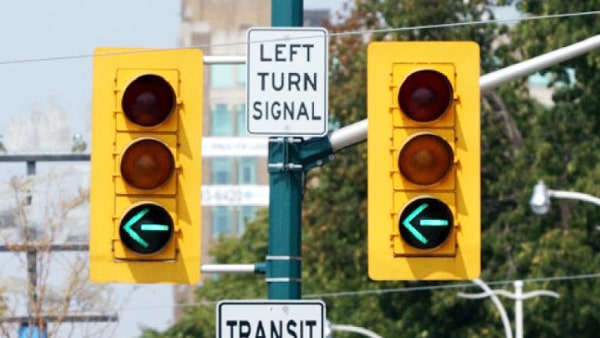
A steady green arrow pointing left permits you to:

A green arrow pointing to the left on a traffic light means you may:
  1. A. Turn left or continue straight
  2. B. Turn left only after making a complete stop in every case
  3. C. Turn left after stopping for pedestrians and yielding to vehicles still in the intersection
  4. D. Turn without regard to anyone already in the intersection

Correct answer: C. – Turn left after stopping for pedestrians and yielding to vehicles still in the intersection

A green arrow permits movement only in the direction shown by the arrow. Before turning, stop for pedestrians and yield to vehicles within the intersection. The arrow does not authorize a conflict with a road user who is still there.

Source: Georgia Department of Driver Services Drivers’ Manual — Section 7, “Green left arrow”

Question 6

Which centerline marking prohibits passing in both directions?

  1. A. A broken white line
  2. B. Two solid yellow lines
  3. C. A broken yellow line
  4. D. A single solid white line

Correct answer: B. – Two solid yellow lines

A solid yellow line on your side of a two-lane road marks a no-passing zone. When both centerlines are solid yellow, passing is prohibited in either direction. The yellow lines also separate traffic moving in opposite directions.

Source: Georgia Department of Driver Services Drivers’ Manual — Section 7, “No Passing Lines—Single Lines”, Georgia Department of Driver Services Drivers’ Manual — Section 7, “Center Lines”