


Hawaii CDL Practice Test Questions and Answers (HI) 7

5 out of 5 (41 votes)
80% Passing score
50 Questions
10 Mistakes allowed
Aloha, and welcome to the seventh Hawaii CDL practice test - a vital tool for all aspiring commercial drivers in Hawaii. This test is designed to mirror the format of the actual DMV CDL permit test in 2026, providing an invaluable learning experience. With 50 questions, each carefully crafted to test your knowledge on a broad spectrum of topics, this CDL practice test is your stepping stone to mastering the essentials for your CDL permit. One of the key advantages of this practice test is the variety of Hawaii DMV written test questions it includes. Each question is a building block in your understanding of road safety, traffic laws, and vehicle operation. From understanding intricate road signs to grasping the nuances of traffic signals and pavement markings, this Hawaii CDL practice test covers it all. It's a comprehensive preparation tool that ensures no stone is left unturned in your journey to passing the CDL test. Unlike the real general knowledge CDL written test in Hawaii in 2026, our practice test is not timed. This means you have the freedom to take your time with each permit test question, delve deeper into the subject matter, and solidify your understanding without the pressure of a ticking clock. It's an approach that not only prepares you for the written knowledge test but also enhances your learning experience, allowing you to absorb information at your own pace. To further aid your learning, our Hawaii CDL practice test incorporates visual learning aids. These include images of road signs and realistic traffic scenarios, offering a more engaging and effective way to learn for visual learners. Such aids are instrumental in helping you recognize and respond to real-world driving situations. Remember, the same set of online Hawaii CDL test questions will appear every time you take this practice test. This consistency is crucial in reinforcing your learning and ensuring you're well-prepared for the actual test day. So, utilize the integrated study aids, take your time, and let this practice test be your guide to achieving success in your Hawaii CDL test in 2026.
FREE CDL Practice Test App
Pass your Hawaii CDL General Knowledge test with the NextDoorDriving app. Real questions and answers—100% free and ad-free.
Download on the App Store

Sample Hawaii CDL Test Questions - General Knowledge

Question 1

What does a LOOSE GRAVEL warning sign indicate?
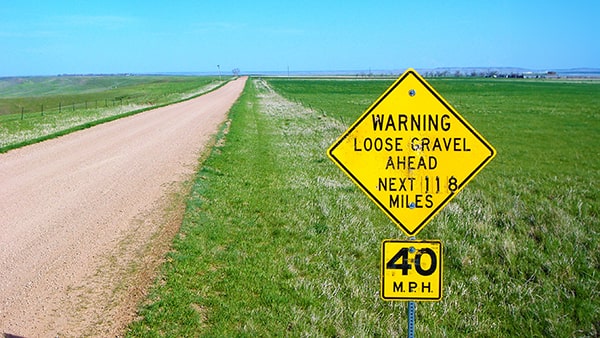
This sign alerts the driver of __________.
  1. A A road-construction crew is present
  2. B Slow-moving traffic is ahead
  3. C The pavement is slippery only when wet
  4. D Loose gravel is present on the roadway surface

Correct answer: D – Loose gravel is present on the roadway surface

The LOOSE GRAVEL sign provides advance warning that loose gravel is present on the roadway surface. It identifies a specific surface condition rather than merely indicating construction, congestion, or wet pavement. Drivers should recognize the warned condition before entering the affected section of road.

Source: Manual on Uniform Traffic Control Devices for Streets and Highways, 11th ed. with Revision 1 — § 2C.30, “Surface Condition Signs”

Question 2

A school bus must be evacuated when which condition exists?

  1. A The bus is on fire or fire is threatened
  2. B The bus is stalled on or next to a railroad-highway crossing
  3. C A collision is imminent
  4. D Any of the above

Correct answer: D – Any of the above

The Hawaii CDL manual requires evacuation when a school bus is on fire or threatened by fire, stalled on or adjacent to a railroad-highway crossing, or in imminent danger of a collision. A hazardous-materials spill may also require rapid evacuation. The decision must be timely and should account for whether leaving the bus creates an additional danger.

Source: Hawaii Commercial Driver License Manual — § 10.3.1, “Planning for Emergencies”

Question 3

If hazardous materials are spilling from your vehicle, which actions should you take?

  1. A Park the vehicle without moving it more than safety requires
  2. B Secure the area and keep people away
  3. C Remain at the scene and call or send someone for help
  4. D All of the above

Correct answer: D – All of the above

The manual’s hazardous-materials emergency procedure is to park, secure the area, stay at the scene, and call or send someone for help. Do not continue driving merely to locate assistance because that can spread contamination. Move the vehicle only as safety requires and only when doing so will not endanger you or others.

Source: Hawaii Commercial Driver License Manual — § 9.7, “Hazardous Materials—Emergencies”

Question 4

What occurs during the stab-braking method?

  1. A The brakes are never applied fully
  2. B The brakes are fully applied, released when the wheels lock, and reapplied after the wheels roll
  3. C Steady pedal pressure is maintained without releasing the brakes
  4. D The parking brake is used to prevent wheel lockup

Correct answer: B – The brakes are fully applied, released when the wheels lock, and reapplied after the wheels roll

With stab braking, apply the brakes fully and release them when the wheels lock. Once the wheels begin rolling again, apply the brakes fully a second time and repeat as necessary. Reapplying before the wheels roll can prevent the vehicle from straightening, while keeping the wheels locked causes a skid and loss of control.

Source: Hawaii Commercial Driver License Manual — § 5.4.3, “Emergency Stops”

Question 5

If reflective triangles are used as the vehicle's emergency warning devices, how many must be carried?

  1. A 1
  2. B 2
  3. C 3
  4. D 4

Correct answer: C – 3

A truck, truck tractor, or bus must carry an approved set of emergency warning devices. When reflective triangles are used, the required equipment is three bidirectional emergency reflective triangles. Current federal rules also permit at least six fusees for vehicles on which flame-producing devices are allowed, but the reflective-triangle option always consists of three.

Source: Hawaii Commercial Driver License Manual (June 2025) — § 2.1, “Emergency Equipment”, 49 CFR § 393.95(f), (g) – Emergency equipment on all power units

Question 6

What is the primary reason for inspecting a commercial vehicle?

  1. A To complete required paperwork
  2. B To protect the safety of the driver and other road users
  3. C To verify that only the exterior lights work
  4. D To determine whether the tires have too much air

Correct answer: B – To protect the safety of the driver and other road users

Safety is the most important reason for conducting a vehicle inspection. Finding a defect before or during a trip may prevent a breakdown or crash and protect everyone using the road. The Hawaii Commercial Driver License Manual emphasizes inspecting the vehicle systematically rather than checking only the lights, tires, or another single component.

Source: Hawaii Commercial Driver License Manual (June 2025) — § 2.1.1, “Why Inspect”