Hawaii Permit Test Practice 3

5 out of 5 (40 votes)
80% Passing score
20 Questions
4 Mistakes allowed
Hawaii’s permit test rewards drivers who actually know the rules, not just the ones who can make a decent guess from the wording. That sounds obvious, sure, but it matters here. The real written knowledge test covers everyday traffic laws, road signs, right-of-way, speed limits, safe driving habits, and the little judgment calls that show up when you are sharing the road with commuters, visitors, cyclists, pedestrians, and drivers who may or may not know where they are going. This Hawaii permit practice test gives you 20 multiple-choice questions built around those same core topics. You will need 16 correct answers to pass, which lines up with the 80% score used on the actual Hawaii DMV written test. There is no time limit, so you can slow down and think through the answers instead of clicking like you are trying to escape a pop-up ad. And yes, retaking it helps. The first attempt is usually a temperature check. The second and third attempts are where you start noticing the details you skimmed past the first time, which is a slightly irritating but very useful part of studying. The practice test is also a good place to connect the rules with Hawaii’s licensing process, because the written test is not floating off by itself somewhere. Teen drivers can apply for a learner’s instructional permit at 15 years and 6 months after passing the required vision and written tests. With that permit, the driver must have it in immediate possession and sit beside a licensed driver who is at least 21. Between 11:00 p.m. and 5:00 a.m., that supervising driver has to be a parent or guardian. Before moving to a provisional license, drivers under 18 must hold the permit for at least 180 days, complete a State-certified driver education course, and meet the required classroom and behind-the-wheel certification steps. Adult first-time applicants follow a more direct route, although direct does not mean “skip the important parts.” Adults still need to pass the Class 3 written knowledge test, get an instruction permit before the road test unless already licensed from another U.S. jurisdiction, and practice with a licensed driver age 21 or older. So, yes, this is a Hawaii DMV practice test. But used properly, it is also a rehearsal for the licensing process itself: read carefully, learn the rules, catch your weak spots, and go into the real permit test with fewer surprises than the person guessing two seats over.
FREE DMV Practice Test App
Study for your Hawaii permit test or driver’s license with the NextDoorDriving app. 700+ DMV questions and answers, 100% free!
Download on the App Store

Sample Hawaii Permit Test Questions

Question 1

When may you drive around or under a railroad-crossing gate that is lowered, opening, or closing?

  1. A When the train is still far from the crossing
  2. B When your vehicle will not touch the gate
  3. C After checking carefully in both directions
  4. D Never

Correct answer: D – Never

Hawaii law prohibits driving through, around, or under a railroad-crossing gate while it is closed or is being opened or closed. When a lowered gate or another warning indicates an approaching train, stop between 15 and 50 feet from the nearest rail. Do not proceed until the train has passed and the crossing is available.

Source: HRS § 291C-91 – Obedience to signal indicating approach of train
Question 2

Which nighttime situation is appropriate for using high-beam headlights?

  1. A While driving through fog
  2. B While following another vehicle closely
  3. C On a dark road when you are not approaching or following another vehicle
  4. D Whenever you are traveling on a freeway

Correct answer: C – On a dark road when you are not approaching or following another vehicle

High beams can improve visibility on a dark road, but they should not be used when approaching or following another vehicle. In fog, use low beams because reflected high-beam light reduces visibility. At night, adjust your speed so you can stop within the distance illuminated by your headlights.

Source: State of Hawaii Driver’s Manual — Ch. X, “Fog” and “Night Driving”

Question 3

At a Hawaii intersection without painted crosswalk lines, a pedestrian is crossing within the unmarked crosswalk on your half of the roadway. What must you do?

  1. A Stop and wait until the pedestrian has passed your vehicle and you can proceed safely
  2. B Continue because only marked crosswalks provide pedestrian priority
  3. C Sound the horn so the pedestrian yields
  4. D Continue if your traffic signal is green, regardless of the pedestrian’s location

Correct answer: A – Stop and wait until the pedestrian has passed your vehicle and you can proceed safely

A crosswalk includes the area connecting sidewalk lines at an intersection, even when it is not marked on the pavement. A driver must stop when a pedestrian in that crosswalk is on the driver’s half of the roadway or is approaching closely enough to be in danger. The driver may proceed after the pedestrian has passed and it is safe.

Source: HRS § 291C-1 – Definitions, HRS § 291C-72(a) – Pedestrians’ right-of-way in crosswalks

Question 4

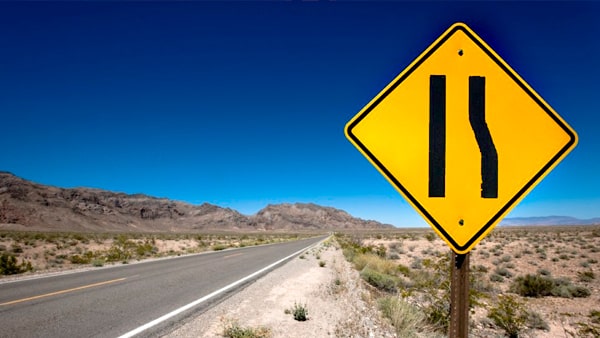
A yellow diamond sign shows the right-hand lane tapering into the lane beside it. What does it warn you about?

This sign means:
  1. A The right lane ends or the roadway narrows
  2. B A divided highway begins
  3. C A steep hill is ahead
  4. D Trucks cross the roadway ahead

Correct answer: A – The right lane ends or the roadway narrows

This warning sign indicates that a lane ends or the roadway narrows ahead. Yellow diamond-shaped signs alert drivers to hazardous or changing roadway conditions. Watch surrounding traffic and make any necessary lane change gradually and only when there is sufficient clearance.

Source: State of Hawaii Driver’s Manual — Ch. VI, “Warning Signs”, State of Hawaii Driver’s Manual — Ch. X, “Lane Changing”

Question 5

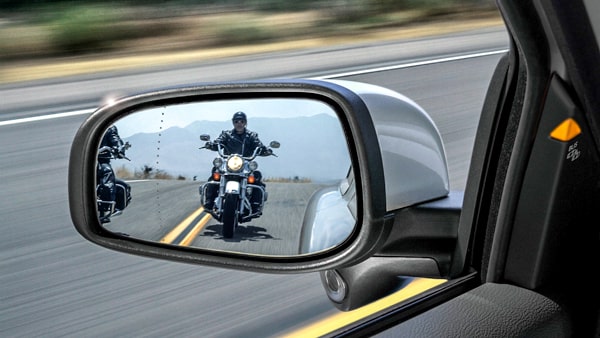
Why should you make an especially careful check for motorcycles before changing lanes?

Look carefully for motorcycles before you change lanes because:
  1. A Motorcycles are prohibited from using a full traffic lane
  2. B Their small profile makes them more difficult to detect and judge
  3. C Motorcycles always have priority at intersections
  4. D Motorcycles always have priority on highways

Correct answer: B – Their small profile makes them more difficult to detect and judge

A motorcycle has a narrow profile and is generally shorter than a passenger vehicle, making it less noticeable in traffic. Its size can also make its speed and distance difficult to judge. Check mirrors and physically check the area beside your vehicle before making a lane change that can be completed safely.

Source: HRS § 291C-84(a) – Turning movements and required signals, State of Hawaii Driver’s Manual — Ch. XI, “Size”

Question 6

In Hawaii, when may a driver turn left at a steady red signal, unless a sign prohibits the turn?

  1. A Whenever no opposing traffic is visible
  2. B When turning from a two-way street onto a one-way street
  3. C After stopping, when turning from a one-way street onto a one-way street carrying traffic to the left
  4. D Whenever the vehicle ahead completes the same turn

Correct answer: C – After stopping, when turning from a one-way street onto a one-way street carrying traffic to the left

After stopping at a steady red signal, a driver on a one-way street may turn left onto another one-way street where traffic moves to the left. The driver must yield to pedestrians proceeding as directed at the intersection. A posted sign or county ordinance may prohibit the turn.

Source: HRS § 291C-32(a)(3)(C) – Traffic-control signal legend