


Hawaii DMV Permit Test Practice 4

4.9 out of 5 (40 votes)
80% Passing score
20 Questions
4 Mistakes allowed
Getting ready for the Hawaii DMV practice test means more than memorizing a few signs and hoping the multiple-choice answers look familiar. Hawaii’s standard passenger-vehicle learner permit exam is the Class 3 written knowledge test, and it is based on the official Hawaii Driver’s Manual. That means you can expect questions on traffic laws, safe driving rules, road signs, signals, pavement markings, alcohol and drug laws, sharing the road, and the basic decisions drivers make every day when nobody is gently reminding them what to do. This Hawaii learner’s permit practice test is built to help you study with that real test in mind. The official Class 3 permit test is commonly listed by county licensing offices as a 30-question multiple-choice exam, with 24 correct answers needed to pass. So, yes, 80% is the magic number. Miss more than 6, and you are back to studying. Our Hawaii permit test practice gives you a focused way to review the same kinds of rules and road-safety topics, including child passenger safety, which matters here for very obvious reasons. Protecting keiki is not just a nice idea tucked into the handbook. It is part of being a responsible driver. You will also see the practical side of getting licensed in Hawaii, because the process is not handled by one giant DMV office. Driver licensing runs through the counties, with locations and fees varying between places. Applicants must pass a vision screening, and the written test may be taken in person at a county driver licensing center or, for eligible applicants age 15 years and 6 months or older, online through KnowTo Drive. The online version has its own rules: desktop or laptop only, webcam monitoring, no phone, no tablet, no touchscreen device, and a one-hour time limit. After passing online, you still have to visit a county licensing office to finish the permit process, usually within 30 days. As you work through this Hawaii driver permit practice test, you will get immediate feedback after each question, with explanations that show why the correct answer is correct. That is the part that actually helps. Guessing your way through one attempt does not teach much, but reviewing missed questions, spotting weak areas, and connecting the rule to a real driving situation will. By the end, you should have a clearer sense of what Hawaii expects from new drivers, what the real permit test is likely to cover, and how to walk into the licensing process without feeling like you missed some tiny but important detail.
FREE DMV Practice Test App
Study for your Hawaii permit test or driver’s license with the NextDoorDriving app. 700+ DMV questions and answers, 100% free!
Download on the App Store

Sample Hawaii Permit Test Questions

Question 1

A yellow diamond sign shows a straight arrow with a shorter line joining it from the right. What does it warn you about?
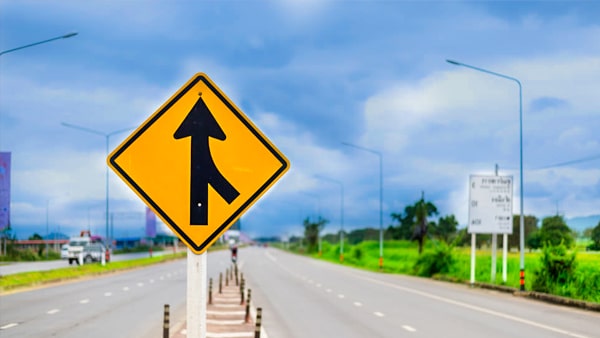
This sign means:
  1. A Two-way traffic begins ahead
  2. B Your lane ends and you must move right
  3. C Traffic may merge into your lane from the right
  4. D A divided highway begins ahead

Correct answer: C – Traffic may merge into your lane from the right

This is a merging-traffic warning sign. It indicates that vehicles may enter the roadway from the right ahead. Watch the entering traffic and adjust your position or speed as necessary to avoid a conflict while obeying applicable right-of-way rules.

Source: Hawaii Driver’s Manual — Ch. VI, “Warning Signs”

Question 2

Alcohol-impaired driving should be viewed as:

  1. A A concern only when a crash occurs
  2. B A safety problem for every driver, whether or not that driver drinks
  3. C A matter only for law enforcement
  4. D A concern only for people who consume alcohol

Correct answer: B – A safety problem for every driver, whether or not that driver drinks

The Hawaii Driver’s Manual identifies alcohol-impaired driving as every driver’s problem, whether the individual drinks or not. Alcohol slows reflexes, interferes with judgment, reduces alertness, and impairs vision. Even slight intoxication can contribute to serious driving mistakes with consequences for other road users.

Source: Hawaii Driver’s Manual — Ch. IX, “The Problem”, Hawaii Driver’s Manual — Ch. IX, “Alcohol”

Question 3

You face a red circular signal and a green right arrow at the same time. What may you do?

  1. A Remain stopped regardless of the arrow
  2. B Wait until the circular signal becomes green
  3. C Cautiously make the movement shown by the arrow
  4. D Follow the arrow because the road ahead is closed

Correct answer: C – Cautiously make the movement shown by the arrow

Under Hawaii’s signal law, a green arrow permits you to cautiously enter the intersection for the movement shown by the arrow, even when another indication is displayed. Use the proper lane and proceed only in the arrow’s direction. Yield to pedestrians in the adjacent crosswalk and traffic lawfully using the intersection.

Source: HRS § 291C-32(a)(1)(B) – Traffic-control signal legend, Hawaii Driver’s Manual — Ch. VI, “Lighted Arrows” and “Combination Signals”

Question 4

When a traffic signal turns green, what should you verify before entering the intersection?

  1. A No vehicle or pedestrian remains in your path
  2. B The vehicle behind you has started moving
  3. C Cross traffic also has a green signal
  4. D All pedestrians have a red signal

Correct answer: A – No vehicle or pedestrian remains in your path

A green signal allows you to proceed, but you must yield to vehicles and pedestrians lawfully within the intersection or an adjacent crosswalk. Look through the intersection before moving. This check helps you identify road users who have not yet finished crossing and other developing hazards.

Source: HRS § 291C-32(a)(1)(A) – Traffic-control signal legend, Hawaii Driver’s Manual — Ch. V, “The Rules of Right-of-Way”

Question 5

What color combination is normally used on warning signs for roadway hazards such as curves and narrow bridges?

  1. A Black symbols or words on white
  2. B Black symbols or words on yellow
  3. C White symbols or words on blue
  4. D White symbols or words on green

Correct answer: B – Black symbols or words on yellow

Ordinary roadway warning signs are usually diamond-shaped with a black symbol, legend, and border on a yellow background. They alert drivers to hazards that exist or may be found on or near the roadway. Drivers should recognize the condition shown and be prepared to respond safely.

Source: Hawaii Driver’s Manual — Ch. VI, “Warning Signs”

Question 6

Which sequence should you use when moving into another lane?

  1. A Signal, check the mirrors, and move immediately
  2. B Check traffic, signal, check the mirrors and blind spot, then move when clear
  3. C Signal and move quickly before another vehicle closes the gap
  4. D Check one mirror, accelerate, and then signal

Correct answer: B – Check traffic, signal, check the mirrors and blind spot, then move when clear

In Hawaii, a lane change must be made only when it can be completed with reasonable safety, and the required signal must be given. The driver’s manual directs you to check traffic ahead, beside, and behind, use the mirrors, and physically check blind spots by turning your head. Move gradually only when ample clearance is available.

Source: HRS § 291C-84 – Turning movements and required signals, Hawaii Driver’s Manual — Ch. X, “Lane Changes”