


Hawaii Drivers Ed Practice Test 8

4.9 out of 5 (35 votes)
80% Passing score
20 Questions
4 Mistakes allowed
Four-way stops in Hawaii deserve more attention than most new drivers give them. They look simple, and then two cars arrive at almost the same time, someone waves when they should not, a pedestrian steps in, and suddenly the whole intersection feels like a group project nobody agreed to lead. This Hawaii permit test practice, the eighth test in our series, focuses on intersections and right-of-way rules because that is where clean handbook knowledge has to turn into actual driving judgment. The official Hawaii Class 3 learner permit test is based on the Hawaii Driver’s Manual, so the real exam is not just asking whether you memorized a few signs. It can cover traffic laws, safe driving habits, signals, pavement markings, alcohol and drug laws, sharing the road, and basic vehicle operation. County licensing information describes the knowledge test as a 30-question multiple-choice exam, with 24 correct answers needed to pass. That leaves room for 6 misses, which sounds decent until you realize a couple of careless right-of-way questions can eat into that cushion pretty quickly. This Hawaii DMV practice test gives you 20 multiple-choice questions built around the kinds of intersection decisions drivers actually have to make. Four-way stops get special attention here, but the point is broader than that. You are practicing how to read the road, sort out who has the right-of-way, and avoid the little confident mistakes that make other drivers tap their brakes and silently judge you. Or not silently. Depends on the driver. Use it with the Hawaii Driver’s Manual, online drivers education, flashcards, or a road sign chart, but do not treat it like a decoration next to the “real” studying. Practice questions are where weak spots show up. Miss one, read why, and let the correction stick before test day does the correcting for you. For licensing context, minors may apply for a learner’s instructional permit at 15 years and 6 months, after meeting the document, vision test, written test, and parental-consent requirements. Adult first-time applicants generally need an instruction permit before the road test unless they already hold a valid U.S. license from another jurisdiction. Out-of-state transfers have their own documentation steps, and sometimes the road test may be waived. Take this free drivers ed test online when you can focus for a few minutes. The goal is not to sound smart about right-of-way. It is to know what to do when the intersection gets messy.
FREE DMV Practice Test App
Study for your Hawaii permit test or driver’s license with the NextDoorDriving app. 700+ DMV questions and answers, 100% free!
Download on the App Store

Sample Hawaii Permit Test Questions

Question 1

What does the pictured orange work-zone sign warn you about?
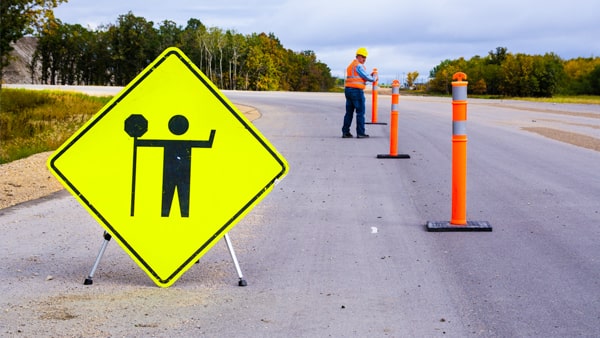
This sign means:
  1. A Pedestrians are crossing ahead
  2. B The construction zone has ended
  3. C A school crossing is ahead
  4. D A flagperson is directing traffic ahead

Correct answer: D – A flagperson is directing traffic ahead

The sign warns that a flagperson is stationed ahead in a work zone. Flagpersons may stop, slow, or guide vehicles through the area using red flags or STOP/SLOW paddles. Follow the flagperson’s directions and be prepared for changing traffic movement.

Source: Hawaii Driver’s Manual — Ch. VI, “Construction and Maintenance Devices—Flagpersons”
Question 2

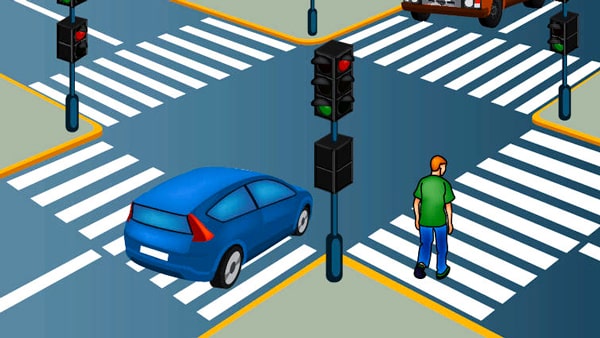
You are turning right on green as a pedestrian begins crossing the street you will enter. Who has the right-of-way?

You are waiting at a red light to turn right, and a pedestrian on your right is waiting to cross the street you want to enter. Who has the right-of-way when your light turns green?
  1. A The pedestrian in the crosswalk
  2. B You, if the crosswalk has no painted lines
  3. C You, because your signal is green
  4. D Whichever person enters the crossing area first

Correct answer: A – The pedestrian in the crosswalk

In Hawaii, a driver turning on a green signal must yield to pedestrians lawfully within the intersection or an adjacent crosswalk. The crosswalk may be marked or unmarked. Do not begin or continue the turn until the pedestrian has passed your vehicle and you can proceed safely.

Source: HRS § 291C-32(a)(1)(A), (C) – Traffic-control signal legend, HRS § 291C-72(a) – Pedestrians’ right-of-way in crosswalks

Question 3

When turning left at an intersection, to whom must you yield?

  1. A Only vehicles already behind you
  2. B Only vehicles turning left from the opposite direction
  3. C Vehicles entering the road from a driveway
  4. D Oncoming road users close enough to create an immediate hazard

Correct answer: D – Oncoming road users close enough to create an immediate hazard

Hawaii law requires a turning driver to yield to a vehicle, bicycle, or person approaching from the opposite direction when that road user is within the intersection or close enough to be an immediate hazard. Wait until the left turn can be completed without crossing the path of such traffic.

Source: HRS § 291C-62 – Vehicle turning

Question 4

On a two-lane Hawaii road, you are at least 10 mph below the limit, passing is not possible, and five vehicles are lined up behind you. What must you do if it is safe?

  1. A Make a U-turn at the next intersection
  2. B Move off at the nearest safe location so the vehicles can pass
  3. C Cross the centerline and wave the vehicles around
  4. D Stop within your travel lane

Correct answer: B – Move off at the nearest safe location so the vehicles can pass

Under this specific rule, the slow-moving vehicle must move off the roadway at the nearest safe place with enough space for trailing vehicles to pass. The requirement applies when passing is prohibited or impossible and at least five vehicles are immediately behind. You do not have to pull off if doing so would create an unsafe situation.

Source: HRS § 291C-41(d) – Drive on right side of roadway; exceptions

Question 5

When turning right on a circular green signal, which road users must you yield to?

  1. A Only vehicles behind you
  2. B Only oncoming motor vehicles
  3. C Pedestrians and other traffic lawfully within the intersection
  4. D No one, because the signal is green

Correct answer: C – Pedestrians and other traffic lawfully within the intersection

A circular green signal permits you to proceed or turn unless a sign prohibits the movement. When turning, you must yield to pedestrians and other vehicles lawfully within the intersection or an adjacent crosswalk. Begin the turn only when your path is clear of those road users.

Source: HRS § 291C-32(a)(1)(A) – Traffic-control signal legend

Question 6

When approaching a sharp curve, when should you reduce speed with the brakes?

  1. A Continuously while traveling through the curve
  2. B Before entering the curve
  3. C Immediately after entering the curve
  4. D Only as you approach the end of the curve

Correct answer: B – Before entering the curve

Reduce to an appropriate speed before entering the curve, then maintain a steady speed while traveling through it. Braking or changing speed abruptly in a curve can upset the vehicle’s balance and cause a loss of control. Additional caution is needed when the surface is wet or covered with gravel, sand, or mud.

Source: Hawaii Driver’s Manual — Ch. X, “Turns and Curves”