


Hawaii Driving Test Practice 9

5 out of 5 (35 votes)
80% Passing score
20 Questions
4 Mistakes allowed
A solid Hawaii permit practice test should do more than toss a few obvious road-sign questions at you and call it preparation. This one is built around school bus safety, which is one of those subjects that sounds simple right up until the question gets specific: which direction traffic is moving, where the bus is stopped, whether children are getting on or off, and what you are legally expected to do before anyone has to guess. This Hawaii DMV practice test gives you 20 multiple-choice questions, and you will need 16 correct answers to pass. That is a useful benchmark, not just a nice round score to aim for. The real Hawaii drivers license test asks you to understand the rules well enough to apply them, especially in everyday situations where a distracted driver can cause serious trouble. School zones, wet roads, neighborhood streets, and keiki walking near traffic are not rare edge cases in Hawaii. They are normal driving conditions, which is exactly why school bus rules deserve more attention than people usually give them. For younger drivers, Hawaii allows learner’s instructional permit applicants to start at 15 years and 6 months, as long as they meet the testing, vision, document, and parental-consent requirements. Honolulu lists the minor learner permit written exam as a 30-question multiple-choice test, so practicing with shorter sets like this can help you build accuracy without turning study time into a full afternoon event. Adults applying for a first Hawaii license generally need an instruction permit before the road test unless they already hold a valid U.S. license from another state. And, small but important detail here: Hawaii licensing is handled by the counties. Honolulu, Maui, Hawaii County, and Kauai may have their own appointment flow, testing locations, and check-in rules, so do not assume every office runs exactly the same. Hawaii also offers the KnowTo Drive Online learner permit test for eligible applicants age 15 years and 6 months or older. It is offered in English and Spanish, has a one-hour time limit, and must be taken on a desktop or laptop with a webcam, not a phone or tablet. Passing online still means finishing the permit process in person with the county. Use this free Hawaii driver's license practice test alongside the Hawaii Driver’s Manual, especially if school bus laws are one of those “I think I know it” topics. That phrase has betrayed many otherwise decent test-takers.
FREE DMV Practice Test App
Study for your Hawaii permit test or driver’s license with the NextDoorDriving app. 700+ DMV questions and answers, 100% free!
Download on the App Store

Sample Hawaii Permit Test Questions

Question 1

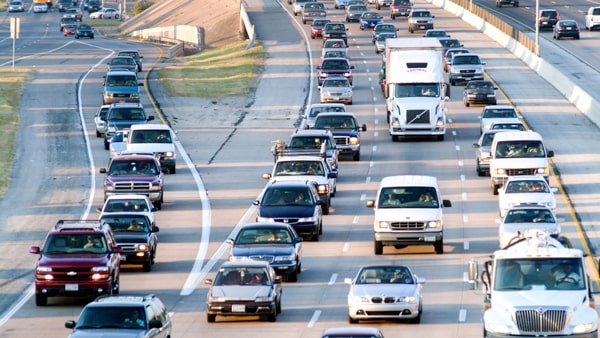
When passing a large truck traveling in the center lane of a three-lane roadway, which method is best?

  1. A Use the left lane and follow normal safe-passing procedures
  2. B Remain beside the truck in the left lane
  3. C Use the right lane because the truck driver can see that side best
  4. D Stay behind the truck without checking whether another lane is clear

Correct answer: A – Use the left lane and follow normal safe-passing procedures

The Hawaii Driver’s Manual generally directs drivers to pass on the left and warns that passing on the right approaches the overtaken vehicle in the driver’s blind spot. Large vehicles have severely limited visibility to their sides and rear. Use proper lane-change procedures, and return to your lane only after you can see the overtaken vehicle in your interior mirror.

Source: Hawaii Driver’s Manual — Ch. X, “Passing”, Hawaii Driver’s Manual — Ch. XI, “Limitations of Large Vehicles—Visibility”
Question 2

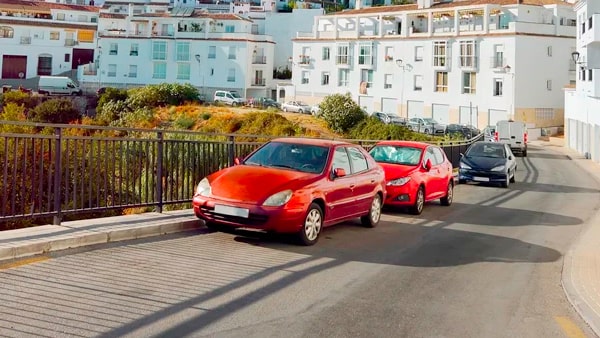
Before pulling away from a parallel parking space, how should you check for approaching traffic?

  1. A Sound the horn and move out
  2. B Turn on the hazard warning signals
  3. C Turn your head and look toward the traffic lane
  4. D Use only the inside rearview mirror

Correct answer: C – Turn your head and look toward the traffic lane

In Hawaii, a driver may not start a parked vehicle until the movement can be made with reasonable safety. Check the mirrors, turn your head to look for traffic in the blind spot, signal, and yield before leaving the curb. The driver pulling from the parking space has primary responsibility for avoiding a conflict with approaching traffic.

Source: HRS § 291C-83 – Starting parked vehicle, Hawaii Driver’s Manual — Ch. X, “Look Back Before Driving from Curb”

Question 3

According to the Hawaii Driver’s Manual, when parking uphill beside the right curb, where should you point the front wheels?

When parking your vehicle facing uphill with a curb, you should point your front wheels:
  1. A To the right, toward the curb
  2. B To the left, away from the curb
  3. C In either direction
  4. D Straight ahead

Correct answer: A – To the right, toward the curb

The Hawaii Driver’s Manual directs drivers parking uphill or downhill to turn the wheels to the right, toward the curb. This positioning is intended to keep a vehicle that rolls free from entering the traffic lane. Always set the parking brake and place an automatic transmission in Park; use reverse or low gear when Park is unavailable.

Source: Hawaii Driver’s Manual — Ch. X, “Parking on a Hill”

Question 4

When preparing to merge onto a freeway, how should you check the lane you intend to enter?

When you enter a freeway, you should check traffic by using:
  1. A Use the inside and outside mirrors only
  2. B Use only the inside rearview mirror
  3. C Use the mirrors and turn your head to check the blind spot
  4. D Use only the left outside mirror

Correct answer: C – Use the mirrors and turn your head to check the blind spot

Observe freeway traffic while traveling along the entrance lane and adjust your speed to fit an available gap. Use the mirrors, then turn your head to check the area that the mirrors do not show. Signal and merge only when there is enough clearance, matching freeway traffic speed as closely as conditions permit.

Source: Hawaii Driver’s Manual — Ch. X, “Entering the Freeway”, Hawaii Driver’s Manual — Ch. X, “Lane Changes”

Question 5

Before following a green arrow through an intersection, to whom must you yield?

  1. A Only the vehicle directly behind you
  2. B No one, because the arrow gives an unconditional right-of-way
  3. C Pedestrians in the adjacent crosswalk and traffic lawfully using the intersection
  4. D Vehicles only, not pedestrians

Correct answer: C – Pedestrians in the adjacent crosswalk and traffic lawfully using the intersection

Hawaii law allows traffic facing a green arrow to cautiously enter for the movement indicated. Drivers must yield to pedestrians lawfully within the adjacent crosswalk and to other traffic lawfully using the intersection. Proceed only in the direction shown by the arrow unless another displayed indication permits an additional movement.

Source: HRS § 291C-32(a)(1)(B) – Traffic-control signal legend, Hawaii Driver’s Manual — Ch. VI, “Lighted Arrows”

Question 6

What is the recommended visual-scanning pattern while driving?

  1. A Keep your eyes fixed straight ahead
  2. B Watch only the vehicle directly ahead
  3. C Look forward only when no vehicle is behind you
  4. D Keep your eyes moving and scan both nearby and distant conditions

Correct answer: D – Keep your eyes moving and scan both nearby and distant conditions

Defensive drivers keep their eyes moving and look well ahead for developing traffic situations. Most attention should remain on the roadway ahead, with frequent glances to the sides, mirrors, and instrument panel. A continuing scanning pattern provides better awareness than staring at one point or watching only the vehicle directly ahead.

Source: Hawaii Driver’s Manual — Ch. X, “Defensive Driving”, Hawaii Driver’s Manual — Ch. X, “Attentiveness”