Hawaii Road Signs Test

4.9 out of 5 (36 votes)
80% Passing score
10 Questions
2 Mistakes allowed
This Hawaii road signs test is built for the part of the permit exam that people tend to rush through, mostly because signs feel familiar until the choices start looking a little too similar. It focuses on the visual language of driving in Hawaii: sign shapes, colors, symbols, pavement markings, traffic signals, lane markings, and the safe decisions that go with them. Not just “what does this sign mean,” either. More like, what should you actually do when that sign shows up and traffic is already moving around you. The official Hawaii learner permit exam for a standard passenger vehicle is the Class 3 written knowledge test. It is based on the Hawaii Driver’s Manual and covers a wider range of material, including traffic laws, safe driving practices, signs, signals, pavement markings, alcohol and drug laws, sharing the road, and basic vehicle operation. County licensing offices commonly describe it as a 30-question multiple-choice test, with 24 correct answers needed to pass. That is 80%, which also means there is not a huge amount of room for casual guessing. This Hawaii DMV signs practice test keeps things tighter and more focused. You will answer 20 multiple-choice questions on regulatory signs, warning signs, guide signs, traffic signals, right-of-way clues, lane-use markings, and those little details that can quietly cost you a question. To pass this practice test, you need at least 16 correct answers, matching the same 80% standard used on the official knowledge exam. And no, this is not the official Hawaii DMV road sign test, because road signs are not usually handled as a separate stand-alone exam. They are part of the broader Class 3 knowledge test. Still, practicing them on their own is a smart move, especially if you have been reading the manual and everything is starting to blend into one long government-flavored paragraph. This Hawaii permit practice test gives you a cleaner way to isolate the sign material, check what you actually remember, and catch the weak spots before they follow you into the testing room. Use it alongside the Hawaii Driver’s Manual, take your time, and retake it if needed. Road signs are not decoration. They are instructions, warnings, permissions, limits, and occasionally, very small tests of whether you were paying attention.

FREE DMV Practice Test App
Study for your Hawaii permit test or driver’s license with the NextDoorDriving app. 700+ DMV questions and answers, 100% free!
Download on the App Store

Sample Hawaii Permit Test Questions

Question 1

A yellow curb is accompanied by an official LOADING ZONE sign. What may you do there?

  1. A Stop briefly to load or unload as the sign permits
  2. B Park without a time limit
  3. C Stop only while operating an emergency vehicle
  4. D Park only with an accessible parking placard

Correct answer: A – Stop briefly to load or unload as the sign permits

In this situation, the official loading-zone sign controls how the curbside space may be used. Stop only for loading or unloading and follow any posted limits on time, vehicle type, or hours. Hawaii law requires drivers to obey applicable official traffic-control devices.

Source: HRS § 291C-31(a) – Obedience to and required traffic-control devices, Hawaii Driver’s Manual — Ch. VI, “Other Regulatory Signs”

Question 2

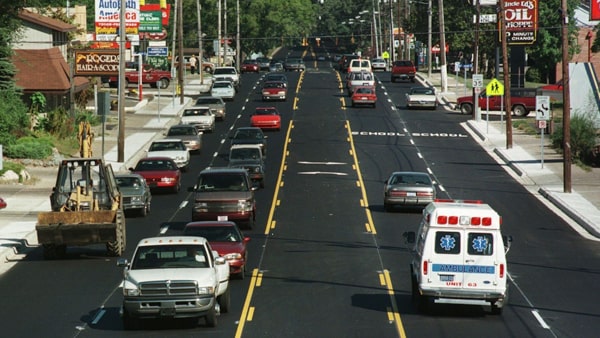
A center lane bordered by solid and broken yellow lines is intended for:

The center lane in the illustration is used for:
  1. A Normal through travel
  2. B Left-turn maneuvers from either direction
  3. C Passing slower vehicles
  4. D Emergency vehicles only

Correct answer: B – Left-turn maneuvers from either direction

These markings identify a two-way left-turn lane. Drivers traveling in either direction may use it for left-turn maneuvers, but it is not a normal travel lane. The lane must never be used to pass another vehicle.

Source: Hawaii Driver’s Manual — Ch. VI, “Pavement Markings”

Question 3

You approach a STOP sign with a crosswalk but no stop line. Where must you stop?

  1. A Before entering the crosswalk
  2. B About 50 feet from the intersection
  3. C Where a stop line would normally be painted
  4. D After your front wheels enter the crosswalk

Correct answer: A – Before entering the crosswalk

Hawaii law requires a driver facing a STOP sign to stop at the marked stop line. If there is no stop line, the driver must stop before entering the crosswalk on the near side. If neither marking exists, stop at the nearest point with a view of approaching traffic before entering the intersection.

Source: HRS § 291C-63(b) – Vehicle entering stop or yield intersection, Hawaii Driver’s Manual — Ch. VI, “Regulatory Signs”

Question 4

A yellow diamond sign showing a truck descending a slope warns of:

This sign means:
  1. A A truck weight restriction
  2. B A hill or steep downgrade ahead
  3. C A truck service area
  4. D A roadway closed to trucks

Correct answer: B – A hill or steep downgrade ahead

The symbol warns that a hill or downgrade is ahead. Yellow diamond-shaped signs generally alert drivers to hazards or changing roadway conditions. Be prepared to adjust your speed and take other safe action appropriate for the grade.

Source: Hawaii Driver’s Manual — Ch. VI, “Warning Signs”

Question 5

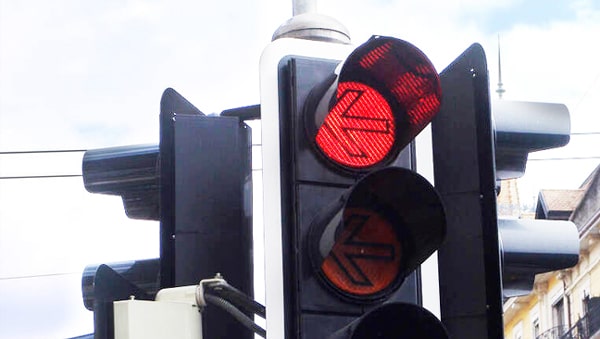
In Hawaii, how does a red arrow apply to traffic in the indicated lane?

What is the difference between traffic lights with red arrows and those with solid red lights?
  1. A It has the same meaning as a red light for that lane
  2. B It controls left-turning vehicles only
  3. C It permits a turn after slowing without stopping
  4. D It permanently closes the lane

Correct answer: A – It has the same meaning as a red light for that lane

The state manual says a red arrow has the same meaning as a red light for the indicated lane. Stop at the required location and follow the rules governing movement against a red indication, including any posted turn prohibition. The arrow identifies the lane or movement being controlled.

Source: HRS § 291C-32(a) – Traffic-control signal legend, Hawaii Driver’s Manual — Ch. VI, “Traffic Signals”

Question 6

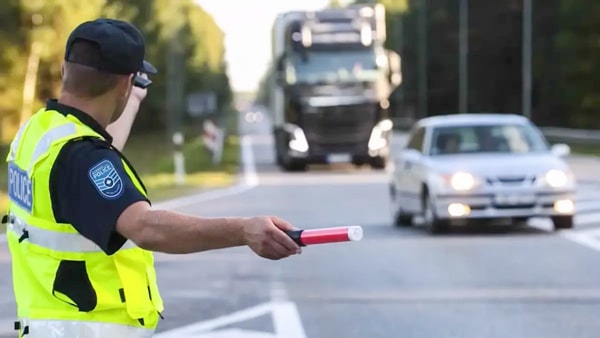
A police officer directs you through an intersection while the signal is red. What should you do?

A traffic light is red, but a police officer is telling you to go ahead anyway. What should you do?
  1. A Remain stopped until the light turns green
  2. B Change lanes before entering the intersection
  3. C Proceed as the officer directs
  4. D Wait for the officer to approach your vehicle

Correct answer: C – Proceed as the officer directs

Follow the officer’s lawful direction even when it conflicts with a traffic signal. Hawaii’s traffic-control-device law expressly recognizes directions given by traffic or police officers. Willfully refusing to comply with a lawful traffic direction from an authorized police officer is a petty misdemeanor.

Source: HRS § 291C-23 – Obedience to police officers, HRS § 291C-31(a) – Obedience to and required traffic-control devices