Hawaii Road Signs Test 4

5 out of 5 (35 votes)
80% Passing score
20 Questions
4 Mistakes allowed
A Hawaii road signs practice test is a focused way to study one of the most practical parts of the Class 3 written knowledge test. Road signs are not handled as a separate, neatly boxed-off exam in Hawaii; they are folded into the regular 30-question permit test, right alongside traffic laws, safe driving rules, signals, pavement markings, right-of-way, impaired driving laws, sharing the road, and the basic things every driver is expected to know before being handed a permit. So, yes, this is a road signs test, but it is really helping you prepare for the way sign questions appear on the actual Hawaii DMV practice test experience. This practice test includes 20 multiple-choice questions built around the signs, colors, shapes, and symbols Hawaii drivers need to recognize without making a whole dramatic production out of it. Red signs, yellow warnings, green guide signs, lane-use markings, signals, pavement markings, the odd sign shape that suddenly looks less familiar than it should — it is all fair game. And that matters, because road signs do not usually give you a long, generous moment to think things over. They show up on curves, near intersections, through busy Honolulu traffic, along coastal roads, and in those wet, winding spots where guessing is a poor little strategy. To pass this Hawaii signs test, you will need 16 correct answers out of 20. That 80% mark is intentional, since Hawaii’s official Class 3 knowledge test uses the same passing standard: 24 correct answers out of 30. The official exam is based on the Hawaii Driver’s Manual, so that manual should still be your anchor. This practice test is the extra work, the rehearsal, the place where you catch the small misunderstandings before they become very official misunderstandings. Use it if you are getting ready for a learner’s instructional permit, renewing your license, or just realizing that some signs have quietly slipped out of memory. Take it more than once. Not because repetition is exciting — it usually is not — but because sign recognition gets faster once your brain stops treating every symbol like a tiny roadside riddle. By the time you sit for the real written test, the goal is not to feel lucky. The goal is to recognize what you are looking at and move on with confidence.
FREE DMV Practice Test App
Study for your Hawaii permit test or driver’s license with the NextDoorDriving app. 700+ DMV questions and answers, 100% free!
Download on the App Store

Sample Hawaii Permit Test Questions

Question 1

A yellow diamond sign shows the road curving right and then left. What does it warn of?
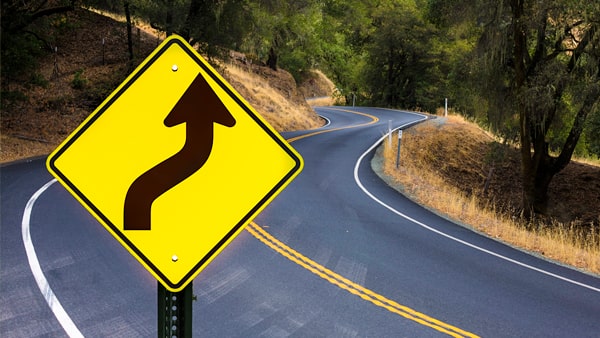
This sign means:
  1. A One sharp right turn
  2. B Reverse curves beginning to the right
  3. C Reverse curves beginning to the left
  4. D The end of the paved road

Correct answer: B – Reverse curves beginning to the right

This reverse-curve sign warns of two successive curves in opposite directions. The symbol shows that the first curve is to the right and the second is to the left. As with other warning signs, be prepared to adjust your speed and path for the roadway alignment.

Source: HRS § 291C-39 – Traffic control devices; uniform standards and specifications, MUTCD, 11th ed. with Revision 1 — W1-4, “Horizontal Alignment—Reverse Curve”
Question 2

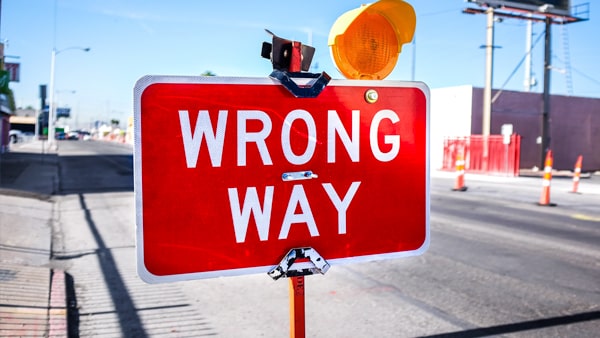
What does a red-and-white WRONG WAY sign tell you?

This red and white sign means:
  1. A You may enter after yielding
  2. B The roadway is closed in every direction
  3. C U-turns are prohibited at this location
  4. D You are traveling against the permitted direction of traffic

Correct answer: D – You are traveling against the permitted direction of traffic

A WRONG WAY sign is used where a driver may mistakenly enter or continue along a one-way roadway in the prohibited direction. It is commonly used to supplement a DO NOT ENTER sign. Drivers must obey the sign and must not continue against the permitted traffic flow.

Source: HRS § 291C-31(a) – Obedience to and required traffic-control devices, MUTCD, 11th ed. with Revision 1 — § 2B.47, “WRONG WAY Sign (R5-1a)”

Question 3

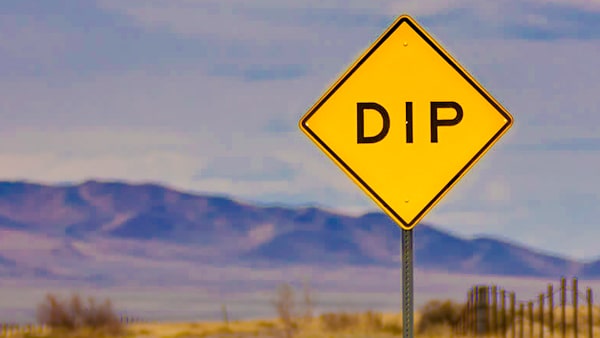
A yellow diamond sign marked DIP warns of:

This sign means:
  1. A A low section in the roadway
  2. B An unpaved shoulder
  3. C A pedestrian crossing
  4. D A required stop

Correct answer: A – A low section in the roadway

A DIP sign warns that a low section of roadway is ahead. The change in elevation may affect vehicle control if approached too quickly. Reduce speed as needed and be prepared for the roadway condition indicated by the warning sign.

Source: MUTCD, 11th ed. with Revision 1 — W8-2, “Dip”, Hawaii Driver’s Manual — Ch. VI, “Warning Signs”

Question 4

Under Hawaii guidance, a single solid white lane line should be crossed only:

  1. A Whenever another lane is moving faster
  2. B In unusual circumstances and with great care
  3. C When entering any driveway
  4. D When making a U-turn

Correct answer: B – In unusual circumstances and with great care

A single solid white line separates lanes moving in the same direction but indicates that lane-to-lane movement is hazardous. Hawaii guidance permits crossing it only in unusual circumstances and with great care. Before moving, the driver must also determine that the lane change can be made safely.

Source: HRS § 291C-38(c)(3) – Longitudinal traffic lane markings, Hawaii Driver’s Manual — Ch. VI, “Pavement Markings”

Question 5

What does an octagonal red STOP sign require?

This sign means:
  1. A Slow only when approaching traffic is visible
  2. B Stop completely, then proceed after yielding when safe
  3. C Continue cautiously without stopping if the road is clear
  4. D Stop only for vehicles on the intersecting road

Correct answer: B – Stop completely, then proceed after yielding when safe

At a STOP sign, Hawaii law requires a complete stop at the stop line, before the near crosswalk if there is no line, or at the appropriate point before entering the intersection if neither exists. After stopping, yield to traffic that is already in the intersection or is close enough to be an immediate hazard. Proceed only when safe.

Source: HRS § 291C-63(b) – Vehicle entering stop or yield intersection, Hawaii Driver’s Manual — Ch. VI, “Regulatory Signs”

Question 6

What must you do at a red-and-white triangular YIELD sign?

  1. A Stop only when an emergency vehicle approaches
  2. B Cross the intersection without changing speed
  3. C Always make a complete stop
  4. D Slow to a reasonable speed and stop if safety requires

Correct answer: D – Slow to a reasonable speed and stop if safety requires

Hawaii law requires a driver approaching a YIELD sign to slow to a speed reasonable for existing conditions. Stop at the designated location if stopping is necessary for safety. After slowing or stopping, yield to traffic in or approaching the intersection closely enough to present an immediate hazard.

Source: HRS § 291C-63(c) – Vehicle entering stop or yield intersection, Hawaii Driver’s Manual — Ch. VI, “Regulatory Signs”