


Idaho CDL Practice Test: General Knowledge (ID) 6

5 out of 5 (40 votes)
80% Passing score
50 Questions
10 Mistakes allowed
Aspiring commercial drivers in Idaho, welcome to your sixth Idaho CDL General Knowledge Practice Test. This crucial stepping stone in your CDL preparation offers a comprehensive set of 50 questions, designed to rigorously test your knowledge and readiness. Achieving at least 40 correct answers is your goal here, signaling that you're well on your way to mastering the essentials of commercial driving. Our Idaho general knowledge practice test for CDL is more than just a series of DMV test questions; it's a learning experience. Every question has been crafted to reflect real-life situations you might encounter on the road. This approach helps bridge the gap between theoretical knowledge and practical application, preparing you for real-world driving scenarios. You'll find permit test questions covering a wide array of topics, from understanding your vehicle's equipment to handling emergencies, from conducting pre-trip inspections to recognizing and dealing with hazardous materials. While you may not be aiming for a HazMat endorsement at this stage, understanding the basics of hazardous materials is vital for every driver. We understand the importance of staying current, which is why our Idaho DMV CDL test content is regularly updated. You'll be studying the most up-to-date information, reflecting the latest driving laws and regulations as of 2026. This ensures you're not just preparing to pass a test, but also to be a safe, knowledgeable driver on Idaho's roads. The best part? You can take this Idaho CDL practice test on general knowledge multiple times. It's a tool for learning, not just assessing. We encourage you to use this DMV test to become completely comfortable with the material. Once you consistently score well, you'll know you're ready to move on to the next stage of your CDL preparation. So, dive in, study hard, and let's get you ready for the road ahead in 2026!
FREE CDL Practice Test App
Pass your Idaho CDL General Knowledge test with the NextDoorDriving app. Real questions and answers—100% free and ad-free.
Download on the App Store

Sample Idaho CDL Test Questions - General Knowledge

Question 1

If the shoulder is clear, why may steering right be safer than steering left around a sudden obstacle?

  1. A Turning right prevents every type of skid
  2. B Turning right eliminates hydroplaning
  3. C A vehicle may be passing on your left
  4. D Turning right guarantees that no collision will occur

Correct answer: C – A vehicle may be passing on your left

The safest escape direction depends on the actual traffic and roadway conditions. If the shoulder is clear, moving right may be preferable because another vehicle could be overtaking on the left. Use your mirrors to identify an open path, turn only as much as necessary to clear the obstacle, and be prepared to counter-steer.

Source: Idaho Commercial Driver’s License Manual — § 2.17.1, “Steering to Avoid a Crash”
Question 2

What should you do first when your vehicle begins hydroplaning?

  1. A Use stab braking
  2. B Downshift immediately
  3. C Accelerate slightly
  4. D Release the accelerator

Correct answer: D – Release the accelerator

Release the accelerator to allow the vehicle to slow and the tires to regain contact with the road. If driving a manual transmission, push in the clutch so the wheels can turn freely. Do not use the brakes to slow a hydroplaning vehicle because the tires have little or no traction for braking or steering.

Source: Idaho Commercial Driver’s License Manual — § 2.6.2, “Hydroplaning”

Question 3

What driving limitation does a helper primarily address while you are backing?

  1. A Areas behind the vehicle that the driver cannot see
  2. B Slow acceleration in reverse gear
  3. C Excessive air-brake pressure
  4. D Difficulty operating the steering wheel

Correct answer: A – Areas behind the vehicle that the driver cannot see

A helper can monitor blind spots and areas behind the vehicle that the driver cannot see. Idaho CDL guidance says the helper should stand near the rear where the driver can still see them. Before backing, agree on clear hand signals, especially a stop signal. Stop immediately if communication is lost or the helper disappears from view.

Source: Idaho Commercial Driver’s License Manual — § 2.2.4, “Backing Safely”

Question 4

About how far ahead can a commercial driver see with low-beam headlights?

  1. A 250 feet
  2. B 200 feet
  3. C 150 feet
  4. D 350 feet

Correct answer: A – 250 feet

The Idaho CDL manual uses approximately 250 feet as the low-beam sight distance and about 350 to 500 feet for high beams. At night, adjust your speed so the vehicle's stopping distance remains within the illuminated area. Dirty or poorly adjusted headlights can reduce the distance available for recognizing and responding to hazards.

Source: Idaho Commercial Driver’s License Manual — § 2.11.4, “Headlights”

Question 5

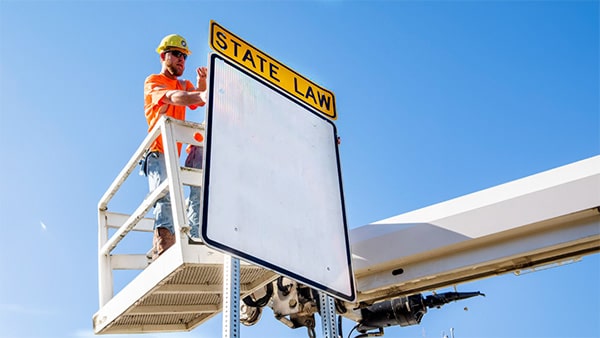
In Idaho, a tall rectangular sign with a white background and black or red markings is commonly what type of sign?

Many _____________ are this shape.
  1. A Parking-area guide sign
  2. B Regulatory sign
  3. C General warning sign
  4. D Recreational guide sign

Correct answer: B – Regulatory sign

Most regulatory signs are rectangular, commonly with the longer dimension vertical. They tell drivers about applicable traffic laws or requirements, such as speed limits, prohibited movements, or lane-use rules. Important exceptions have distinctive shapes, including the octagonal STOP sign and the downward-pointing triangular YIELD sign.

Source: Manual on Uniform Traffic Control Devices for Streets and Highways, 11th ed., Revision 1 — § 2B.02, “Design of Regulatory Signs”

Question 6

During an emergency move off the roadway, avoid braking if possible until your speed drops to about:

  1. A 10 mph
  2. B 20 mph
  3. C 25 mph
  4. D 30 mph

Correct answer: B – 20 mph

When leaving the roadway in an emergency, avoid braking if possible until the vehicle slows to approximately 20 mph. Then brake very gently because a loose shoulder provides less traction than pavement. Keep one set of wheels on the pavement when possible, and remain on a clear shoulder until the vehicle has stopped.

Source: Idaho Commercial Driver’s License Manual — § 2.17.1, “Leaving the Road”