Idaho DMV Sign Test 3

4.9 out of 5 (121 votes)
80% Passing score
20 Questions
4 Mistakes allowed
Idaho road signs do a lot of work before you ever read a word on them. Shape, color, placement, and even the way a sign interrupts the road ahead are all part of the message, which is why this Idaho DMV sign test practice focuses on more than just matching pictures to names. You need to know that an octagon means stop before your brain starts negotiating with it, and that a triangle means yield even when traffic around you is making the whole situation feel more dramatic than it needs to be. This Idaho practice drivers test includes 20 multiple-choice questions covering the signs and road clues Idaho drivers are expected to understand, including warning signs, regulatory signs, school zones, work zones, railroad crossings, traffic signals, pavement markings, right-of-way signs, and sign colors and shapes. A passing score on this practice road signs drivers test is 16 correct answers. The official Idaho Class D knowledge test is larger, with 40 questions, and you need 34 correct answers to pass. That matters because failing the real knowledge test means waiting 3 days before retesting and paying the test fee again. A small detail, sure, until it is suddenly your afternoon. The questions here are built to help you recognize what a sign is telling you and what you are supposed to do next. Some are straightforward. Some put the sign into a driving situation, which is honestly where the learning tends to stick better. It is one thing to identify a school zone sign in a quiet practice screen; it is another to understand what it means when there are cars behind you, pedestrians nearby, and your attention is being pulled in six directions at once. Idaho’s actual Class D knowledge test is based on the Idaho Driver’s Handbook and covers traffic laws, road rules, signs, signals, safe driving, impaired driving, sharing the road, and driver responsibility. New applicants, many out-of-state transfer applicants, and drivers with an Idaho license expired for 25 months or more may be required to take it. Applicants also complete a vision screening, with Idaho requiring at least 20/40 vision in one eye, with or without corrective lenses. You can take this Idaho permit test road signs practice on a phone, tablet, or computer, and you can repeat it as often as needed. Use it until the signs stop feeling like guesses and start feeling like instructions you actually trust.
FREE DMV Practice Test App
Study for your Idaho permit test or driver’s license with the NextDoorDriving app. 700+ DMV questions and answers, 100% free!
Download on the App Store

Sample Idaho Permit Test Questions

Question 1

When a two-way road has double solid yellow centerlines, which maneuver is prohibited?

  1. A. Turning left into a driveway when it is safe
  2. B. Turning left out of a business entrance when it is safe
  3. C. Passing another vehicle
  4. D. All of the above

Correct answer: C. – Passing another vehicle

Double solid yellow centerlines prohibit passing in either direction. In Idaho, a driver may cross them to turn left into or out of a driveway or business entrance when the turn can be made safely. The lines should not be crossed merely to overtake another vehicle.

Source: Idaho Driver’s Handbook (July 2026) — Highway & Vehicle Knowledge, “Pavement Markings”
Question 2

In Idaho, a green arrow displayed with a steady red light permits you to:

  1. A. Remain stopped for the movement shown by the arrow
  2. B. Wait until the circular signal also turns green
  3. C. Proceed only in the direction shown by the green arrow
  4. D. Proceed in any direction after slowing

Correct answer: C. – Proceed only in the direction shown by the green arrow

A green arrow permits movement in the direction it points, even when a steady red indication is displayed at the same time. Movements not authorized by the arrow or another displayed signal remain prohibited. A driver facing a left-turn green arrow must yield to traffic and pedestrians lawfully within the intersection or adjacent crosswalk.

Source: Idaho Code § 49-802(1)(b) – Traffic-Control Signal Legend, Idaho Driver’s Handbook (July 2026) — Traffic Laws & the Rules of the Road, “Stopping”

Question 3

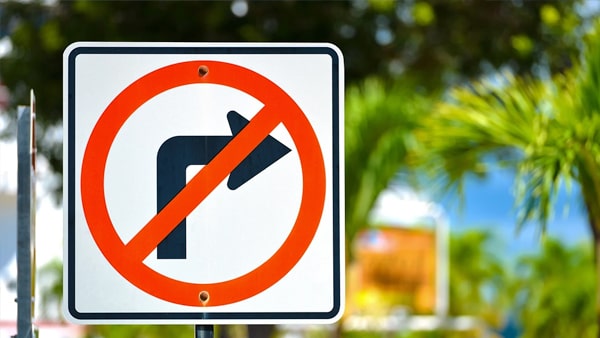
A sign showing a right-turn arrow inside a red circle with a diagonal slash means:

This sign means:
  1. A. No U-turn
  2. B. No left turn
  3. C. No right turn
  4. D. No turns in either direction

Correct answer: C. – No right turn

This regulatory sign prohibits right turns at the location where it is posted. The curved arrow identifies the maneuver, while the red circle and slash show that the maneuver is not allowed. Follow any other lane-use or movement controls displayed at the intersection.

Source: Idaho Driver’s Handbook (July 2026) — Highway & Vehicle Knowledge, “Turn Prohibition & Lane Control Signs”

Question 4

A yellow, diamond-shaped traffic sign is generally a:

  1. A. Warning sign
  2. B. Interstate route marker
  3. C. School crossing sign
  4. D. Speed limit sign

Correct answer: A. – Warning sign

Most warning signs are diamond-shaped with black symbols or words on a yellow background. They alert drivers to unexpected roadway conditions that may require reduced speed or another response. School warning signs are commonly fluorescent yellow-green and use a different five-sided shape.

Source: Idaho Driver’s Handbook (July 2026) — Highway & Vehicle Knowledge, “Warning Signs”

Question 5

A yellow diamond sign showing a short road joining the main road from the right warns of:

This sign means:
  1. A. A mandatory right turn
  2. B. A side road entering from the right
  3. C. A straight-ahead-only lane
  4. D. A prohibited right turn

Correct answer: B. – A side road entering from the right

The Side Road warning sign indicates that another road joins the highway from the direction shown by the symbol. It warns of a potential intersection and entering or crossing traffic. It does not require you to turn or prohibit a particular movement.

Source: IDAPA 39.03.41.004 – Incorporation by Reference, Manual on Uniform Traffic Control Devices for Streets and Highways, 11th ed. — § 2C.46, “Intersection Warning Signs”

Question 6

How should you handle an intersection when its traffic signal is not functioning?

  1. A. Wait until the signal is repaired
  2. B. Wait for an officer to arrive
  3. C. Treat the intersection as a four-way stop
  4. D. Continue through without stopping

Correct answer: C. – Treat the intersection as a four-way stop

The Idaho handbook instructs drivers to treat a nonfunctioning traffic signal as a four-way stop. Stop before entering and follow the normal right-of-way rules for an all-way stop. The first vehicle to arrive proceeds first; when vehicles arrive together, the vehicle on the left yields to the one on the right.

Source: Idaho Driver’s Handbook (July 2026) — Highway & Vehicle Knowledge, “Traffic Signals”, Idaho Driver’s Handbook (July 2026) — Traffic Laws & the Rules of the Road, “Right-of-Way and Yielding”