


Illinois Permit Test (Rules of The Road) Simulator

4.5 out of 5 (2529 votes)
80% Passing score
35 Questions
7 Mistakes allowed
The Illinois DMV permit test rewards people who actually understand the rules, not people who skim a few road signs the night before and hope the rest feels obvious. And, honestly, a lot of it does feel obvious until the wording gets specific. Right-of-way at intersections, school bus laws, construction-zone penalties, pavement markings, DUI rules, distracted driving, lane use, turns, passing, parking—it is all covered in the Class D written exam, and Illinois expects you to know the difference between sometimes true and always true.   This Illinois DMV practice test is built around that real permit-test structure. You’ll answer 35 multiple-choice questions, just like the standard Illinois knowledge test, and you’ll need 28 correct answers to pass. That is an 80% score, or 7 misses at most. It sounds manageable, and it is, but only if you have practiced the material in a way that makes the details stick. Immediate feedback helps with that. When you miss a question, you see why the answer works instead of just being told you were wrong, which is the part that actually does the teaching. The questions cover the same broad territory found in the Illinois Rules of the Road: traffic signs, signals, pavement markings, safe driving habits, right-of-way, alcohol and drug laws, sharing the road, and those Illinois-specific items that can sneak up on you. Road signs are not handled as a separate road-sign-only test for a standard Class D permit, by the way. They are mixed into the written knowledge test, so this Illinois rules of the road practice test treats them the same way. It also helps to keep the licensing process in your head while you study, because the permit test is not floating out there by itself. Teen applicants can usually begin at 15 with parent or guardian consent, driver education enrollment, a vision screening, and the written exam. Under Illinois GDL rules, a teen permit must be held for at least 9 months, with 50 hours of supervised practice driving, including 10 at night. Adults have a different route, though first-time applicants under 20 may need a 6-hour Adult Driver Education Course before licensing. So yes, study the questions, but study them like they connect to the license you are trying to earn.
FREE DMV Practice Test App
Study for your Illinois permit test or driver’s license with the NextDoorDriving app. 700+ DMV questions and answers, 100% free!
Download on the App Store

Sample Illinois Permit Test Questions

Question 1

Before opening the driver’s door next to moving traffic, what are you responsible for doing?

  1. A Check mirrors and look behind for vehicles and bicyclists
  2. B Open the door slightly so traffic will move over
  3. C Give a left-turn hand signal
  4. D Sound the horn

Correct answer: A – Check mirrors and look behind for vehicles and bicyclists

A door on the side available to moving traffic may be opened only when it is reasonably safe and will not interfere with traffic. The official manual advises drivers to check for approaching vehicles and bicyclists after parking. Reaching across with the right hand can provide a better opportunity to check the area before opening the driver’s door.

Source: 625 ILCS 5/11-1407 – Opening and closing vehicle doors, Illinois Rules of the Road 2026 — Ch. 5, “Bicycles”
Question 2

Which lights should an Illinois driver use in fog or similarly poor visibility?

  1. A The horn at regular intervals
  2. B Parking lights only
  3. C High-beam headlights
  4. D Low-beam headlights

Correct answer: D – Low-beam headlights

Headlights are required when rain, snow, fog, or other atmospheric conditions require windshield wipers and whenever people or vehicles are not clearly visible at 1,000 feet. In fog, the official manual directs drivers to use dimmed headlights or fog lights. Parking lamps cannot be used as a substitute for the required headlamps.

Source: 625 ILCS 5/12-201(b) – When lighted lamps are required, Illinois Rules of the Road 2026 — Ch. 11, “Fog”

Question 3

What does a single solid white line between lanes traveling in the same direction indicate?

  1. A It may be crossed whenever convenient
  2. B Crossing requires special care and is discouraged
  3. C It may be crossed only to enter a driveway
  4. D It may be crossed only for a U-turn

Correct answer: B – Crossing requires special care and is discouraged

Illinois guidance states that a single solid white line separates lanes moving in the same direction. Crossing it requires special care and is discouraged. By contrast, crossing double solid white lines is prohibited, while a broken white line may be crossed when changing lanes or turning.

Source: Illinois Rules of the Road 2026 — Ch. 10, “White Lane Lines”

Question 4

When leaving a private road or driveway in an urban area, what must you do before entering the roadway?

  1. A Sound the horn and continue
  2. B Stop with part of the vehicle in the roadway
  3. C Accelerate quickly into the nearest opening
  4. D Stop, yield to pedestrians, and then yield to roadway traffic

Correct answer: D – Stop, yield to pedestrians, and then yield to roadway traffic

Before entering the sidewalk area from an alley, building, private road, or driveway in an urban area, the driver must stop. If there is no sidewalk, the stop must occur at the nearest point where approaching traffic can be seen. After stopping, yield as necessary to pedestrians and yield to all vehicles approaching on the roadway.

Source: 625 ILCS 5/11-1205 – Emerging from alley, building, or private road or driveway

Question 5

In Illinois, a chemical test of breath, blood, urine, or another bodily substance can measure a driver’s:

  1. A Reaction time
  2. B Blood-alcohol concentration
  3. C Eyesight
  4. D General driving skill

Correct answer: B – Blood-alcohol concentration

Chemical analysis of breath, blood, urine, or another bodily substance can determine alcohol concentration, commonly expressed as BAC, and may also detect drugs or intoxicating compounds. Under implied consent, an arrested driver may be asked to submit to testing. For a first offender, a BAC of .08% or more results in a six-month statutory summary suspension; refusal results in a one-year suspension.

Source: 625 ILCS 5/11-501.1(a) – Suspension of drivers license; statutory summary alcohol, other drug or drugs, or intoxicating compound or compounds related suspension or revocation; implied consent, 625 ILCS 5/11-501.2(a) – Chemical and other tests, Illinois Rules of the Road 2026 — Ch. 6, “Statutory Summary Suspension/Revocation Law”

Question 6

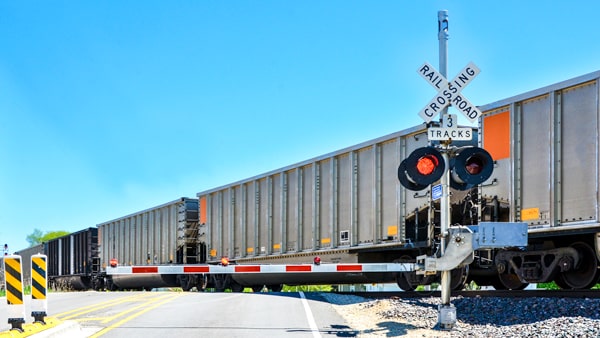
When may an Illinois driver go through, around, or under a railroad crossing gate that is closed or moving?

When may you legally drive around or under a railroad crossing gate?
  1. A Never
  2. B When the tracks appear clear in both directions
  3. C When the gate appears to be malfunctioning
  4. D When there seems to be enough time before the train arrives

Correct answer: A – Never

A driver may not pass through, around, or under a railroad crossing gate while it is closed, opening, or closing. When a gate is lowered or a signal warns of an approaching train, stop between 15 and 50 feet from the nearest rail. A first violation carries a $500 fine; a later violation carries a $1,000 fine and may result in a driving-privilege suspension of at least six months.

Source: 625 ILCS 5/11-1201(a), (b), (e) – Obedience to signal indicating approach of train or railroad track equipment