Illinois Rules of The Road Practice Test

4.7 out of 5 (1865 votes)
80% Passing score
20 Questions
4 Mistakes allowed
Illinois drivers are expected to know more than the obvious stuff, and that is where this Illinois rules of the road practice test earns its keep. The written exam is based on the Illinois Secretary of State’s Rules of the Road, which means the questions are not floating around in some vague “common sense driving” category. They come from actual Illinois traffic laws, road signs, pavement markings, right-of-way rules, safe driving practices, and the day-to-day decisions that show up at intersections, lane changes, parking spaces, and, yes, those moments when another driver seems to be inventing their own private traffic code. This Illinois DMV practice test gives you 20 multiple-choice questions modeled around the material you need to understand for the Illinois permit test. It covers road signs, signals, turns, passing, lane use, speed laws, alcohol and drug rules, distracted driving, pedestrians, bicyclists, motorcycles, large vehicles, and emergency vehicles. That sounds like a lot because it is a lot, although not in a dramatic way. More in the “you probably want to know this before you are sitting at a Driver Services facility” way. The real Illinois Class D written knowledge test must include at least 35 questions, and you need an 80% score to pass. On a 35-question test, that means 28 correct answers, with no more than 7 missed. This practice test uses the same 80% standard, so getting at least 16 out of 20 correct is a solid sign that your prep is headed in the right direction. Not a guarantee, obviously, but a useful checkpoint before the official exam. The format is simple, which is good, because the rules themselves can get fussy. Each answer gives immediate feedback, so you are not just guessing, clicking, and moving on with a false sense of confidence. You see what you missed and why it matters, especially with those questions where two answers look annoyingly close. Illinois testing is handled through Secretary of State Driver Services facilities. Applicants usually need the proper identification documents, a photo, the required fee, and any required exams, including vision, written, and road tests. You also get 3 attempts to pass the written and/or road tests within 1 year from your first attempt. So, use this Illinois permit practice test with the official handbook, road sign review, and driver education materials. It is a cleaner way to study, and frankly, a better use of your time than hoping the handbook stuck in your mind.

FREE DMV Practice Test App
Study for your Illinois permit test or driver’s license with the NextDoorDriving app. 700+ DMV questions and answers, 100% free!
Download on the App Store

Sample Illinois Permit Test Questions

Question 1

What is the proper way to indicate an intended turn or lane change to other drivers?

  1. A Activate the appropriate turn signal before beginning the movement
  2. B Wait until the vehicle has started moving into the new direction
  3. C Flash the high beams instead of using a turn signal
  4. D Rely only on the vehicle’s lane position

Correct answer: A – Activate the appropriate turn signal before beginning the movement

Illinois requires an appropriate signal before turning or moving right or left on a roadway. The signal must operate continuously for at least the final 100 feet in a business or residence district and at least 200 feet outside those districts. Signaling does not replace the requirement to determine that the movement can be made safely.

Source: 625 ILCS 5/11-804(a), (b) — When signal required

Question 2

On a two-lane, two-way roadway, passing on the left is prohibited at which locations?

  1. A Within 100 feet of an intersection
  2. B Within 100 feet of a railroad crossing
  3. C Near a bridge, viaduct, or tunnel when the view is blocked within 100 feet
  4. D All of the above

Correct answer: D – All of the above

Each listed location restricts passing on a two-lane, two-way roadway. A driver may not pass within 100 feet of an intersection or railroad crossing, or where the view is obstructed within 100 feet of a bridge, viaduct, or tunnel. These restrictions reduce conflicts where drivers cannot adequately see or respond to hazards.

Source: Illinois Rules of the Road 2026 — Ch. 4, “Passing”

Question 3

A school bus stops on a two-lane roadway to unload pupils and activates its red visual signals. What must an approaching driver in the opposite direction do?

If a school bus stops to unload children on a two-lane highway, vehicles traveling in the opposite direction are:
  1. A Continue because the bus is in the opposite lane
  2. B Slow down and pass at a cautious speed
  3. C Stop, then proceed once the pupils reach the shoulder even if the signals remain active
  4. D Stop and wait until the bus moves, the bus driver signals, or the visual signals are no longer operating

Correct answer: D – Stop and wait until the bus moves, the bus driver signals, or the visual signals are no longer operating

Illinois requires a driver approaching from either direction to stop before reaching a school bus receiving or discharging pupils when its required visual signals are operating. The driver must remain stopped until the bus resumes motion, the bus driver signals permission to proceed, or the visual signals are turned off. The opposing-traffic exception for certain roadways with four or more lanes does not apply here.

Source: 625 ILCS 5/11-1414(a), (e) — Approaching, overtaking, and passing school bus

Question 4

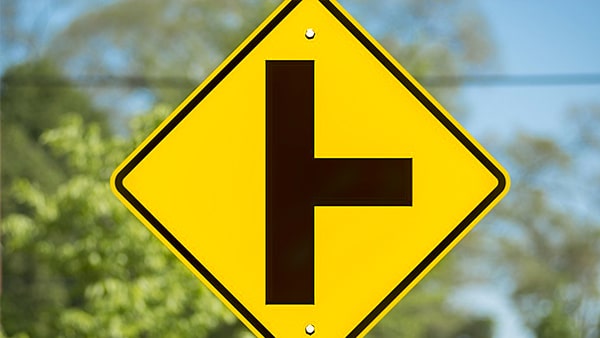
A yellow diamond sign showing a short road joining from the right warns that:

This sign means:
  1. A All traffic must turn right
  2. B A side road enters from the right ahead
  3. C Traffic must continue straight
  4. D Right turns are prohibited

Correct answer: B – A side road enters from the right ahead

The SIDE ROAD sign warns that another roadway enters from the right ahead. Be alert for vehicles entering, leaving, or crossing your path near the junction. Because it is a warning sign, it does not require you to turn or prohibit a particular movement.

Source: Illinois Rules of the Road 2026 — Ch. 9, “Intersections Ahead—Side Road”

Question 5

An authorized emergency vehicle approaches using its required warning signals. What should you do?

  1. A Yield, move as close as possible to the right edge clear of the intersection, and stop if necessary
  2. B Remain in your lane and reduce your speed slightly
  3. C Stop immediately in the intersection
  4. D Accelerate until you reach a place where passing is prohibited

Correct answer: A – Yield, move as close as possible to the right edge clear of the intersection, and stop if necessary

Illinois law requires you to yield and immediately move parallel to and as close as possible to the right edge or curb, clear of any intersection. Stop if necessary for the emergency vehicle to pass safely, and remain there until it has passed unless a police officer directs otherwise. Do not stop where you would block the intersection.

Source: 625 ILCS 5/11-907(a) – Operation of vehicles and streetcars on approach of authorized emergency vehicles, Illinois Rules of the Road 2026 — Ch. 4, “Emergency/Maintenance Vehicles”

Question 6

What can happen when even a small amount of alcohol is mixed with another drug?

  1. A The combination can make driving dangerously impaired
  2. B The substances cancel each other’s effects
  3. C The drug becomes harmless while driving
  4. D Alcohol leaves the body more quickly

Correct answer: A – The combination can make driving dangerously impaired

Many prescription and nonprescription drugs can impair safe driving. The official handbook warns that mixing even small amounts of alcohol with other drugs is very dangerous. A driver should check medication warnings and avoid driving when alcohol or another substance may cause impairment.

Source: Illinois Rules of the Road 2026 — Ch. 6, “Other Drugs”