Illinois Permit Practice Test 2

4.8 out of 5 (1299 votes)
80% Passing score
20 Questions
4 Mistakes allowed
Illinois gives new drivers a pretty clear path, but clear does not always mean quick, simple, or something you can bluff your way through after skimming a few road sign pictures. The written test is one of the first official checkpoints, and this Illinois rules of the road practice test is meant to make that checkpoint feel less like a guessing game and more like, well, something you actually prepared for. This Illinois practice permit test gives you 20 multiple-choice questions covering the kinds of things that tend to show up when the state wants to know whether you are ready to drive around other human beings. Seat belt rules, road signs, right-of-way, basic traffic laws, safe driving decisions, the usual cast. The questions are written around real driving situations, not just stiff handbook language, so you are practicing the way these rules show up on actual roads, whether that means a crowded Chicago intersection, a quieter street in Springfield, or some perfectly ordinary stretch of road where people still somehow manage to make things complicated. For teen drivers, the permit is not the finish line. It is more like the part where Illinois starts keeping score. You can apply for an instruction permit at 15 with the right consent and driver education enrollment, but before moving to an initial license at 16, you generally need to hold that permit for at least 9 months. You also need 50 hours of supervised driving practice, including 10 at night, certified by a parent, guardian, or responsible adult. So yes, the written exam matters, but it is tied into a bigger Graduated Driver Licensing process that expects you to build experience before the state hands over more freedom. The study tools are there for the moments when your brain briefly leaves the room. A hint can nudge you without spoiling the whole thing, and if you miss a question, the explanation does the useful little job of telling you why the answer is right. That beats memorizing a random “cheat sheet” from the internet and then discovering, at a Driver Services facility, that confidence and accuracy are not the same thing. Adults are not completely off the hook either. First-time applicants ages 18 to 20 may need a 6-hour Adult Driver Education Course if they have not completed approved driver education before. So use this Illinois DMV permit test practice with the official handbook, take the explanations seriously, and give yourself a cleaner shot at passing the first time.
FREE DMV Practice Test App
Study for your Illinois permit test or driver’s license with the NextDoorDriving app. 700+ DMV questions and answers, 100% free!
Download on the App Store

Sample Illinois Permit Test Questions

Question 1

When a traffic signal displays a green arrow pointing left, you may:
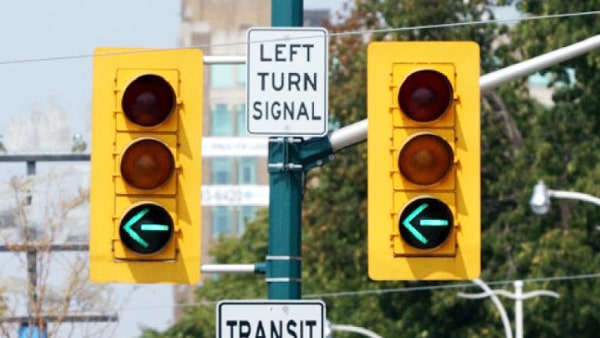
A green arrow pointing to the left on a traffic light means you may:
  1. A Turn left or continue straight through the intersection
  2. B Turn left only after making a complete stop
  3. C Turn left cautiously after yielding to lawful traffic and pedestrians still present
  4. D Turn left without checking the intersection because the arrow guarantees a clear path

Correct answer: C – Turn left cautiously after yielding to lawful traffic and pedestrians still present

A green arrow permits you to enter the intersection for the movement shown by the arrow. You must still yield to pedestrians and bicyclists lawfully in an adjacent crosswalk and to other traffic lawfully using the intersection. A left-pointing arrow does not authorize you to continue straight unless another signal permits that movement.

Source: 625 ILCS 5/11-306(a)(2) — Traffic-control signal legend

Question 2

When driving near a playground where children are present, which response is appropriate?

When you drive through an area where children are playing, you should expect them:
  1. A Assume the children will remain away from the roadway
  2. B Maintain your speed unless a child reaches the centerline
  3. C Watch closely and be ready to reduce speed
  4. D Sound the horn continuously until you leave the area

Correct answer: C – Watch closely and be ready to reduce speed

Illinois law requires drivers to exercise proper precaution when they observe a child. The state manual advises motorists to watch for playgrounds and other areas where children are likely to be and to be ready to reduce speed. Remain especially watchful rather than assuming children will recognize or avoid every traffic hazard.

Source: 625 ILCS 5/11-1003.1 — Drivers to exercise due care, Illinois Rules of the Road 2026 — Ch. 5, “Children”

Question 3

When parking downhill beside a curb, how should you position the front wheels?

  1. A Turn them toward the curb
  2. B Turn them away from the curb
  3. C Keep them straight and parallel to the curb
  4. D Wheel direction does not matter if the transmission is in Park

Correct answer: A – Turn them toward the curb

When the vehicle faces downhill beside a curb, turn the front wheels toward the curb. If the vehicle begins to roll, this position directs it toward the curb rather than the center of the roadway. Place the transmission in Park and use the parking or emergency brake as appropriate.

Source: Illinois Rules of the Road 2026 — Ch. 4, “Parking—Hill Parking”

Question 4

An oncoming vehicle begins turning left across your path, creating an immediate collision risk. What should you do?

  1. A Maintain speed because the other driver is required to yield
  2. B Slow down or stop as needed to avoid the collision
  3. C Sound the horn while maintaining speed
  4. D Accelerate through the conflict area

Correct answer: B – Slow down or stop as needed to avoid the collision

The left-turning driver must yield when an approaching vehicle is close enough to create an immediate hazard. Even when that driver violates the rule, Illinois law requires other motorists to decrease speed as necessary to avoid a collision. Brake or stop as needed instead of maintaining or increasing speed into the hazard.

Source: 625 ILCS 5/11-902 — Vehicle turning left, 625 ILCS 5/11-601(a) — General speed restrictions

Question 5

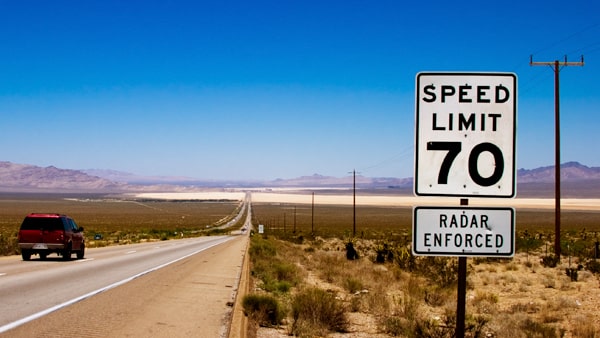
A posted speed limit represents:

The posted speed limits show:
  1. A The minimum speed for that roadway
  2. B The exact speed drivers must maintain
  3. C The maximum legal speed when conditions are safe
  4. D A speed that is safe under every traffic and weather condition

Correct answer: C – The maximum legal speed when conditions are safe

A posted limit establishes the maximum legal speed, not a speed that must always be maintained. Illinois law requires drivers to reduce speed when traffic, weather, visibility, curves, hills, pedestrians, or other hazards make the posted speed unsafe. Driving at or below the limit does not eliminate that duty.

Source: 625 ILCS 5/11-601(a), (b) — General speed restrictions

Question 6

A diamond-shaped traffic sign generally provides:

  1. A A warning about a hazard or changing roadway condition
  2. B An interstate route number
  3. C A railroad crossbuck instruction
  4. D A regulatory speed limit

Correct answer: A – A warning about a hazard or changing roadway condition

Diamond-shaped signs are warning signs. They alert drivers to road hazards, construction, intersections, changes in road alignment, or other conditions requiring special attention. Most are yellow, while construction and maintenance warning signs are orange.

Source: Illinois Rules of the Road 2026 — Ch. 9, “Warning Signs”