


Illinois Practice Permit Test 3

4.8 out of 5 (979 votes)
80% Passing score
20 Questions
4 Mistakes allowed
This Illinois rules of the road practice test gives you a cleaner way to study for the Illinois permit test without turning the whole thing into a guessing game. It has 20 questions, just like a focused little checkpoint, covering the laws and driving situations new drivers are expected to understand before they sit for the written knowledge test. You will run into everyday safety rules, traffic law basics, right-of-way thinking, and details that people love to skim past, like when mobile device use is allowed and when it very much is not. The real Illinois permit test requires 16 correct answers out of 20, so this is not one of those practice tests where “close enough” is doing much for you. The point is to get used to the wording, the pace, and the slightly official way Illinois asks about things that seem obvious in normal life. And, awkwardly enough, that wording matters. A rule you “basically know” can still trip you up when two answer choices sound almost the same, which is why using an Illinois DMV practice test before test day is a smart move, not extra busywork. It also helps to treat this Illinois permit practice test as part of a larger study routine. The Illinois Driver’s Handbook should still be in the mix, along with flashcards or an online course if you like having the same information come at you from a few different angles. Repetition is not exciting. Fine. But it works, especially with rules that need to be recalled quickly instead of vaguely remembered. After the written test piece, the adult licensing process has its own steps. Applicants 18 and older are outside the teen GDL permit-holding structure, but that does not mean the state skips the formalities. A first-time adult applicant generally needs to visit a Secretary of State Driver Services facility, show the required identification documents, pay the proper fee, pass the vision screening, pass the written knowledge test, and complete any required permit or road test steps. There is also the photo, the temporary secure paper license after approval, and the permanent card mailed later. One more thing worth knowing before you get too deep into scheduling: if you are 18 to 20 and have never been licensed, Illinois generally requires the 6-hour Adult Driver Education Course unless you already completed approved driver education. If you are 21 or older, that course usually is not required for a first-time Class D license. Still, the knowledge test is waiting either way, so getting comfortable with the rules now is the sensible place to start.
FREE DMV Practice Test App
Study for your Illinois permit test or driver’s license with the NextDoorDriving app. 700+ DMV questions and answers, 100% free!
Download on the App Store

Sample Illinois Permit Test Questions

Question 1

A traffic signal displays a red circular light together with a green arrow. What movement is permitted?

  1. A Driving straight through the intersection only
  2. B Moving only in the direction shown by the green arrow
  3. C No movement until the circular light becomes green
  4. D Any movement after briefly slowing down

Correct answer: B – Moving only in the direction shown by the green arrow

Illinois law permits traffic facing a green arrow to enter cautiously for the movement indicated by that arrow. The driver must still yield to pedestrians and bicyclists lawfully in an adjacent crosswalk and to other traffic lawfully using the intersection. The red circular light prohibits movements not authorized by the arrow or another displayed indication.

Source: 625 ILCS 5/11-306(a)(2) – Traffic-control signal legend, Illinois Rules of the Road 2026 — Ch. 10, “Arrows”

Question 2

Which action is prohibited by Illinois law while driving?

  1. A Checking the dashboard clock
  2. B Driving below the maximum limit when conditions require it
  3. C Adjusting the vehicle’s climate controls
  4. D Wearing headset receivers over both ears

Correct answer: D – Wearing headset receivers over both ears

A motor-vehicle driver generally may not wear headset receivers while driving. The law contains limited exceptions, including a single-sided headset or earpiece used with a cellular or other mobile telephone. A stereo headset covering both ears does not fall within that single-sided exception.

Source: 625 ILCS 5/12-610(a), (d) – Headset receivers, Illinois Rules of the Road 2026 — Ch. 4, “Distracted Driving”

Question 3

If you must drive in fog, which headlights should you use?

  1. A Low-beam headlights
  2. B High-beam headlights
  3. C Parking lights only
  4. D Hazard lights instead of headlights

Correct answer: A – Low-beam headlights

Use low-beam headlights, or fog lights if the vehicle has them, and reduce your speed. Increase following distance and remain within the distance you can see. If the fog becomes too dense to continue safely, pull off the roadway and stop rather than crawling along the travel lane.

Source: Illinois Rules of the Road 2026 — Ch. 11, “Fog”

Question 4

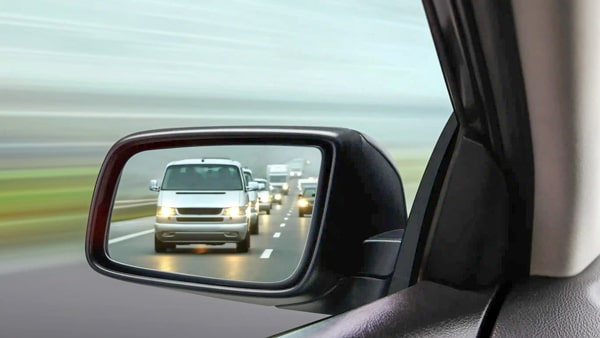
You notice in your mirror that another driver is following too closely. What should you do?

Checking traffic behind you:
  1. A Brake sharply to make the driver increase the following distance
  2. B Move to another lane or slowly pull off the road and allow the vehicle to pass
  3. C Increase speed above the posted limit
  4. D Stop in your lane and wait for the driver to go around

Correct answer: B – Move to another lane or slowly pull off the road and allow the vehicle to pass

Do not respond to a tailgater by speeding or braking aggressively. The official handbook advises moving to another lane or slowly pulling off the road and allowing the vehicle to pass. Continue observing surrounding traffic and make any lane change or pull-off only when it can be completed safely.

Source: Illinois Rules of the Road 2026 — Ch. 11, “Following Distances”

Question 5

When approaching a pedestrian using a guide dog or white cane, a driver must:

  1. A Yield only if the pedestrian is at a marked corner
  2. B Yield the right-of-way
  3. C Sound the horn and continue at the same speed
  4. D Proceed unless another pedestrian is assisting

Correct answer: B – Yield the right-of-way

Illinois law requires drivers to yield to pedestrians with clearly visible disabilities. The driver handbook specifically identifies guide dogs, white canes, wheelchairs, and other assistive devices as indications that a pedestrian may have a disability. Approach carefully and yield rather than expecting the pedestrian to move out of the vehicle’s path.

Source: 625 ILCS 5/11-1004 – Pedestrian with disabilities; right-of-way, Illinois Rules of the Road 2026 — Ch. 5, “Pedestrians With Disabilities”

Question 6

A yellow diamond-shaped sign displaying a black cross warns of what?

This sign shows one type of:
  1. A A crossroad intersection ahead
  2. B A series of roadway curves
  3. C A mandatory right turn
  4. D A lane shift

Correct answer: A – A crossroad intersection ahead

The crossroad sign is one of the intersection-ahead warning signs. It indicates that another road crosses the roadway ahead and that traffic may be present at the intersection. Be prepared to observe vehicles approaching from either side and respond to any regulatory signs or signals.

Source: Illinois Rules of the Road 2026 — Ch. 9, “Intersections Ahead”