


Illinois Driving Test Practice 6

4.8 out of 5 (532 votes)
80% Passing score
20 Questions
4 Mistakes allowed
Turn signals are one of those driving rules everyone claims to understand, right up until a test question starts asking about timing, distance, lane changes, and who is supposed to know what you are doing before you do it. This sixth Illinois rules of the road practice test leans into that exact area, with 20 multiple-choice questions built around proper signaling, right-of-way, signs, intersections, and the everyday rules that somehow become a little less obvious when they are written in official test language. This Illinois DMV practice test is untimed, which is good, because rushing through turn-signal questions is a weird way to learn anything. You need 16 correct answers to pass, matching the usual Illinois written test benchmark, and you can review explanations after you finish. That review is where the useful stuff tends to happen. Not the dramatic stuff, obviously. Nobody frames a missed signaling question on the wall. But when you realize why Illinois expects a signal at least 100 feet before a turn in a residential area, or why signaling does not magically give you the right-of-way, the rules start to feel less like memorized fragments and more like actual driving decisions. The real Illinois driver test practice experience is not about seeing the exact state exam in advance. Illinois does not publish the real questions, so this drivers permit practice test is designed to mirror the format, phrasing, and rule coverage without pretending to be a leaked answer sheet. Better, honestly. Leaked answer sheets make people lazy. Good practice makes people notice the trap hiding in a perfectly ordinary sentence. Of course, the written exam is only part of getting licensed in Illinois. Applicants usually go through a Secretary of State Driver Services facility, bring the required identification documents, take a photo, pay the proper fee, and pass whatever exams apply. Vision screening may be required too, and Illinois can add restrictions for corrective lenses, daylight-only driving, or mirrors depending on the results. First-time applicants also have to deal with document groups covering identity, signature, Social Security number, and Illinois residency, with REAL ID requiring extra residency proof. Under 18? Parent or guardian consent comes into the picture as well. So yes, use this Illinois driving permit practice test for the questions. But use it for the rhythm of the process too, because the test is easier when the licensing maze is not surprising you at the same time.
FREE DMV Practice Test App
Study for your Illinois permit test or driver’s license with the NextDoorDriving app. 700+ DMV questions and answers, 100% free!
Download on the App Store

Sample Illinois Permit Test Questions

Question 1

In Illinois, what must you do when approaching a pedestrian using a white cane or accompanied by a visibly identifiable service animal?
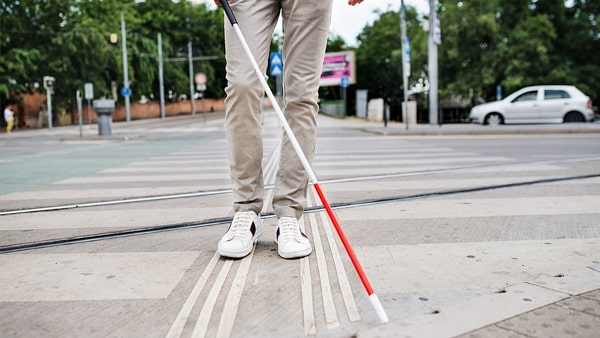
When driving near a blind pedestrian who is carrying a white cane or using a guide dog, you should:
  1. A Stop before coming within 10 feet and take necessary precautions
  2. B Continue if the pedestrian is outside a marked crosswalk
  3. C Sound the horn and pass without stopping
  4. D Stop only after the pedestrian enters your lane

Correct answer: A – Stop before coming within 10 feet and take necessary precautions

A vehicle operator must stop before coming closer than 10 feet to a pedestrian with a disability who is carrying or using a white cane or is accompanied by a visibly identifiable service animal. The driver must take all precautions necessary to avoid an accident or injury. Drivers must also yield to pedestrians with clearly visible disabilities.

Source: 625 ILCS 60/15(a) – Mobility device; service animal; white cane, 625 ILCS 5/11-1004 – Pedestrian with disabilities; right-of-way

Question 2

At a stop sign with no marked stop line, where must you stop if a crosswalk is present?

  1. A At the corner
  2. B Before entering the near-side crosswalk
  3. C Just beyond the crosswalk
  4. D At least 15 feet from the corner

Correct answer: B – Before entering the near-side crosswalk

At a stop sign, the first stopping location is a clearly marked stop line. If there is no stop line, stop before entering the crosswalk on the near side of the intersection. If neither marking exists, stop at the nearest point where approaching traffic can be seen before entering the intersection.

Source: 625 ILCS 5/11-1204(b) – Stop and yield signs, Illinois Rules of the Road 2026 — Ch. 4, “Right of Way”

Question 3

During the first 12 months of an Illinois graduated license, a driver under 18 may carry:

  1. A Any number of passengers under 20 if they wear seat belts
  2. B No passengers under 20
  3. C One passenger under 20, subject to specified family exceptions
  4. D Only one passenger of any age

Correct answer: C – One passenger under 20, subject to specified family exceptions

For the first 12 months after licensing, or until the driver turns 18, whichever occurs first, a graduated-license holder may have no more than one passenger under age 20. Additional siblings, stepsiblings, children, or stepchildren are excepted. The stated purpose of the graduated licensing program includes developing safe driving habits and reducing crashes, injuries, and fatalities among inexperienced drivers.

Source: 625 ILCS 5/6-107(a), (g) – Graduated license, Illinois Rules of the Road 2026 — Ch. 3, “Initial Licensing Phase — Drivers Ages 16-17”

Question 4

A sign that prohibits parking, but does not separately prohibit standing or stopping, allows you to:

  1. A Never stop at that location
  2. B Stop temporarily while actually loading or unloading
  3. C Park as long as the driver remains inside
  4. D Leave the vehicle unattended for less than five minutes

Correct answer: B – Stop temporarily while actually loading or unloading

The Vehicle Code defines parking as standing a vehicle, occupied or not, other than while it is temporarily and actually being used to load or unload merchandise or passengers. Remaining inside the vehicle does not by itself make parking lawful. A separate posted restriction may prohibit standing or stopping, so all signs at the location must be observed.

Source: 625 ILCS 5/1-156 – Park or Parking, Illinois Rules of the Road 2026 — Ch. 4, “Prohibited Stopping, Standing, or Parking”

Question 5

A normal right turn from a two-way street should finish in:

  1. A The left-hand lane
  2. B The lane farthest from the curb
  3. C The right-hand lane nearest the curb
  4. D Any open lane

Correct answer: C – The right-hand lane nearest the curb

Illinois law requires both the approach and the right turn to be made as close as practical to the right-hand curb or roadway edge. The official manual directs drivers to follow the curb and enter the right-hand lane of the new roadway. Traffic-control signs or pavement markings may require a different turning path and must be obeyed.

Source: 625 ILCS 5/11-801(a)(1), (3) – Required position and method of turning, Illinois Rules of the Road 2026 — Ch. 4, “Right Turns”

Question 6

Which statement follows defensive-driving guidance about other motorists?

  1. A A driver will always obey a traffic signal
  2. B An activated turn signal guarantees the driver will turn
  3. C Be prepared to react and do not assume you know what another driver will do
  4. D Drivers of larger vehicles are always safer

Correct answer: C – Be prepared to react and do not assume you know what another driver will do

Defensive driving requires you to remain prepared to react to another driver. The official manual specifically warns against assuming that you know what another driver will do. Continue observing traffic and respond to the movements you actually see rather than treating signals, vehicle size, or apparent right-of-way as guarantees of another driver’s behavior.

Source: Illinois Rules of the Road 2026 — Ch. 11, “Drive Defensively”