


Illinois Drivers License Test 7

4.8 out of 5 (430 votes)
80% Passing score
20 Questions
4 Mistakes allowed
Illinois gives new drivers a fairly clear path to a license, but clear does not always mean light. There are rules to know, restrictions to remember, documents to bring, hours to log, and then, sitting right in the middle of it all, the Illinois drivers license test. This Illinois driver license practice test is built for that part of the process: the point where the handbook needs to turn into actual working knowledge. This seventh Illinois DMV practice test in our series includes 20 multiple-choice questions covering the kinds of details Illinois expects drivers to understand before they get behind the wheel on their own. Some of it is everyday driving knowledge. Some of it is legal responsibility, like knowing you must carry proof of insurance. And some of it, frankly, is the sort of material that feels easy until two answer choices look almost the same and both sound vaguely official. To pass this license practice test, you will need at least 16 correct answers, which is a useful benchmark before you walk into the real Illinois drivers license test. The practice test is not just there to count right and wrong answers. Each question gives immediate feedback with an explanation, so you can see why an answer is correct instead of just memorizing the shape of it. That matters more than people want to admit. Illinois does not release the exact DMV test questions, so the best preparation is learning the rules well enough that unfamiliar wording does not throw you off. The structure, phrasing, and subject matter here are designed to stay close to the actual Illinois DMV test experience without pretending to be a leaked copy of anything. The licensing process itself is worth keeping in view while you study. Teens can apply for an instruction permit at 15 with parent or guardian consent, proper identification, a vision screening, enrollment in approved driver education, and a passing written exam. Before moving to an initial license at 16, they must hold the permit for at least 9 months, complete driver education, and log 50 supervised driving hours, including 10 at night. Illinois Graduated Driver Licensing rules also bring nighttime limits, passenger restrictions, and a cell phone ban for drivers under 19 except in emergencies. You can take this Illinois online drivers license test on a desktop, phone, or app, which makes it easier to study in the small gaps where studying actually happens. Not elegant, maybe, but effective.
FREE DMV Practice Test App
Study for your Illinois permit test or driver’s license with the NextDoorDriving app. 700+ DMV questions and answers, 100% free!
Download on the App Store

Sample Illinois Permit Test Questions

Question 1

Which visual habit should a safe driver avoid?

  1. A Shifting focus to different parts of the roadway
  2. B Fixing the eyes on a single point straight ahead
  3. C Reading roadway signs while traveling
  4. D Watching changing traffic conditions

Correct answer: B – Fixing the eyes on a single point straight ahead

Keeping your gaze fixed on one point limits awareness of the broader driving environment. The driver manual recommends reading road signs and shifting focus to different parts of the roadway, particularly as a way to remain visually engaged. Drivers must also stay prepared to react to changing traffic and roadway conditions.

Source: Illinois Rules of the Road — Ch. 11, “Drive Defensively” and “Drowsy Driving”
Question 2

On an Illinois interstate, you are in the left lane, not passing, and another vehicle is directly behind you. What should you do when no exception applies?

  1. A Use the left shoulder to let the vehicle pass
  2. B Turn on the hazard flashers and remain there
  3. C Continue in the left lane at the same speed
  4. D Move into the right lane when the movement can be made safely

Correct answer: D – Move into the right lane when the movement can be made safely

A vehicle generally may not remain in the left lane of an interstate or fully controlled-access freeway except while passing. Exceptions cover conditions such as congestion, inclement weather, hazards, certain exits, and situations in which no vehicle is directly behind. When none applies, move right when the lane change can be completed safely.

Source: 625 ILCS 5/11-701(d), (e) — Drive on right side of roadway - exceptions

Question 3

For a person covered by Illinois’ safety-belt law, when should a properly adjusted belt be worn?

  1. A Only when traveling faster than 40 mph
  2. B Only on rural highways
  3. C Only while sitting in the front seat
  4. D At all speeds whenever riding in a vehicle on a street or highway

Correct answer: D – At all speeds whenever riding in a vehicle on a street or highway

Each covered driver and passenger in a motor vehicle operated on a street or highway must wear a properly adjusted and fastened safety belt, subject to statutory exceptions. The requirement is not limited to high speeds, rural roads, or front seats. Air bags provide supplemental protection and do not replace safety belts.

Source: 625 ILCS 5/12-603.1(a), (b) — Driver and passenger required to use safety belts, exceptions and penalty, Illinois Rules of the Road — Ch. 4, “Safety Belt Law” and “Air Bag Safety”

Question 4

What primarily determines a safe driving speed below the maximum limit?

  1. A The number shown on the speed-limit sign alone
  2. B A speed exactly 5 mph below the posted limit
  3. C Current traffic, weather, and roadway conditions
  4. D The driver’s mechanical repair skills

Correct answer: C – Current traffic, weather, and roadway conditions

Illinois requires drivers to travel at a speed that is reasonable and proper for existing conditions. A driver must reduce speed when weather, highway conditions, pedestrians, traffic, curves, intersections, or other hazards make the posted maximum unsafe. Staying below the maximum limit does not remove the duty to slow when necessary.

Source: 625 ILCS 5/11-601(a) — General speed restrictions, Illinois Rules of the Road — Ch. 11, “Vehicle Speed”

Question 5

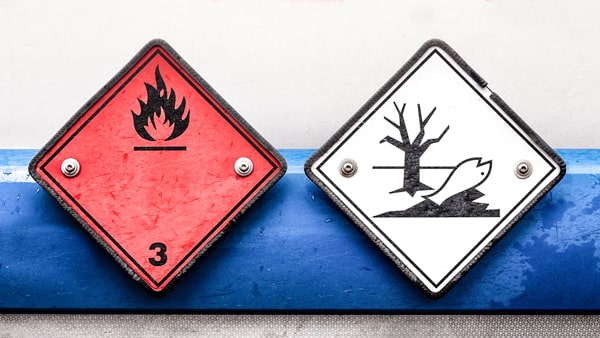
At a railroad grade crossing where no statutory exception applies, a vehicle required to display hazardous-material placards must:

Which of the following is true about vehicles displaying a diamond-shaped sign (indicating a hazardous load)?
  1. A Drive around the crossing on the shoulder
  2. B Cross without stopping if no train is immediately visible
  3. C Stop 15 to 50 feet from the nearest rail, look and listen, and proceed only when safe
  4. D Stop only when traveling after dark

Correct answer: C – Stop 15 to 50 feet from the nearest rail, look and listen, and proceed only when safe

Illinois requires a qualifying placarded vehicle carrying hazardous material to stop between 15 and 50 feet from the nearest rail. While stopped, the driver must look and listen for a train or railroad equipment and proceed only when the crossing can be made safely. The statute contains limited exceptions, including certain crossings controlled by an officer, flagperson, functioning green signal, or an official exemption sign.

Source: 625 ILCS 5/11-1202(a-1)(3), (b) — Certain vehicles must stop at all railroad grade crossings

Question 6

A first non-aggravated Illinois DUI conviction can result in which consequences?

  1. A Possible imprisonment
  2. B A possible criminal fine
  3. C Revocation of driving privileges
  4. D All of these choices

Correct answer: D – All of these choices

A first non-aggravated DUI conviction is a Class A misdemeanor. A Class A misdemeanor may carry a determinate jail term of less than one year and a fine generally ranging from $75 to $2,500, subject to statutory provisions governing fines. The Secretary of State must revoke driving privileges after receiving a report of a DUI conviction.

Source: 625 ILCS 5/11-501(c)(1) — Driving while under the influence of alcohol, other drug or drugs, intoxicating compound or compounds or any combination thereof, 730 ILCS 5/5-4.5-55(a), (e) — CLASS A MISDEMEANORS; SENTENCE, 625 ILCS 5/6-205(a)(2) — Mandatory revocation of license or permit; hardship cases