Illinois Drivers Ed Practice Test 8

4.8 out of 5 (408 votes)
80% Passing score
20 Questions
4 Mistakes allowed
Illinois right-of-way questions are where a lot of new drivers get humbled, usually because everyone thinks they know how a four-way stop works until there are actual cars involved. This Illinois driver's ed practice test leans into those messy little moments: intersections, turns, lane choices, traffic signals, stop signs, and the quiet chaos of figuring out who gets to go first without starting a neighborhood incident. You’ll get 20 multiple-choice questions pulled from a larger pool, which is helpful because the real Illinois permit test is not interested in rewarding pure memorization. It is based on the Secretary of State’s Rules of the Road and covers the usual suspects: traffic laws, road signs, pavement markings, safe driving habits, right-of-way rules, DUI and distracted-driving laws, and how to share the road with pedestrians, bicyclists, motorcycles, emergency vehicles, and big trucks that need more room than your brain wants to give them at first. Officially, the Class D written test has at least 35 questions, and you need 80% to pass. In normal-person math, that means 28 right on a 35-question test. This Illinois permit practice test is not timed, which is good, because rushing through right-of-way questions is how people confidently pick the second-best answer. Take the extra second. Read the sign. Notice the lane marking. Think about the pedestrian who is absolutely going to matter in the question even if they feel like background decoration. Road sign questions are part of the regular written test too, not some separate little side quest, so sign shapes, colors, school zones, railroad crossings, work zones, traffic signals, and pavement markings all deserve attention. And then, because Illinois likes a process, there is the licensing side. Teen applicants generally need to be at least 15, have parent or guardian consent, meet driver education requirements, pass vision screening, and pass the written exam. Adults 18 and older can apply for an instruction permit, while some may need a 6-hour Adult Driver Education Course before getting licensed. Bring the right documents, expect the required fees, and plan on handling testing through a Secretary of State Driver Services facility. The test is only one piece of the whole thing, sure, but it is the piece that tells you whether the rules are actually sticking.

FREE DMV Practice Test App
Study for your Illinois permit test or driver’s license with the NextDoorDriving app. 700+ DMV questions and answers, 100% free!
Download on the App Store

Sample Illinois Permit Test Questions

Question 1

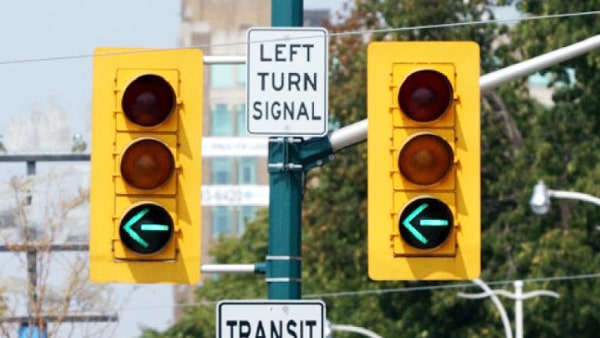
A steady green arrow pointing left authorizes you to:

On the intersection, if you see a green arrow pointing to the left, you can:
  1. A Travel in any direction through the intersection
  2. B Turn left after yielding to anyone lawfully within the intersection or crosswalk
  3. C Either turn left or continue straight
  4. D Remain stopped until a circular green light appears

Correct answer: B – Turn left after yielding to anyone lawfully within the intersection or crosswalk

Traffic facing a green arrow may cautiously enter the intersection to make the movement shown by the arrow. A left-pointing arrow therefore permits a left turn, not straight or unrestricted travel. The turning driver must yield to vehicles, bicyclists, and pedestrians lawfully within the intersection or an adjacent crosswalk.

Source: 625 ILCS 5/11-306(a)(2) — Traffic-control signal legend, Illinois Rules of the Road — Ch. 10, “Arrows”

Question 2

What should you do when another driver is following your vehicle too closely?

  1. A Brake abruptly to force the driver to slow down
  2. B Exceed the speed limit to increase the gap
  3. C Change lanes or slowly pull off when safe and allow the driver to pass
  4. D Prevent the driver from passing

Correct answer: C – Change lanes or slowly pull off when safe and allow the driver to pass

The driver manual advises moving to another lane or slowly pulling off the roadway to allow a tailgating vehicle to pass. Do this only when the movement can be completed safely. Do not retaliate or slam on the brakes in front of the other driver, because that conduct increases the risk of a crash.

Source: Illinois Rules of the Road — Ch. 11, “Following Distances” and “Aggressive Driving”

Question 3

Before moving into another lane to pass a vehicle, which action is required?

Before passing another vehicle you should:
  1. A Flash your high-beam headlights
  2. B Activate the four-way hazard flashers
  3. C Make sure the movement is safe and signal the lane change
  4. D Sound the horn in every situation

Correct answer: C – Make sure the movement is safe and signal the lane change

Illinois law prohibits moving right or left on a roadway unless the movement can be made with reasonable safety, and an appropriate signal is required. A lane-change signal must be given continuously for at least the last 100 feet in a business or residence district and at least 200 feet outside such a district. Hazard flashers do not replace the required turn signal.

Source: 625 ILCS 5/11-804(a), (b) — When signal required

Question 4

When a truck or other vehicle is overtaking you on the left, what must you do with your speed?

When a truck driver behind you wants to pass your vehicle, your speed should:
  1. A Do not increase it until the passing vehicle is completely ahead
  2. B Accelerate to shorten the passing maneuver
  3. C Vary your speed repeatedly
  4. D Increase it until both vehicles are side by side

Correct answer: A – Do not increase it until the passing vehicle is completely ahead

Under Illinois law, the driver of an overtaken vehicle must not increase speed until the overtaking vehicle has completely passed. When the passing driver gives an audible signal and passing on the right is not involved, the overtaken driver also must give way to the right. These duties apply when the passing vehicle is a truck or another type of vehicle.

Source: 625 ILCS 5/11-703(b) — Overtaking a vehicle on the left

Question 5

According to the Illinois driver manual, what causes most rear-end crashes?

  1. A Checking the rearview mirror too frequently
  2. B Following the vehicle ahead too closely
  3. C Driving in the right-hand lane
  4. D Using a turn signal before changing lanes

Correct answer: B – Following the vehicle ahead too closely

Following too closely, also called tailgating, is identified as the cause of most rear-end crashes. The three-second rule helps a driver establish a safe following distance on a good road in good weather. A longer interval is needed when roadway or weather conditions are unfavorable.

Source: Illinois Rules of the Road — Ch. 11, “Following Distances”

Question 6

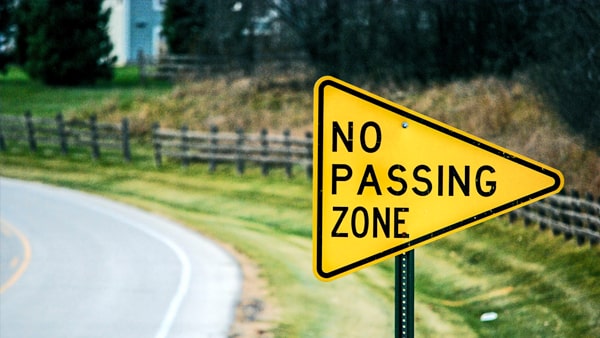
A yellow, pennant-shaped sign posted on the left side of a two-lane road marks:

The sign with this shape and color is a _____________ sign.
  1. A The beginning of a no-passing zone
  2. B A wrong-way entrance
  3. C A railroad crossing
  4. D A required stop

Correct answer: A – The beginning of a no-passing zone

The yellow-and-black, three-sided sign identifies a no-passing zone. It appears on the left side of a two-lane, two-way roadway at the beginning of the restricted area. No-passing pavement markings are also used in that area.

Source: Illinois Rules of the Road — Ch. 9, “Shapes of Signs” and “No Passing”