Illinois DMV Permit Practice Test 9

4.8 out of 5 (367 votes)
80% Passing score
20 Questions
4 Mistakes allowed
School bus questions deserve more study time than most new drivers expect. Not because the rule is impossible, exactly, but because Illinois test writers can fold a simple idea into a few different roadway setups, and suddenly the answer depends on details you may have skimmed past. This Illinois DMV practice permit test keeps the focus right there: when to stop for a school bus, when traffic in the opposite direction is affected, what flashing lights actually mean, and how to handle those slightly fussy loading and unloading situations where children may be nearby. The real Illinois Class D permit knowledge test is based on the Illinois Secretary of State’s Rules of the Road, so school bus safety is only one part of a larger exam. You are also expected to know Illinois traffic laws, road signs, pavement markings, signals, right-of-way rules, lane use, turns, passing, parking, speed laws, safe driving practices, and the rules around alcohol, drugs, distracted driving, pedestrians, bicyclists, motorcycles, large vehicles, and emergency vehicles. So, yes, there is a lot in the bucket. Illinois requires the Class D written test to have at least 35 questions, and you need 80% to pass. On a 35-question test, that works out to 28 correct answers, with no more than 7 missed. This 20-question Illinois permit practice test is not trying to be the whole written exam in miniature. It is more targeted than that, which is the point. It gives you a clean run at one high-stakes topic, with questions written and reviewed by experienced driving instructors who know how these rules tend to show up on permit exams. The wording may feel straightforward in places, then oddly specific in others, because that is often where the test hides the real work. After each answer, you will get immediate feedback with an explanation, not just a bland right-or-wrong notice. That matters. A missed question is only useful if you understand what tripped you up, whether it was the direction of travel, the type of road, or the bus’s signals. At the end, you will see a summary of your results, including the answers you missed and the explanations worth reviewing again. A passing score on this DMV practice test permit is 16 out of 20. And since Illinois allows 3 attempts to pass the written and/or road tests within 1 year of your first attempt, this is a sensible place to tighten things up before the real test.

FREE DMV Practice Test App
Study for your Illinois permit test or driver’s license with the NextDoorDriving app. 700+ DMV questions and answers, 100% free!
Download on the App Store

Sample Illinois Permit Test Questions

Question 1

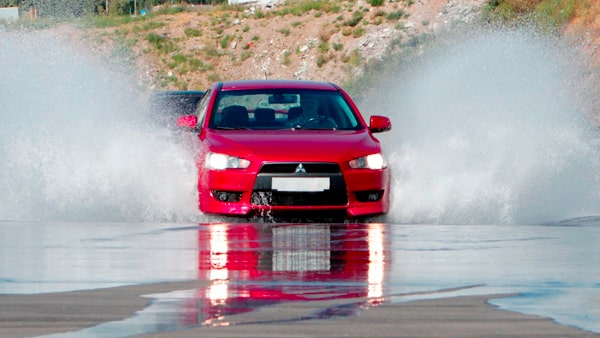
Your vehicle begins to skid while hydroplaning on a wet roadway. What should you do first?

If the roadway is wet and your car starts to skid, you should:
  1. A Ease your foot off the accelerator
  2. B Shift immediately into a lower gear
  3. C Pump the brakes rapidly and firmly
  4. D Shift into neutral and turn sharply

Correct answer: A – Ease your foot off the accelerator

If you cannot immediately regain control during hydroplaning, release the accelerator and ride out the skid. General skid guidance also calls for easing off the accelerator or brakes and steering in the direction of the skid until traction returns. Sudden braking or steering can make loss of control more severe.

Source: Illinois Rules of the Road 2026 — Ch. 11, “Rain”, Illinois Rules of the Road 2026 — Ch. 11, “Skidding”

Question 2

Why must safety belts still be worn in a vehicle equipped with air bags?

  1. A Safety belts prevent the vehicle from being involved in a crash
  2. B Air bags provide supplemental protection and do not replace safety belts
  3. C Safety belts are needed only when the air bags are turned off
  4. D Air bags protect only passengers in the back seat

Correct answer: B – Air bags provide supplemental protection and do not replace safety belts

Illinois law generally requires drivers and passengers age 8 or older to wear properly adjusted and fastened safety belts, even in vehicles with air bags. Air bags are designed to provide supplemental protection in combination with safety belts. Wear the lap belt across the hips and keep the shoulder strap snug rather than placing it behind the back or under an arm.

Source: 625 ILCS 5/12-603.1(a) – Driver and passenger required to use safety belts, exceptions and penalty, Illinois Rules of the Road 2026 — Ch. 4, “Safety Belt Law” and “Air Bag Safety”

Question 3

The signal is green, but traffic ahead leaves no room for your vehicle beyond the intersection. What should you do?

  1. A Enter and stop inside the crosswalk
  2. B Remain outside until there is enough space to clear the intersection
  3. C Enter if cross traffic can drive around you
  4. D Use the shoulder to get through the intersection

Correct answer: B – Remain outside until there is enough space to clear the intersection

Illinois law prohibits entering an intersection or marked crosswalk unless enough space exists on the other side for your vehicle without obstructing vehicles or pedestrians. This rule applies even when a traffic signal indicates that you may proceed. Wait behind the intersection until traffic ahead moves and you can clear it completely.

Source: 625 ILCS 5/11-1425(a) – Stop when traffic obstructed

Question 4

In Illinois, if your driving privilege is revoked and you have no valid restricted driving permit, you may:

  1. A Drive only during an emergency
  2. B Drive directly to work or school
  3. C Not drive
  4. D Drive when accompanied by a licensed adult

Correct answer: C – Not drive

A person whose driving privilege is revoked may not drive or be in actual physical control of a motor vehicle on a highway unless specifically authorized by a qualifying permit or license. A standard violation is a Class A misdemeanor. That classification permits a sentence of less than one year of imprisonment and a fine generally ranging from $75 to $2,500, with enhanced consequences possible in some cases.

Source: 625 ILCS 5/6-303(a) – Driving while driver's license, permit, or privilege to operate a motor vehicle is suspended or revoked, 730 ILCS 5/5-4.5-55(a), (e) – CLASS A MISDEMEANORS; SENTENCE

Question 5

At an intersection without operating traffic signals, a pedestrian is crossing within an unmarked crosswalk on your half of the roadway. What must you do?

  1. A Continue because the crosswalk has no painted lines
  2. B Stop and yield the right-of-way
  3. C Sound the horn and pass behind the pedestrian
  4. D Proceed if another vehicle has already stopped

Correct answer: B – Stop and yield the right-of-way

Illinois law requires a driver to stop and yield when a pedestrian in a crosswalk is on the driver’s half of the roadway or approaching closely enough from the other half to be in danger. The handbook also addresses a pedestrian in an unmarked crosswalk on the driver’s side when traffic signals are absent. Never pass another vehicle stopped for that pedestrian.

Source: 625 ILCS 5/11-1002(a), (d) – Pedestrians' right-of-way at crosswalks, Illinois Rules of the Road 2026 — Ch. 4, “Pedestrian Right of Way”

Question 6

The posted limit is 55 mph, but rain has made the roadway wet and slippery. Which speed should you choose?

  1. A Exactly 35 mph, regardless of traffic and visibility
  2. B A speed below 55 mph that is reasonable and proper for the conditions
  3. C 55 mph because the posted limit remains in effect

Correct answer: B – A speed below 55 mph that is reasonable and proper for the conditions

Illinois law requires drivers to reduce speed when weather or highway conditions create a special hazard, even if they are below the posted maximum. The required reduction is based on actual conditions rather than a fixed number of miles per hour. On wet pavement, slow sufficiently to maintain control and reduce the risk of hydroplaning.

Source: 625 ILCS 5/11-601(a) – General speed restrictions, Illinois Rules of the Road 2026 — Ch. 11, “Rain”