Illinois DMV Test Evaluation

4.7 out of 5 (2867 votes)
80% Passing score
10 Questions
2 Mistakes allowed
The Illinois permit test rewards people who study the actual rules and do not rely on guesswork. The official Class D written exam pulls from Illinois traffic laws, road signs, pavement markings, safe driving habits, right-of-way rules, DUI and distracted-driving laws, and the everyday judgment calls that come up around pedestrians, bicyclists, motorcycles, emergency vehicles, and big trucks. So, yes, knowing what a red octagon means is important, but it is not the whole story. This Illinois rules of the road practice test gives you a compact first check before you move deeper into the full permit test material. It includes 10 multiple-choice questions, and you will need at least 8 correct to pass this practice round. That matches Illinois’ 80% passing standard. On the real Illinois DMV permit test, the written exam has at least 35 questions, which means 28 correct answers and no more than 7 missed. Seven sounds generous for about two seconds, then the lane-use questions, sign shapes, right-of-way situations, and parking rules start crowding into the same corner of your brain. The practice test focuses on the material Illinois expects new drivers to know before they move forward in the licensing process: signs, signals, pavement markings, turns, lane use, parking, speed laws, and the rules for who goes first when traffic gets a little too polite or a little too aggressive. Road sign questions are not handled as a separate road-sign-only test for a standard Class D permit; they are built into the written exam, which means they count right alongside everything else. That matters for teens starting the instruction permit process at 15, usually with parent or guardian consent and approved driver education, and it matters for adults taking the first step toward licensing as well. Applicants still have to meet the usual requirements, including proper identification, vision screening, fees, and any required education. For drivers under 18, Illinois also requires a permit holding period of at least 9 months and 50 hours of supervised driving, including 10 at night. First-time applicants ages 18-20 may need a 6-hour Adult Driver Education Course before getting licensed. Immediate feedback is part of the value here, because a missed answer should teach you something while the mistake is still fresh, not three days later when you vaguely remember being annoyed by it.

FREE DMV Practice Test App
Study for your Illinois permit test or driver’s license with the NextDoorDriving app. 700+ DMV questions and answers, 100% free!
Download on the App Store

Sample Illinois Permit Test Questions

Question 1

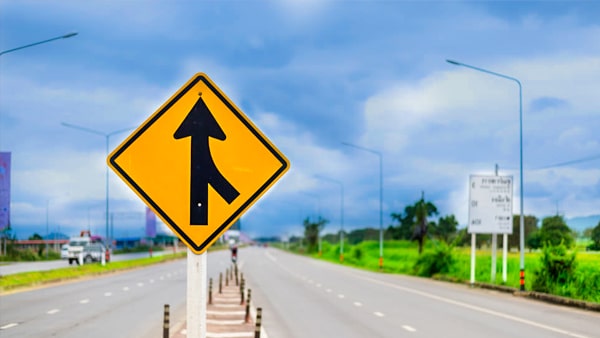
A yellow MERGING LANES warning sign indicates that:

This sign means:
  1. A Oncoming traffic will enter your side of the road
  2. B The roadway becomes a two-way road ahead
  3. C Two lanes traveling in the same direction will soon become one
  4. D A divided highway begins ahead

Correct answer: C – Two lanes traveling in the same direction will soon become one

The MERGING LANES sign warns that two lanes moving in the same direction will soon combine into one. Be ready to change lanes or allow other traffic to merge. Drivers may need to adjust their speed and position to avoid a collision during the merge.

Source: Illinois Rules of the Road 2026 — Ch. 9, “Merging Lanes”

Question 2

Heavy rain has flooded the roadway ahead. What should you do?

  1. A Enter slowly while keeping steady pressure on the accelerator
  2. B Follow another vehicle through to judge the water’s depth
  3. C Turn around and find another route
  4. D Stop in the water before deciding whether to continue

Correct answer: C – Turn around and find another route

Do not drive through a flooded roadway or viaduct. The depth and current of the water may be impossible to determine, and entering it can leave the vehicle disabled or carried by moving water. Turn around and use another route rather than testing the flooded area.

Source: Illinois Rules of the Road 2026 — Ch. 11, “Rain”

Question 3

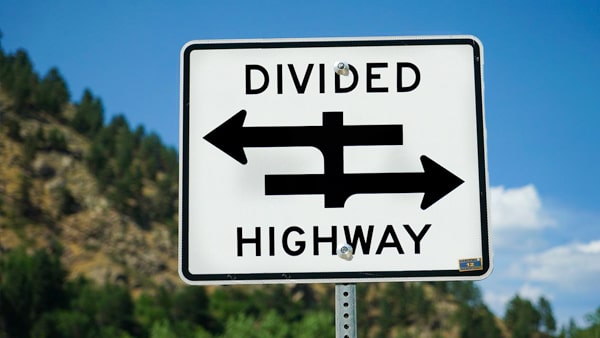
What does an APPROACHING A DIVIDED HIGHWAY sign tell you?

This sign means:
  1. A You must turn left or right at the next intersection
  2. B The road ends at a T-intersection
  3. C The road you will cross or enter has opposing traffic separated by a median
  4. D Your road passes over a divided highway

Correct answer: C – The road you will cross or enter has opposing traffic separated by a median

This sign is placed on an approach to a divided highway. It tells you that a median separates the two directions of traffic on the road you are about to cross or turn onto. Watch for the separate roadways and enter the proper side of the divided highway.

Source: Illinois Rules of the Road 2026 — Ch. 9, “Approaching a Divided Highway”

Question 4

You are already in an intersection waiting to turn left when the signal changes to red. What should you do?

  1. A Back out of the intersection after checking behind you
  2. B Remain there until the signal becomes green again
  3. C Yield to oncoming traffic, then complete the turn when a safe interval occurs
  4. D Turn immediately before oncoming traffic reaches you

Correct answer: C – Yield to oncoming traffic, then complete the turn when a safe interval occurs

Illinois requires a left-turning driver to yield to oncoming vehicles that are close enough to be an immediate hazard. After yielding, the driver may proceed when a safe interval occurs. If you are already within the intersection when the signal turns red, do not back up or remain there through another signal cycle; finish the turn after oncoming traffic clears.

Source: 625 ILCS 5/11-902 – Vehicle turning left, Illinois Rules of the Road 2026 — Ch. 4, “Turning”

Question 5

How does drinking coffee affect the elimination of alcohol from your body?

  1. A It lowers your blood-alcohol concentration immediately
  2. B It neutralizes alcohol’s effects
  3. C It does not speed up the elimination of alcohol
  4. D It causes alcohol to enter the bloodstream faster

Correct answer: C – It does not speed up the elimination of alcohol

Coffee does not speed the elimination of alcohol from the body. Food and showers also do not remove alcohol more quickly. Time is the only way to eliminate alcohol’s effects, so feeling more alert after drinking coffee does not establish that a person is able to drive safely.

Source: Illinois Rules of the Road 2026 — Ch. 6, “Blood-Alcohol Concentration (BAC)/Presence of Drugs”

Question 6

A train is plainly visible and close enough to create a hazard at a railroad crossing. What must you do?

  1. A Slow down and cross before the train arrives
  2. B Stop 15 to 50 feet from the nearest rail and wait until the tracks are clear
  3. C Cross if the warning lights have not started flashing
  4. D Drive around the gate if no train is on the first track

Correct answer: B – Stop 15 to 50 feet from the nearest rail and wait until the tracks are clear

Illinois law requires a driver to stop between 15 and 50 feet from the nearest rail when a train is plainly visible in hazardous proximity or otherwise creates an immediate hazard. Do not proceed until the tracks are clear and crossing is safe. After one train passes, check all tracks for another train before moving.

Source: 625 ILCS 5/11-1201(a) – Obedience to signal indicating approach of train or railroad track equipment, Illinois Rules of the Road 2026 — Ch. 4, “Railroad Crossing”