


Illinois DMV Sign Test 3

4.8 out of 5 (366 votes)
80% Passing score
20 Questions
4 Mistakes allowed
The official Illinois learner's permit test is not only asking whether you can spot a Stop sign from across the room. It is checking whether you understand signs, signals, pavement markings, lane rules, and the traffic-law basics that keep you from making confident, deeply wrong choices in public. This Illinois road signs practice test gives you 20 questions focused on the sign material you are expected to know: shapes, colors, regulatory signs, warning signs, school signs, railroad crossings, work-zone signs, traffic signals, and pavement markings. Yes, the octagon still means stop. Yes, the yield sign still wants you to calm down and look around. But the real value here is getting used to the way sign questions are framed, because the written test can be a little plain-faced about it. It will not wink when it tries to catch you mixing up warning signs and regulatory signs. For the Illinois Class D written knowledge test, expect at least 35 questions and an 80% passing score. On a 35-question test, that works out to 28 correct answers, which leaves room for 7 misses. Not a disaster, but also not enough room to wander in cold and hope vibes carry the day. Illinois gives you 3 attempts within 1 year from your first attempt, although ideally this Illinois DMV practice test helps you avoid becoming too familiar with that policy. The licensing process has its own pile of details, and they are worth knowing before you are already standing there with paperwork in hand. Teen drivers can apply for an instruction permit at 15, then hold it for 9 months while completing 50 hours of supervised driving, including 10 at night. The supervising driver must be a parent or an adult age 21 or older with a valid license, and teen driver education includes at least 6 hours behind the wheel with a certified instructor. Adults have rules too: an adult instruction permit is valid for 1 year, and first-time applicants under 20 may need a 6-hour adult driver education course if they have not been licensed before or completed other approved driver education. Wherever you are in your licensing journey, use this updated 2026 Illinois permit practice test as a slower, safer place to miss things now, read the explanation, and fix the mistake before the real test gets involved.
FREE DMV Practice Test App
Study for your Illinois permit test or driver’s license with the NextDoorDriving app. 700+ DMV questions and answers, 100% free!
Download on the App Store

Sample Illinois Permit Test Questions

Question 1

What does a steady green traffic light permit you to do?

  1. A Slow and prepare to stop before entering
  2. B Stop before every movement through the intersection
  3. C Proceed when the intersection is clear after yielding as required
  4. D Proceed straight but never turn right

Correct answer: C – Proceed when the intersection is clear after yielding as required

In Illinois, a steady green light permits traffic to proceed straight or turn unless a sign prohibits the movement. Drivers must yield to pedestrians and vehicles lawfully within the intersection or crosswalk. Enter only after confirming that the intended path is clear.

Source: 625 ILCS 5/11-306(a)(1) – Traffic-control signal legend, Rules of the Road 2026 — Ch. 10, “Steady Lights”

Question 2

At an intersection of two-way streets, what may a driver generally do after stopping at a steady red light?

  1. A Proceed straight if no traffic is visible
  2. B Turn left if the roadway is clear
  3. C Turn right after yielding, unless the turn is prohibited
  4. D Make any of these movements

Correct answer: C – Turn right after yielding, unless the turn is prohibited

Illinois generally permits a right turn on red after a complete stop unless a sign, ordinance, or rule prohibits it. The driver must yield to vehicles presenting an immediate hazard and to pedestrians or bicyclists in or near the intersection. A left turn on red is allowed only from a one-way street onto another one-way street carrying traffic to the left.

Source: 625 ILCS 5/11-306(c)(1), (c)(3) – Traffic-control signal legend, Rules of the Road 2026 — Ch. 10, “Steady Lights”

Question 3

An orange diamond sign showing a worker with a shovel warns that:

This sign means that:
  1. A A roadside cleanup group is ahead
  2. B Workers may be close to the traffic lane ahead
  3. C Children may be playing near the roadway
  4. D A pedestrian crosswalk is ahead

Correct answer: B – Workers may be close to the traffic lane ahead

This is a WORKERS AHEAD warning sign. It indicates that workers may be operating close to your traffic lane. Adjust to the posted work-zone speed, remain alert, follow all signs, and maintain a safe distance from workers, barriers, and other traffic.

Source: Illinois Rules of the Road 2026 — Ch. 9, “Construction and Maintenance Signs—Workers Ahead”

Question 4

Your signal turns green, but traffic ahead leaves no room beyond the intersection. What must be true before you enter?

  1. A There must be enough space to clear the intersection without blocking traffic or pedestrians
  2. B You must be able to stop within the intersection
  3. C You must be able to drive around the traffic using another lane
  4. D Other drivers must acknowledge your horn

Correct answer: A – There must be enough space to clear the intersection without blocking traffic or pedestrians

Illinois law prohibits entering an intersection unless there is enough space on the far side for your vehicle without obstructing other vehicles or pedestrians. This rule applies even when a traffic signal indicates that you may proceed. Wait behind the intersection until sufficient space is available.

Source: 625 ILCS 5/11-1425(a) — Stop when traffic obstructed

Question 5

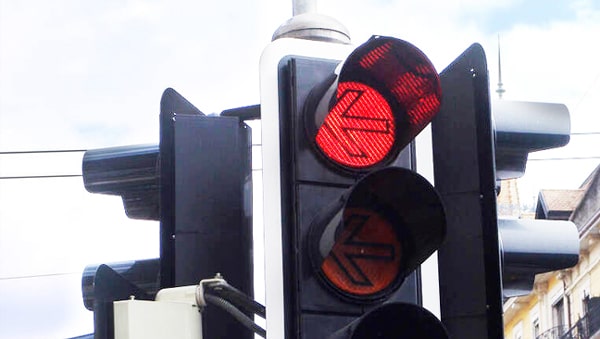
At an Illinois signal, how does a steady red arrow differ from a steady circular red light?

What is the difference between traffic lights with red arrows and those with solid red lights?
  1. A The arrow specifically controls the movement it points toward, while a circular red controls traffic facing the signal generally
  2. B A red arrow is used only for left turns
  3. C A red arrow permits a turn without first stopping
  4. D There is no difference because both apply to every possible movement

Correct answer: A – The arrow specifically controls the movement it points toward, while a circular red controls traffic facing the signal generally

A steady red arrow applies specifically to the movement indicated by the arrow, while a circular red signal applies generally to traffic facing it. State law permits a right turn on any steady red, and a left turn from one one-way street to another one-way street, after stopping and yielding unless the turn is prohibited. Drivers must also obey any other signal displayed for a different movement.

Source: 625 ILCS 5/11-306(c)(1)–(3) — Traffic-control signal legend

Question 6

A yellow diamond sign showing a truck descending a slope warns of:

This sign means:
  1. A A weight limit for trucks
  2. B A steep or dangerous downgrade ahead
  3. C A truck service area ahead
  4. D A roadway closed to trucks

Correct answer: B – A steep or dangerous downgrade ahead

The DOWNGRADE sign warns that a dangerous hill is ahead. The downgrade may be long, steep, or include sharp curves. Reduce your speed before beginning the descent so that you enter the hill at a controlled speed.

Source: Illinois Rules of the Road 2026 — Ch. 9, “Warning Signs—Downgrade”