


Indiana Permit Practice Test 2

4.7 out of 5 (524 votes)
80% Passing score
20 Questions
4 Mistakes allowed
This second Indiana BMV practice test is a solid way to check whether you actually know the material the state expects you to know, beyond the few rules everyone remembers from riding in the passenger seat. It gives you 20 questions covering Indiana traffic laws, safe driving habits, road signs, seat belt rules, visibility requirements, and ordinary driving situations that are easy to skim past in the manual. And some of those smaller details count. In Indiana, for example, headlights are required when it rains, which sounds simple enough, until you realize those are exactly the little rules that tend to show up when you were busy studying only signs. The real Indiana learner’s permit knowledge exam is based on the Indiana Driver’s Manual and is scored in two separate areas: traffic maneuvers and rules, and traffic signs. You need 80% or better on each part, not just a decent overall score. The test is commonly described as 50 questions total, with 34 questions on traffic laws and 16 on road signs. So, in practical terms, you should be ready for both sides of the exam, because being strong on road signs will not bail you out if the rules section goes sideways. This Indiana practice permit test is built to help with that kind of preparation. It is useful for teen drivers working toward a learner’s permit, adults getting licensed for the first time, or Indiana drivers who want a refresher before dealing with the BMV again. Standard knowledge exams are taken at BMV branches and usually do not require an appointment, although you do need to arrive at least 30 minutes before closing. If you need the exam read aloud, or if you are deaf or hard of hearing and need testing arrangements, that requires an appointment. There is also the licensing paperwork part, which is not thrilling, but it matters. Indiana applicants must pass a vision screening, and if you drive with glasses or contacts, wear them because a corrective-lenses restriction may be added. You will also need documents proving identity, Social Security number, lawful status, and Indiana residency, including two separate residency documents. Applicants under 18 need an adult to sign the financial liability agreement, and that adult has to show proper identification. Use this Indiana driver permit practice test with the official Driver’s Manual, road sign review, and any driver education materials you have. The point is to get familiar with how Indiana asks the questions, what the BMV cares about, and how those rules work once you are no longer just answering from a screen.
FREE DMV Practice Test App
Study for your Indiana permit test or driver’s license with the NextDoorDriving app. 700+ DMV questions and answers, 100% free!
Download on the App Store

Sample Indiana Permit Test Questions

Question 1

Traffic is backed up beyond a railroad crossing. When may you begin crossing the tracks?
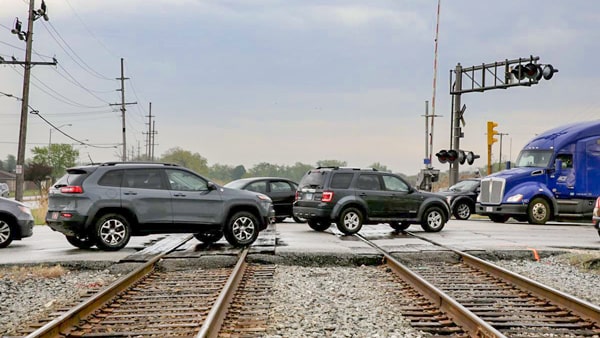
Before you reach the intersection, when crossing railroad tracks in slow traffic, you should:
  1. A. After sounding your horn
  2. B. When the vehicle ahead begins moving
  3. C. When there is room to stop between the gates
  4. D. Only when you can clear all tracks without stopping

Correct answer: D. – Only when you can clear all tracks without stopping

Never begin crossing railroad tracks unless there is enough space beyond them to clear the crossing completely. Indiana guidance tells drivers to avoid stopping or shifting gears while on the tracks. If traffic ahead prevents you from clearing the crossing, remain before the tracks until adequate space opens.

Source: Indiana Driver’s Manual — Ch. 7, “Railroad Crossing Safety”

Question 2

If your tires begin losing traction because of hydroplaning, what should you do first?

  1. A. Maintain speed until the tires grip again
  2. B. Brake hard and turn toward the shoulder
  3. C. Ease off the accelerator and avoid sudden steering or braking
  4. D. Accelerate to push through the water

Correct answer: C. – Ease off the accelerator and avoid sudden steering or braking

Hydroplaning can leave the tires riding on water with little or no friction for braking, accelerating, or turning. Ease off the accelerator when the vehicle loses traction, and keep steering movements controlled. Sudden turns or hard braking can cause or worsen a skid; once traction returns, straighten the vehicle and continue slowly.

Source: Indiana Driver’s Manual — Ch. 7, “Rain”, Indiana Driver’s Manual — Ch. 7, “Skidding”

Question 3

Which driving behavior increases the likelihood of a crash even when roadway conditions appear ideal?

  1. A. Driving on a city street
  2. B. Using a multilane freeway
  3. C. Crossing a bridge or overpass
  4. D. Driving at an excessive speed

Correct answer: D. – Driving at an excessive speed

Excessive speed increases the likelihood of a crash even under ideal conditions. It reduces the driver’s ability to steer around hazards and increases the distance needed to stop. Indiana guidance emphasizes reducing speed further for poor visibility, slick pavement, worn tires, or other hazardous conditions.

Source: Indiana Driver’s Manual — Ch. 7, “Reduce Speed in Dangerous Conditions”, Indiana Driver’s Manual — Ch. 7, “Speed Limits”

Question 4

What should you do when floodwater covers the roadway ahead?

  1. A. Follow another vehicle through the water
  2. B. Drive around any barricade and continue slowly
  3. C. Do not enter the water; use another route
  4. D. Accelerate to reduce the time spent in the water

Correct answer: C. – Do not enter the water; use another route

Do not drive where floodwater covers the road. Indiana guidance warns that the depth may not be obvious and that water can conceal washed-out or undermined pavement. Never drive around a barricade or past a road-closed sign; choose a safe alternative route instead.

Source: Indiana Driver’s Manual — Ch. 7, “Flash Flooding”

Question 5

Before turning left across approaching traffic, what must you do?

  1. A. Turn first if no pedestrians are present
  2. B. Yield to oncoming vehicles that present an immediate hazard
  3. C. Enter the turn because left-turning traffic has priority
  4. D. Continue straight and make the turn elsewhere

Correct answer: B. – Yield to oncoming vehicles that present an immediate hazard

A driver turning left must yield to an oncoming vehicle that is within or close enough to the intersection to create an immediate hazard. The Indiana Driver’s Manual also directs turning drivers to yield to approaching vehicles and pedestrians. Begin the turn only when the path can be used safely.

Source: IC 9-21-8-30 – Intersections; Vehicles Approaching From Opposite Directions; Yield of Right-of-Way, Indiana Driver’s Manual — Ch. 7, “Rules for Safe and Legal Turning”

Question 6

Which statement about motorcycles is accurate?

Which of these statements is true about motorcycles?
  1. A. Their smaller profile can make their speed and distance harder to judge
  2. B. They may travel only on the roadway shoulder
  3. C. A car may share their lane whenever the lane appears wide enough
  4. D. They must always yield to passenger vehicles

Correct answer: A. – Their smaller profile can make their speed and distance harder to judge

A motorcycle’s small profile can make it difficult to judge the motorcycle’s speed and distance. It may also disappear into a vehicle’s blind spot or be missed during a quick check. Motorcyclists are entitled to the full width of a traffic lane, just like operators of other motor vehicles.

Source: Indiana Driver’s Manual — Ch. 7, “Motorcycles and Motor Driven Cycles”