Indiana BMV Permit Practice Test 3

4.7 out of 5 (379 votes)
80% Passing score
20 Questions
4 Mistakes allowed
Indiana’s permit test rewards people who know the manual, not people who vaguely remember a few road signs from the back seat. That sounds obvious, maybe too obvious, but it is the part many new drivers gloss over. This Indiana DMV practice test gives you a cleaner way to work through the material before the official BMV knowledge exam, with 20 questions built around the same kinds of rules, signs, maneuvers, and safe-driving decisions Indiana expects you to understand. The real Indiana learner’s permit test is based on the Indiana Driver’s Manual and is split into two scored areas: traffic laws and maneuvers on one side, road signs on the other. Indiana requires 80% or higher on each part, which is the detail worth underlining here. The commonly reported format is 50 questions total, with 34 on traffic laws and 16 on signs, so you should be thinking in terms of at least 28 correct law questions and 13 correct sign questions. Close enough overall is not really close enough if one section slips. This free DMV practice test is meant to feel useful while you are taking it, not just after you see a score. The questions cover right-of-way, intersections, signs, following distance, distracted driving, and the small but important judgment calls that show up in Indiana driving. Afterward, you can review the answers with explanations, which is where a lot of the actual learning happens. A wrong answer becomes less of a shrug and more of a correction you can remember the next time around. The permit itself is only the first step, though, and Indiana’s licensing rules are a little layered. A learner’s permit is available at age 15 if you are enrolled in approved driver training, or at age 16 without driver education. Approved driver training means 30 hours of classroom or online instruction plus 6 hours of behind-the-wheel training through a BMV-licensed school. For teens, that training also affects timing: a probationary license can come at 16 years and 90 days with approved driver education, or 16 years and 270 days without it. Most young drivers must hold the learner’s permit for 180 days before moving on, and applicants under 18 need 50 hours of supervised driving practice, including 10 at night. Adults 18 and older have fewer hoops here—no required holding period, no supervised driving log, and no driver education requirement—but the vision, knowledge, and skills testing still matter. Use the Indiana BMV practice test as your first serious pass through the rules, because guessing your way through the official exam is a poor little strategy, and Indiana will make you wait until the next business day if you fail.
FREE DMV Practice Test App
Study for your Indiana permit test or driver’s license with the NextDoorDriving app. 700+ DMV questions and answers, 100% free!
Download on the App Store

Sample Indiana Permit Test Questions

Question 1

When following a tractor-trailer, which sign indicates that the truck driver probably cannot see your vehicle?

  1. A. You can see the truck's rear tires
  2. B. You cannot see the truck's rearview mirrors
  3. C. You are approximately ten feet behind the trailer
  4. D. Your headlights are turned on

Correct answer: B. – You cannot see the truck's rearview mirrors

Tractor-trailers have substantial blind spots along their sides and behind the trailer. When following, the manual provides a simple check: if you cannot see the truck driver’s rearview mirrors, the driver cannot see you. Avoid tailgating and leave enough space to keep those mirrors visible.

Source: Indiana Driver’s Manual — Ch. 7, “Sharing the Road with Tractor-Trailers,” “Blind Spots”
Question 2

At a red light, where should you stop if there is no marked stop line?

  1. A. Inside the crosswalk
  2. B. Before entering the near-side crosswalk
  3. C. Just beyond the intersection corner
  4. D. At least 15 feet from the intersection

Correct answer: B. – Before entering the near-side crosswalk

In Indiana, a driver approaching a red light or stop sign must first use the solid white stop line as the stopping point. If there is no stop line, stop before entering the crosswalk on your side of the intersection. If neither a stop line nor a crosswalk is present, stop before entering the intersection.

Source: Indiana Driver’s Manual — Ch. 6, “Approaching a Red Light or Stop Sign”

Question 3

Which head-restraint position follows recommended occupant-safety guidance?

  1. A. Low enough to rest against the neck
  2. B. Higher than the top of the head and close to its back
  3. C. Tilted as far away from the head as possible
  4. D. Removed when the occupant is wearing a seat belt

Correct answer: B. – Higher than the top of the head and close to its back

The Indiana manual includes head-restraint positioning among its guidance for maximizing occupant safety. The restraint should be positioned higher than the top of the occupant’s head and as close as possible to the back of the head. A low or distant restraint does not follow this guidance.

Source: Indiana Driver’s Manual — Ch. 7, “Seat Belts and Child Safety Restraints,” “Seat Belts”

Question 4

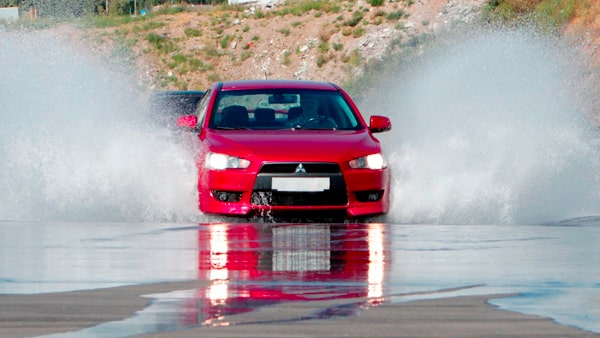
If your rear wheels begin sliding sideways on a wet road, what should you do first?

If the roadway is wet and your car starts to skid, you should:
  1. A. Ease your foot off the accelerator
  2. B. Abruptly shift into a lower gear
  3. C. Pump the brakes quickly and firmly
  4. D. Shift the transmission into neutral

Correct answer: A. – Ease your foot off the accelerator

Skid correction begins by easing off the accelerator when the vehicle loses traction or the rear wheels slide sideways. Avoid a sudden turn away from the skid, and use controlled steering in the direction the rear of the vehicle is sliding. If using anti-lock brakes, maintain firm, continuous brake pressure rather than pumping them.

Source: Indiana Driver’s Manual — Ch. 7, “Braking and Following Distances,” “Skidding”

Question 5

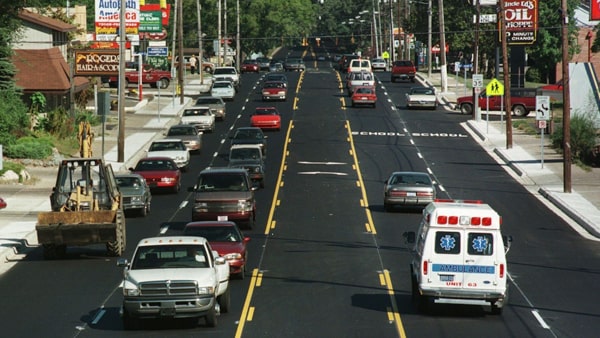
A center lane marked with left-turn arrows pointing in opposite directions is intended for:

The center lane in the illustration is used for:
  1. A. Normal through traffic
  2. B. Vehicles preparing to turn left
  3. C. Passing slower vehicles
  4. D. Emergency vehicles only

Correct answer: B. – Vehicles preparing to turn left

A specially designated center lane is reserved for vehicles preparing to turn left. Drivers traveling in the opposite direction may also enter it for their left turns, creating the opposing-arrow markings. It is not a regular travel lane and must not be used to pass other vehicles.

Source: Indiana Driver’s Manual — Ch. 7, “Turning Left from Specially-Designated Center Lanes”

Question 6

If you become too drowsy to remain alert while driving, what should you do?

  1. A. Turn on the air conditioner and drink coffee
  2. B. Open the windows and increase the radio volume
  3. C. Pull over in a safe area and take a short nap
  4. D. Increase speed to reach your destination sooner

Correct answer: C. – Pull over in a safe area and take a short nap

Drowsiness can slow your responses, impair attention, and lead to poor driving decisions. The manual says not to drive when tired and advises pulling over to a safe area for a short nap. When possible, let a well-rested person drive or use another form of transportation.

Source: Indiana Driver’s Manual — Ch. 7, “Drowsy Driving,” “How to Prevent Drowsy Driving”