Indiana BMV Practice Test 6

4.7 out of 5 (192 votes)
80% Passing score
20 Questions
4 Mistakes allowed
The Indiana permit test covers more than basic road signs and common-sense driving rules. The official BMV knowledge exam comes from the Indiana Driver’s Manual and includes traffic laws, safe driving habits, traffic maneuvers, and road signs. It is multiple choice, yes, but do not let that make it feel lighter than it is. Indiana scores the exam in two separate sections: rules and maneuvers, then road signs. You need 80% or higher on each one, so you cannot do well on signs and then stumble through right-of-way questions like they are optional background noise. This Indiana DMV permit practice test is built around that reality. The practical test format is commonly reported as 50 questions total, with 34 on traffic laws and 16 on road signs. If you are doing the math, or pretending not to while definitely doing it, that means aiming for at least 28 correct law answers and 13 correct sign answers. This sixth Indiana BMV practice test leans into turn signals, lane changes, driver communication, and those tiny judgment calls that somehow become much less tiny when there is a test screen involved. The signaling questions are not just there because someone at the BMV owns a blinker and wants applause. Indiana driving gives you plenty of chances to use, misuse, forget, or belatedly remember your turn signal. Indianapolis traffic, rural southern roads with limited visibility, winter conditions around Fort Wayne, slick pavement near the lake-effect weather zones — different scenery, same basic demand: let other drivers know what you are about to do before you do it. Groundbreaking, apparently. You can take this Indiana practice permit test online from a phone, tablet, or desktop, which makes it easier to squeeze in a round before the official knowledge exam, a retest, or a much-needed rules refresher. And yes, the retest detail matters: if you fail the Indiana knowledge exam, you have to wait until the next business day to try again. Passing results are valid for 180 days, so a little preparation now can save you from making a second trip, and nobody needs extra fluorescent-light time at the BMV. New drivers should also keep the licensing timeline straight. Indiana allows a learner’s permit at 15 with driver education enrollment, or at 16 without it. Teens must hold the permit for 180 days, log 50 supervised driving hours, including 10 at night, and follow probationary license restrictions on passengers, nighttime driving, and telecommunications devices. It is a lot of numbers. Unfortunately, some of them do show up when it counts.

FREE DMV Practice Test App
Study for your Indiana permit test or driver’s license with the NextDoorDriving app. 700+ DMV questions and answers, 100% free!
Download on the App Store

Sample Indiana Permit Test Questions

Question 1

A pedestrian is crossing at a street corner without painted crosswalk lines. What should you do?

  1. A. Proceed because only marked crosswalks require yielding
  2. B. Slow slightly and pass in front of the pedestrian
  3. C. Yield and allow the pedestrian to cross
  4. D. Sound the horn until the pedestrian returns to the curb

Correct answer: C. – Yield and allow the pedestrian to cross

The Indiana Driver’s Manual directs drivers to yield to pedestrians and avoid making a turn that forces a pedestrian to stop, slow down, or take evasive action. A driver should allow a pedestrian already crossing at a corner to clear the vehicle’s path. Proceed only after the crossing movement can be completed safely.

Source: Indiana Driver’s Manual — Ch. 7, “Pedestrian Safety”

Question 2

Which traffic signal requires a complete stop?

  1. A. A flashing red light
  2. B. A steady yellow light
  3. C. A flashing yellow arrow
  4. D. A flashing yellow light

Correct answer: A. – A flashing red light

A flashing red signal has the same basic meaning as a stop sign. Come to a complete stop before entering the intersection. After stopping, proceed cautiously only when the intersection is clear and you have yielded to traffic with the right-of-way.

Source: Indiana Driver’s Manual — Ch. 6, “Red Flashing Lights”

Question 3

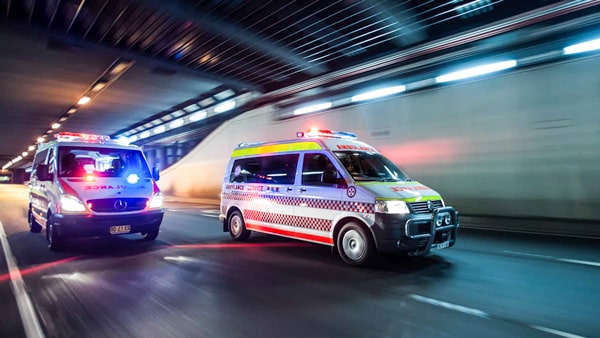
When an emergency vehicle approaches using a siren or alternating emergency lights, you must:

When you hear the sirens or see the red emergency lights of a closely approaching emergency vehicle, you must:
  1. A. Accelerate until you are ahead of it
  2. B. Continue slowly in your current lane
  3. C. Move to the right edge, clear of the intersection, and stop
  4. D. Stop immediately in the middle of the intersection

Correct answer: C. – Move to the right edge, clear of the intersection, and stop

Upon the immediate approach of an authorized emergency vehicle using the required siren or alternating lights, yield the right-of-way. Move parallel to and as close as possible to the right edge or curb, clear of any intersection. Stop there and remain stopped until the emergency vehicle has passed, unless a law enforcement officer directs otherwise.

Source: IC 9-21-8-35(a) – Vehicles Displaying Flashing Lights; Yield Right-of-Way; Violation

Question 4

When changing lanes on an interstate, which procedure is correct?

When changing lanes on a freeway, you should:
  1. A. Signal before moving and verify that the adjacent lane is clear
  2. B. Cross several lanes in one movement
  3. C. Avoid crossing broken white lines under all circumstances
  4. D. Sound the horn instead of using a turn signal

Correct answer: A. – Signal before moving and verify that the adjacent lane is clear

Give a proper signal before changing lanes. Check the roadway ahead, use your mirrors, and briefly turn your head toward the lane to check the blind spot and available space. Change only one lane at a time and move smoothly after confirming that the adjacent lane is clear.

Source: Indiana Driver’s Manual — Ch. 7, “Changing Lanes and Passing Other Vehicles”

Question 5

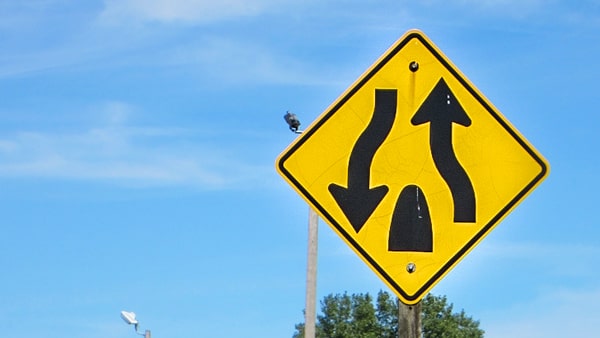
A yellow warning sign showing that the roadway divider is ending means:

This sign means:
  1. A. A mandatory turn is ahead
  2. B. The divided highway ends ahead
  3. C. A one-way street begins ahead
  4. D. The roadway is closed ahead

Correct answer: B. – The divided highway ends ahead

The Divided Highway Ends sign warns that the median or other divider separating opposing traffic will end ahead. Traffic will continue on a roadway where opposing directions are no longer physically separated. Remain on the right side of the roadway and watch for approaching traffic.

Source: Indiana Driver’s Manual — Ch. 6, “Warning Signs”

Question 6

Why should you never turn a moving vehicle’s ignition to the lock position?

  1. A. The steering can lock and cause a loss of control
  2. B. The vehicle will automatically accelerate
  3. C. It is the recommended method for coasting downhill
  4. D. It affects only the radio and other accessories

Correct answer: A. – The steering can lock and cause a loss of control

Do not turn the ignition to the lock position while a vehicle is moving. In a vehicle with a steering-wheel interlock, the steering can lock as the wheel is turned. This can cause the driver to lose control of the vehicle, including during an emergency on the highway.

Source: Indiana Driver’s Manual — Ch. 8, “Ignition Locking”