Indiana Road Signs Test 2

4.8 out of 5 (146 votes)
80% Passing score
20 Questions
4 Mistakes allowed
Indiana road signs deserve more respect than they usually get. People like to treat them as the easy part of the BMV knowledge exam, mostly because a stop sign is, yes, not exactly a riddle. But the official Indiana permit test scores road signs separately from traffic laws and maneuvers, so you cannot just coast through that section and hope your other answers clean up the mess. Indiana requires 80% or better on each part. In the commonly reported 50-question format, that means 34 traffic-law questions and 16 road-sign questions, with about 13 correct sign answers needed to stay safely in passing territory. This Indiana BMV practice test focuses on that road-sign piece, and it gives you 20 multiple-choice questions instead of pretending a quick glance at a few red octagons counts as studying. The questions cover the usual suspects, but also the ones that become irritatingly similar once you are tired: regulatory signs, warning signs, school-zone signs, work-zone signs, railroad crossings, traffic signals, pavement markings, and those color-and-shape clues Indiana expects you to know without squinting at them for five minutes. Red usually means stop, yield, or do-not-do-that. Yellow is the state’s way of politely warning you that something inconvenient is coming. Green points you somewhere. Fine. Then the answer choices start crowding together, and suddenly “obvious” feels less obvious. The test is based on the Indiana Driver’s Manual, the same official source used for the real BMV knowledge exam. At the end, you get your score and a review of what you missed, including the correct answers, which is where the actual learning tends to happen. Slightly humbling, maybe, but useful. Very useful, actually, because getting a sign wrong in practice is much better than discovering the gap at the BMV branch while a retake delay is quietly waiting for you. Scoring 16 or higher on this 20-question Indiana road signs practice test is a good sign that your prep is in decent shape. It will not show you the BMV’s actual exam questions, since those are confidential, but it does give you a realistic feel for the style, topics, and little traps that show up around Indiana road sign recognition.
FREE DMV Practice Test App
Study for your Indiana permit test or driver’s license with the NextDoorDriving app. 700+ DMV questions and answers, 100% free!
Download on the App Store

Sample Indiana Permit Test Questions

Question 1

How should you respond to a flashing yellow traffic signal at an intersection?

  1. A Maintain speed because you have an absolute right-of-way
  2. B Stop and wait for a green signal
  3. C Slow down and proceed with caution
  4. D Stop and remain stopped until the flashing ends

Correct answer: C – Slow down and proceed with caution

A flashing yellow signal instructs drivers to slow down and use caution while passing through the intersection. It does not impose the same stop requirement as a flashing red signal. Continue watching for vehicles, pedestrians, and other hazards that may enter your path.

Source: Indiana Driver’s Manual — Ch. 6, “Yellow Flashing Lights”
Question 2

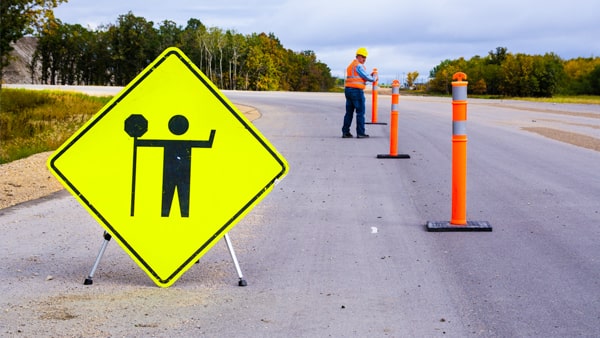
An orange diamond sign showing a person holding a flag warns that:

This sign means:
  1. A A pedestrian crossing is ahead
  2. B The work zone has ended
  3. C A school crossing is ahead
  4. D A flagger is controlling traffic ahead

Correct answer: D – A flagger is controlling traffic ahead

The FLAGGER AHEAD sign warns that a flagger may be directing traffic through a work zone. Indiana drivers must stop for a flag held horizontally across their path and obey the STOP or SLOW message on a flagger’s paddle. Proceed at reduced speed only when directed.

Source: Indiana Driver’s Manual — Ch. 6, “Highway Construction and Maintenance Signs”, Indiana Driver’s Manual — Ch. 7, “Work Zones—Flagger Signals”

Question 3

What color combination is normally used for warning signs showing hazards such as curves or narrow bridges?

  1. A Black symbols on a white background
  2. B Black symbols on a yellow background
  3. C White symbols on a blue background
  4. D White symbols on a green background

Correct answer: B – Black symbols on a yellow background

General warning signs for roadway conditions and hazards normally use black symbols or lettering on a yellow background. Their diamond shape and color help drivers recognize that caution may be necessary ahead. Fluorescent yellow-green is also used for certain school, pedestrian, bicycle, playground, and school-bus warnings.

Source: Indiana Driver’s Manual — Ch. 6, “Yellow or Fluorescent Yellow-Green Traffic Signs”, Indiana Driver’s Manual — Ch. 6, “Warning Signs”

Question 4

If a stop sign is accompanied by both a marked crosswalk and a solid white stop line, where must you stop first?

  1. A Past the crosswalk where cross traffic is visible
  2. B Even with the stop sign
  3. C At the stop line before entering the crosswalk
  4. D At least five feet before reaching the sign

Correct answer: C – At the stop line before entering the crosswalk

Indiana requires a complete stop at the clearly marked stop line. If no stop line is present, stop before entering the crosswalk; if neither marking exists, stop before entering the intersection. Better visibility beyond the line does not remove the requirement to stop at the line first.

Source: IC 9-21-8-32 – Stop Signs at Intersections; Duty to Obey, Indiana Driver’s Manual — Ch. 6, “Approaching a Red Light or Stop Sign”

Question 5

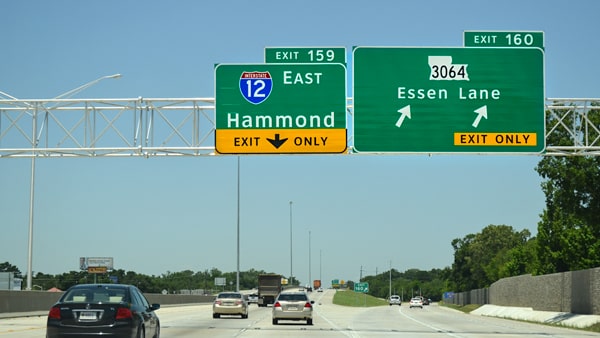
A yellow EXIT ONLY panel appears on an overhead guide sign directly above your lane. What happens if you remain in that lane?

If you see this sign above your lane, you:
  1. A You will be prohibited from taking the exit
  2. B You may either exit or continue on the main roadway
  3. C The lane will continue through the interchange
  4. D The lane will leave the main roadway at the exit

Correct answer: D – The lane will leave the main roadway at the exit

An EXIT ONLY panel identifies a lane that becomes an exit lane rather than continuing on the main roadway. A driver who stays in that lane will leave the highway at the interchange. To continue on the main roadway, move safely into a through lane before the exit separation.

Source: 2025 Indiana Manual on Uniform Traffic Control Devices — § 2E.28, “Signing for Interchange Lane Drops without an Optional Exit Lane”

Question 6

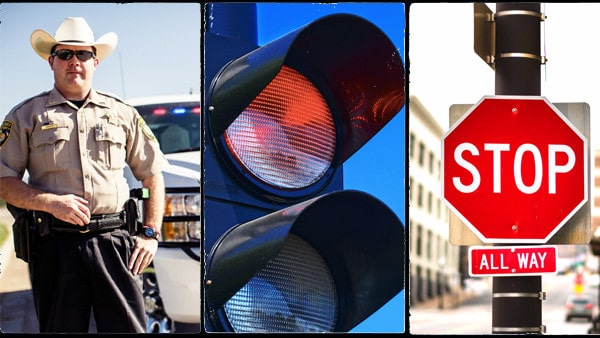
A law enforcement officer directs you to proceed even though the traffic signal is red. Which direction must you follow?

Which of the following must you obey over the other three?
  1. A The steady red signal
  2. B The officer’s lawful direction
  3. C Any nearby stop sign
  4. D A flashing red signal on another approach

Correct answer: B – The officer’s lawful direction

Indiana law prohibits a driver from willfully failing or refusing to comply with a lawful traffic direction from an authorized law enforcement officer. You must follow the officer’s instruction even when it differs from a traffic light or sign. Continue to watch for pedestrians and vehicles while carrying out the direction.

Source: IC 9-21-8-1 – Failure to Comply With Lawful Order of Law Enforcement Officer