


Indiana BMV Sign Test 3

4.9 out of 5 (140 votes)
80% Passing score
20 Questions
4 Mistakes allowed
Indiana gives road signs their own weight on the learner’s permit knowledge exam, which is worth knowing before you stroll into a BMV branch thinking the whole thing is just one big multiple-choice blur. The exam is based on the Indiana Driver’s Manual and covers traffic laws, safe driving, traffic maneuvers, and signs. But the sign portion is scored separately from the traffic-law portion, so a strong overall score does not save you if the road signs section goes sideways. The Indiana permit test format is 50 questions total: 34 traffic-law questions and 16 road-sign questions. Since Indiana requires 80% or higher on each component, you should expect to need at least 28 correct answers on the traffic-law section and at least 13 correct answers on the sign section. That leaves very little room for shrugging at railroad crossings, work-zone warnings, school signs, pavement markings, or those shape-based clues everyone swears they know until the answer choices start looking a little too similar. This Indiana road signs drivers test practice is built around that specific pressure point. It focuses on sign shapes, colors, meanings, and visual cues—the octagonal stop sign, the triangular yield sign, rectangular guide and regulatory signs, warning signs, signals, and the small differences that are easy to skim past when you are studying too fast. The images matter here, not as decoration, but because road signs are visual by nature. Reading about them helps; seeing them repeatedly helps more, in a very plain and practical way. You can use this Indiana DMV practice test whenever studying actually fits into your day, whether that is after school, before work, or during some late-night burst of responsibility that may or may not last. It is free, which is also worth saying plainly, because paying for permit prep is not automatically a sign that it is better. A few BMV details are useful to keep in the back of your mind. Standard knowledge exams are taken at Indiana BMV branches and usually do not require an appointment, though you must arrive at least 30 minutes before closing. Reading assistance or deaf and hard-of-hearing accommodations do require an appointment. You will also need to pass a vision screening, and if you wear glasses or contacts to drive, wear them for the screening. If you fail the knowledge exam, you have to wait until the next business day to retest. Better, obviously, to make the Indiana sign test BMV section feel familiar before you get there.
FREE DMV Practice Test App
Study for your Indiana permit test or driver’s license with the NextDoorDriving app. 700+ DMV questions and answers, 100% free!
Download on the App Store

Sample Indiana Permit Test Questions

Question 1

What color combination is normally used on a highway guide sign showing the distance to an upcoming exit or destination?

  1. A. Black lettering on yellow
  2. B. White lettering on black
  3. C. White lettering on red
  4. D. White lettering on green

Correct answer: D. – White lettering on green

Green traffic signs provide permitted-movement, directional, and guidance information. Highway destination and distance signs normally display white lettering on a green background. Yellow signs warn of hazards, while red signs communicate regulations requiring immediate attention.

Source: Indiana Driver’s Manual — Ch. 6, “Green Traffic Signs”, Indiana Driver’s Manual — Ch. 6, “Traffic Guidance Signs”

Question 2

A green turn arrow is illuminated beside a red circular signal. What may a driver in the proper turn lane do?

  1. A. Remain stopped because the red signal cancels the arrow
  2. B. Wait until the circular signal also turns green
  3. C. Turn in the arrow’s direction if the intersection is clear
  4. D. Proceed only straight through the intersection

Correct answer: C. – Turn in the arrow’s direction if the intersection is clear

A green arrow permits movement in the direction shown even when a red circular signal is displayed for other movements. The driver may make the indicated turn as long as the intersection is clear. The red signal continues to prohibit movements that are not authorized by the green arrow.

Source: Indiana Driver’s Manual — Ch. 6, “Turning through an Intersection”

Question 3

At a green circular signal, how many left-turning vehicles may move into the intersection while waiting for oncoming traffic to clear?

  1. A. None
  2. B. Every vehicle in the left-turn lane
  3. C. One vehicle at a time
  4. D. Two vehicles if both are signaling

Correct answer: C. – One vehicle at a time

A circular green signal permits a left turn only after the driver yields to oncoming traffic and confirms the intersection is clear. Indiana guidance allows only one left-turning vehicle at a time to move into the intersection. If the signal turns red while that vehicle is in the intersection, the driver may finish the turn after oncoming traffic stops.

Source: Indiana Driver’s Manual — Ch. 6, “Turning through an Intersection”

Question 4

What does this orange warning sign indicate?

This sign means that:
  1. A. A volunteer cleanup area is ahead
  2. B. A work crew is ahead
  3. C. A playground is ahead
  4. D. A pedestrian crossing is ahead

Correct answer: B. – A work crew is ahead

This is a Work Crew Ahead sign. Orange construction and maintenance signs alert drivers to temporary roadway conditions and workers who may be near traffic. Stay alert, watch for workers and narrowed lanes, and reduce speed as conditions require.

Source: Indiana Driver’s Manual — Ch. 6, “Highway Construction and Maintenance Signs”, Indiana Driver’s Manual — Ch. 7, “Work Zone Safety Driving Tips”

Question 5

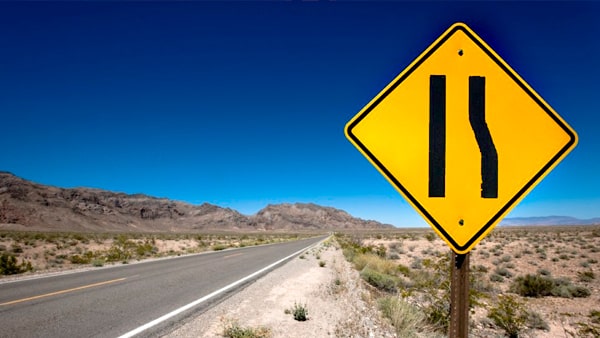
What roadway condition does this warning sign identify?

This sign means:
  1. A. A traffic lane ends ahead
  2. B. A divided highway begins ahead
  3. C. A steep downgrade is ahead
  4. D. Trucks may enter the roadway ahead

Correct answer: A. – A traffic lane ends ahead

The sign warns that a traffic lane ends ahead. Before moving into the continuing lane, check traffic ahead, your mirrors, and your blind spot. Signal and merge only when there is enough room to enter the adjacent lane safely.

Source: Indiana Driver’s Manual — Ch. 6, “Warning Signs”, Indiana Driver’s Manual — Ch. 7, “Changing Lanes and Passing Other Vehicles”

Question 6

You entered an intersection on green, but the signal turns steady yellow before you exit. What should you do?

  1. A. Stop immediately inside the intersection
  2. B. Back out of the intersection
  3. C. Wait for the signal to return to green
  4. D. Carefully complete your movement

Correct answer: D. – Carefully complete your movement

A steady yellow signal warns that the green interval has ended and the light is about to turn red. If you are already within the intersection, carefully finish your movement rather than stopping there. Indiana guidance also permits an approaching driver who is too close to stop safely to complete the movement.

Source: Indiana Driver’s Manual — Ch. 6, “Driving through an Intersection”