Indiana Road Signs Test Simulator

4.5 out of 5 (1014 votes)
80% Passing score
25 Questions
5 Mistakes allowed
Indiana road signs are one of those permit-test topics that seem simple because, well, you have seen signs before. That confidence is not useless, exactly, but it can get a little wobbly once the BMV starts asking about shapes, colors, railroad markings, school zones, work zones, and signs that look familiar until you have to name what they actually mean. This Indiana road signs practice test is built for that exact gap. The official Indiana knowledge exam is based on the Indiana Driver’s Manual and is scored in two parts: traffic maneuvers and road signs. You need 80% or better on each part, not just an overall passing score. The commonly reported format is 50 total questions, with 16 of them focused on signs, which means the sign section is small enough to overlook and important enough to cost you the test. A little unfair? Maybe. But it is also very learnable. Each practice session gives you 20 randomly selected road-sign questions from a larger bank, so the test does not turn into a stale memorization loop after one attempt. You will see sign images with the questions, because that is how road signs work in real life: visually, quickly, and sometimes when your brain is already busy with traffic, lane position, and whatever the car in front of you is doing. The questions cover the usual Indiana permit test territory, including regulatory signs, warning signs, traffic signals, pavement markings, school-zone signs, work-zone signs, railroad crossings, colors, and shapes. You need 16 correct answers to pass this simulator, matching the 80% standard Indiana uses for the real knowledge exam. After each answer, you get immediate feedback with an explanation, not just a cold “correct” or “wrong,” because knowing why a sign means what it means is what keeps the information from evaporating five minutes later. Use this as a focused Indiana BMV practice test before your permit exam, alongside the Driver’s Manual. It is especially useful for first-time applicants, adults refreshing their road-sign knowledge, and anyone who wants to stop treating the sign section like the easy part just because the pictures look familiar.
FREE DMV Practice Test App
Study for your Indiana permit test or driver’s license with the NextDoorDriving app. 700+ DMV questions and answers, 100% free!
Download on the App Store

Sample Indiana Permit Test Questions

Question 1

Which pavement marking identifies the movement allowed or required from a particular traffic lane?

  1. A. A red line along the shoulder
  2. B. A broken yellow centerline
  3. C. A solid white edge line
  4. D. A white directional arrow painted in the lane

Correct answer: D. – A white directional arrow painted in the lane

In Indiana, lane-use arrows identify movements that are permitted or required from particular lanes. An arrow may designate a turn or show that more than one movement is allowed. Edge and center lines serve different purposes, such as separating traffic or marking roadway boundaries.

Source: 2025 Indiana Manual on Uniform Traffic Control Devices — § 3B.23, “Lane-Use Arrows”
Question 2

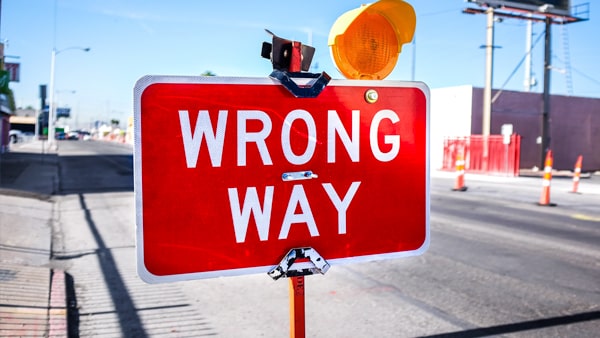
What does a red rectangular sign displaying the words WRONG WAY indicate?

This red and white sign means:
  1. A. Entry is allowed after yielding
  2. B. The roadway is closed in both directions
  3. C. U-turns are prohibited at the next intersection
  4. D. You are traveling against the permitted direction of traffic

Correct answer: D. – You are traveling against the permitted direction of traffic

The WRONG WAY sign warns that your vehicle is moving against the permitted direction of traffic on a one-way roadway or ramp. Indiana classifies it as a red regulatory sign requiring immediate attention. It is commonly used with or beyond a DO NOT ENTER sign to discourage wrong-way travel.

Source: Indiana Driver’s Manual — Ch. 6, “Red Traffic Signs”, Indiana Driver’s Manual — Ch. 6, “Traffic Regulation Signs—Wrong Way”

Question 3

A black arrow curving downward and to the right of an obstruction means drivers must:

  1. A. Pass on either side of the obstruction
  2. B. Keep to the right of the obstruction
  3. C. Make a sharp right turn
  4. D. Move into the left lane

Correct answer: B. – Keep to the right of the obstruction

A KEEP RIGHT sign directs traffic to pass on the right side of a median, island, pier, or similar roadway feature. It is placed where the required path may not otherwise be obvious. It does not indicate an ordinary right turn or permit drivers to choose either side.

Source: 2025 Indiana Manual on Uniform Traffic Control Devices — § 2B.41, “Keep Right and Keep Left Signs”, Indiana Driver’s Manual — Ch. 6, “Traffic Regulation Signs—Keep Right”

Question 4

A steady yellow arrow appears while you are waiting in a right-turn-only lane. What should you do?

  1. A. Prepare to stop unless you are too close to stop safely
  2. B. Begin turning after checking only for pedestrians
  3. C. Remain stopped until every signal is dark
  4. D. Accelerate to enter the intersection before the arrow changes

Correct answer: A. – Prepare to stop unless you are too close to stop safely

A steady yellow arrow means the right-of-way for the indicated movement is ending. Under Indiana guidance, an approaching driver should stop if that can be done safely. A driver who is already too close to stop safely may complete the movement carefully.

Source: Indiana Driver’s Manual — Ch. 6, “Turning through an Intersection”

Question 5

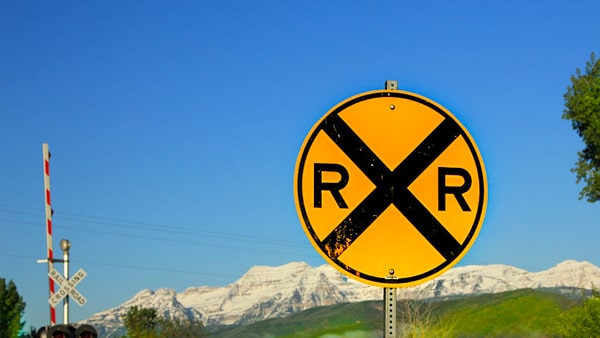
A circular yellow sign marked with a black X and the letters RR warns of:

This sign is a warning that you are approaching:
  1. A. A four-way intersection
  2. B. A pedestrian crosswalk
  3. C. A railroad crossing ahead
  4. D. A work-zone blasting area

Correct answer: C. – A railroad crossing ahead

Circular traffic signs provide advance warning of railroad crossings. This sign appears before the tracks, while a crossbuck normally marks the crossing itself. Indiana drivers should watch for additional signs, signals, gates, or an approaching train and stop when required.

Source: Indiana Driver’s Manual — Ch. 6, “Traffic Sign Shapes—Circular Traffic Signs”, Indiana Driver’s Manual — Ch. 7, “Railroad Crossings”

Question 6

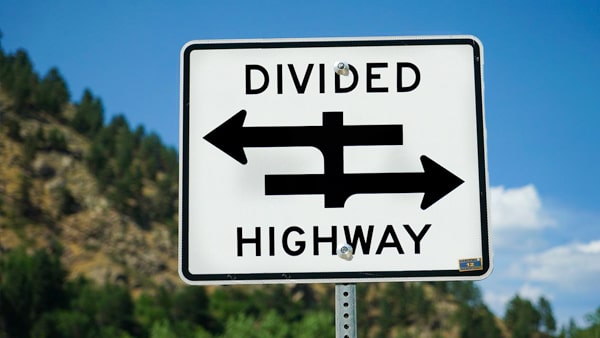
A white sign reading DIVIDED HIGHWAY and showing opposite arrows separated by a vertical line indicates:

This sign means:
  1. A. Traffic must turn either left or right
  2. B. The road ends at a T-intersection
  3. C. The road is approaching an intersection with a divided highway
  4. D. The road passes over a divided highway

Correct answer: C. – The road is approaching an intersection with a divided highway

In Indiana, this sign advises drivers that they are approaching an intersection with a divided highway. The highway’s two roadways carry traffic in opposite directions and are separated by a median. Drivers must follow the ONE WAY signs, arrows, and other controls governing entry onto each roadway.

Source: 2025 Indiana Manual on Uniform Traffic Control Devices — § 2B.50, “Divided Highway Crossing Signs (R6-3 and R6-3a)”