


Iowa CDL General Knowledge Practice Test (IA) 2

4.7 out of 5 (66 votes)
80% Passing score
20 Questions
4 Mistakes allowed
As you delve into the realm of commercial driving in Iowa, our second Iowa CDL General Knowledge Practice Test stands as your indispensable tool. This CDL practice test, one among our comprehensive suite of CDL assessments, is designed to mirror the real DMV written test in 2026, ensuring you're well-prepared regardless of the class of driver's license you're aiming for, be it Class A or Class B, and any endorsements you wish to add. Our Iowa CDL general knowledge test practice comprises 20 questions, requiring a minimum score of 16 correct answers to pass. Crafted with precision and insight, these multiple-choice CDL test questions span a vast array of topics crucial for every aspiring commercial driver. You'll encounter written test questions on essential areas such as pre-trip vehicle inspection, basic vehicle control, gear shifting strategies (including downshifting), navigating hills and steep downgrades, effective communication with fellow road users, speed control, and vital knowledge about drug and alcohol regulations. Notably, our Iowa CDL test questions are not just randomly compiled. They are the brainchild of seasoned professional driving instructors, each contributing years of expertise and experience in teaching. These experts have successfully guided thousands to achieve their driving ambitions, ensuring that every question is relevant, realistic, and an effective learning tool. Moreover, our commitment to accessibility is unwavering. We understand the diverse needs of modern learners, hence our Iowa DMV practice tests are available online across multiple platforms - desktop, mobile, and mobile apps. This flexibility ensures that you can engage with the material wherever you are, fitting your study sessions seamlessly into your busy schedule. Each time you attempt this Iowa CDL general knowledge practice test, the same set of questions will challenge you, reinforcing your learning and helping you identify areas needing more focus. This repetitive practice is a proven method to solidify your understanding and boost your confidence as you approach the actual DMV CDL written test in 2026.
FREE CDL Practice Test App
Pass your Iowa CDL General Knowledge test with the NextDoorDriving app. Real questions and answers—100% free and ad-free.
Download on the App Store

Sample Iowa CDL Test Questions - General Knowledge

Question 1

If STOP signs face traffic on every approach, what type of intersection is it?
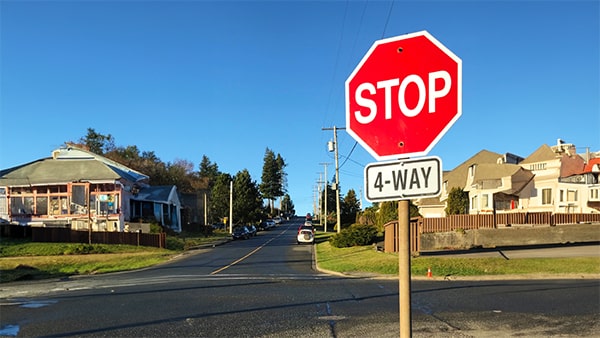
This sign tells the driver they are entering __________.
  1. A An uncontrolled intersection
  2. B A railroad grade crossing
  3. C A school crossing
  4. D An intersection controlled by stop signs

Correct answer: D – An intersection controlled by stop signs

Under Iowa law, a driver approaching an intersection marked by a STOP sign must stop at the proper location. Before proceeding, the driver must yield to traffic already in the intersection or approaching closely enough to present an immediate hazard. Stop signs on every approach make the intersection one controlled by stop signs.

Source: Iowa Code § 321.322.1 — Vehicles entering stop or yield intersection.

Question 2

What authority may federal inspectors exercise over a commercial vehicle in operation?

  1. A They may inspect it but may never restrict its operation
  2. B They may inspect it only at a state border
  3. C They may recommend repairs but cannot issue an order
  4. D They may inspect it and place it out of service when qualifying unsafe conditions are found

Correct answer: D – They may inspect it and place it out of service when qualifying unsafe conditions are found

Federal regulation authorizes FMCSA special agents to inspect motor-carrier vehicles in operation. Authorized personnel must declare a vehicle out of service when its mechanical condition or loading would likely cause a crash or breakdown. A vehicle marked out of service may not be operated until all repairs required by the out-of-service notice have been satisfactorily completed.

Source: Iowa Commercial Driver’s License Manual — § 2.1.1, “Why Inspect”, 49 CFR § 396.9(a), (c) — Inspection of motor vehicles and intermodal equipment in operation.

Question 3

Using the manual’s general calculation before adding air-brake lag, what is the minimum stopping distance at 55 mph under ideal conditions?

  1. A About 150 feet
  2. B About 250 feet
  3. C About 350 feet
  4. D About 419 feet

Correct answer: D – About 419 feet

At 55 mph, the manual assigns approximately 142 feet to perception distance, 61 feet to reaction distance, and 216 feet to braking distance on dry pavement with good brakes. Together, these distances total approximately 419 feet. A vehicle with air brakes has an additional brake-lag distance, making its total stopping distance longer.

Source: Iowa Commercial Driver’s License Manual — § 2.6.1, “Stopping Distance”

Question 4

What must a driver do when approaching a YIELD sign?

When approaching this sign _______________.
  1. A Maintain speed whenever no traffic is immediately visible
  2. B Stop every time and wait for a traffic signal
  3. C Slow to a reasonable speed, stop if safety requires, and yield to hazardous traffic
  4. D Enter the intersection first and then check for traffic

Correct answer: C – Slow to a reasonable speed, stop if safety requires, and yield to hazardous traffic

Iowa law requires a driver approaching a YIELD sign to slow to a reasonable speed for existing conditions. The driver must stop at the proper location if safety requires it. After slowing or stopping, the driver must yield to traffic in the intersection or approaching closely enough to constitute an immediate hazard.

Source: Iowa Code § 321.322.2 — Vehicles entering stop or yield intersection.

Question 5

When reflective triangles are used as required warning equipment on a truck, truck tractor, or bus, how many must be carried?

  1. A 2
  2. B 4
  3. C 1
  4. D 3

Correct answer: D – 3

Federal rules require three bidirectional emergency reflective triangles when triangles are the warning devices carried on a covered truck, truck tractor, or bus. The triangles must conform to Federal Motor Vehicle Safety Standard No. 125. Additional warning devices may be carried, but they do not replace the required equipment.

Source: 49 CFR § 393.95(f) — Emergency equipment on all power units.

Question 6

At a railroad crossing with flashing red lights and a lowered gate, when may you proceed?

  1. A When you cannot see the approaching train
  2. B As soon as the train’s horn becomes quiet
  3. C After the train passes, even if the gate remains lowered
  4. D After the gate rises, the lights stop flashing, and the crossing is safe

Correct answer: D – After the gate rises, the lights stop flashing, and the crossing is safe

Iowa law requires a driver to stop when crossing signals or gates warn of an approaching train and prohibits crossing while a gate is lowered. The CDL manual instructs drivers to remain stopped until the gate rises and the flashing lights stop. Even then, proceed only after confirming that all tracks are clear and crossing is safe.

Source: Iowa Commercial Driver’s License Manual — § 2.15.2, “Warning Signs and Devices”, Iowa Code § 321.341.1–.2 — Obedience to signal indicating approach of railroad train or railroad track equipment.