


Iowa DMV Practice Test 6

4.9 out of 5 (71 votes)
80% Passing score
20 Questions
4 Mistakes allowed
Iowa’s permit test rewards people who actually know the material, not people who skimmed a few “quick answer” pages and hoped the DMV would be feeling generous. This Iowa DOT permit practice test gives you 20 questions built around the kinds of details that matter on the road and on the exam: turn signals, road signs, pavement markings, right-of-way, lane control, safe driving, and the small but important rules that tend to sit quietly in the Iowa Driver’s License Manual until they suddenly matter. You need 16 correct answers to pass this Iowa DMV permit practice test, which keeps it aligned with Iowa’s 80% passing standard. The real Iowa operator knowledge test is commonly listed as 35 questions, with 28 correct answers needed to pass, so this shorter test is not pretending to be the whole event. It is a sharper practice round. A useful one. And, yes, there is a difference. A random cheat sheet may help you recognize a few answers, but it will not do much for questions about when to signal, what a sign is actually telling you, or how Iowa expects drivers to handle shared lanes, intersections, emergency situations, alcohol laws, and other material pulled from the official manual. There is also the licensing part around the test, because of course there is. First-time Iowa drivers should expect a vision screening, and applicants under 18 need parent or guardian consent for an instruction permit. When it is time to get licensed, Iowa will want proof of identity and date of birth, lawful status or presence, Social Security number if you have one, and two documents showing Iowa residency. Testing may be handled through Iowa DOT locations, county treasurer offices, or, for eligible minors, Iowa’s Skip the Trip option with an approved parent, school, or agency proctor. Not the most thrilling paperwork journey, but it is part of the route. After you finish the practice test, you will get a review of the questions you missed, along with the correct answers, hints, and explanations. That is where the studying gets more useful and less vague. You can see exactly where your answer drifted off course, fix it, and come back stronger before the real Iowa drivers license test asks the same idea in less forgiving wording.
FREE DMV Practice Test App
Study for your Iowa permit test or driver’s license with the NextDoorDriving app. 700+ DMV questions and answers, 100% free!
Download on the App Store

Sample Iowa Permit Test Questions

Question 1

A posted maximum speed limit represents:
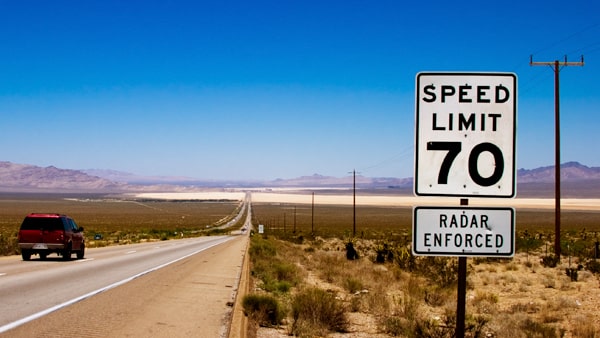
The posted speed limits show:
  1. A. The minimum speed required on the roadway
  2. B. The exact speed every driver must maintain
  3. C. The maximum lawful speed under ideal driving conditions
  4. D. A speed that is safe under every road and weather condition

Correct answer: C. – The maximum lawful speed under ideal driving conditions

The Iowa driver’s manual describes a posted maximum speed as the highest legal speed under ideal driving conditions. It is not a target speed that must be maintained. Rain, snow, fog, traffic, or other hazards may require you to drive below the posted limit to maintain control and stop safely.

Source: Iowa Driver’s License Manual — Ch. 2, § 2.2, “Speed Limit Signs”, Iowa Driver’s License Manual — Ch. 4, § 4.5, “Appropriate Speed”
Question 2

Where should an Iowa driver position the vehicle when approaching and making a right turn?

  1. A. Near the roadway’s center line
  2. B. Close to the left curb or edge
  3. C. As close as practical to the right curb or roadway edge
  4. D. Past the center of the intersection before steering right

Correct answer: C. – As close as practical to the right curb or roadway edge

The approach for a right turn and the turn itself must be made as close as practical to the right-hand curb or roadway edge. Proper positioning helps prevent the vehicle from making an unnecessarily wide path across other lanes. Follow applicable lane-control signs and pavement markings when preparing for the turn.

Source: Iowa Code § 321.311(1)(a) — Turning at intersections., Iowa Driver’s License Manual — Ch. 4, § 4.8, “Proper Turning Techniques”

Question 3

Traffic is backed up beyond an intersection, but your signal is green. What should you do?

  1. A. Enter if cross traffic can drive around you
  2. B. Wait until there is enough room to clear the intersection
  3. C. Enter because the green signal gives you the right-of-way
  4. D. Enter only if you are operating a motorcycle

Correct answer: B. – Wait until there is enough room to clear the intersection

A green signal allows you to proceed only when the intersection is clear and after yielding to lawful traffic already there. Before entering, scan ahead to verify that your path through the intersection is open. If stopped traffic leaves no room on the far side, wait before entering rather than obstructing crossing traffic when the signal changes.

Source: Iowa Driver’s License Manual — § 2.9, “Traffic Signals”, Iowa Driver’s License Manual — § 5.1, “Intersections”

Question 4

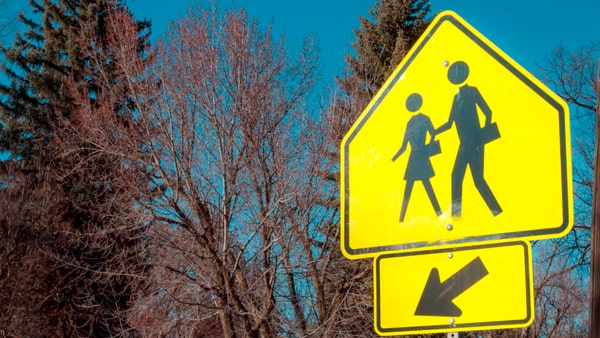
A fluorescent yellow-green pentagon sign showing two people walking identifies:

This road sign means:
  1. A. A school area or school crossing
  2. B. A business district
  3. C. A sidewalk-only route
  4. D. An area where crossing is prohibited

Correct answer: A. – A school area or school crossing

Pentagon-shaped warning signs mark school areas and school crossings. An advance school-crossing sign warns that you are approaching a school area with a marked crossing. Watch carefully for children and be prepared to slow or stop as conditions require.

Source: Iowa Driver’s License Manual — § 2.1, “Traffic Signs”, Iowa Driver’s License Manual — § 2.3, “Warning Signs”

Question 5

Driving faster than surrounding traffic and repeatedly changing lanes to pass tends to:

  1. A. Make the trip substantially safer
  2. B. Increase the chance of a collision
  3. C. Reduce the number of traffic conflicts
  4. D. Become acceptable only on interstate highways

Correct answer: B. – Increase the chance of a collision

Vehicles traveling faster or slower than the traffic flow cause more passing, lane changes, and instances of following too closely. Those additional conflicts increase the chance of collisions. The safer approach is to keep pace with traffic when possible without exceeding the posted speed limit or driving too fast for conditions.

Source: Iowa Driver’s License Manual — § 4.12, “Driving Safely in Traffic”

Question 6

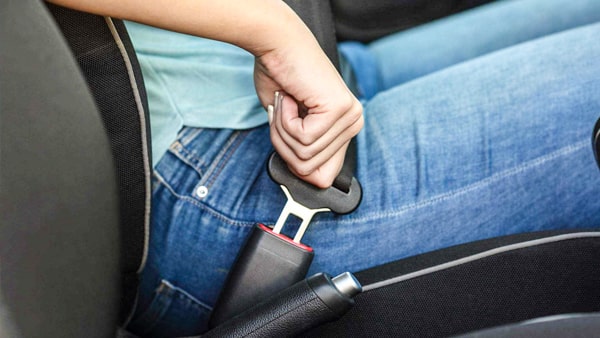
For the greatest protection from crash injuries, seat belts should be worn by:

Seat belts can be most effective as injury preventive devices when they are worn by:
  1. A. Only the driver
  2. B. Passengers only during long trips
  3. C. Everyone only when traveling on an expressway
  4. D. The driver and every passenger on every trip

Correct answer: D. – The driver and every passenger on every trip

Seat belts provide the most protection when everyone buckles up for every trip, regardless of distance or seating position. The state manual describes seat belts as the most effective way to prevent death and injury in a crash. Iowa law specifically requires properly fastened restraints for drivers and front-seat occupants, while separate requirements apply to passengers under 18.

Source: Iowa Code § 321.445(2)(a) – Safety belts and safety harnesses — use required., Iowa Code § 321.446 – Child restraint devices., Iowa Driver’s License Manual — § 3.5, “Seat Belts”