Iowa DMV Practice Test 7

4.6 out of 5 (82 votes)
80% Passing score
20 Questions
4 Mistakes allowed
This Iowa DOT permit practice test does more than run you through a stack of road-sign questions and hope for the best. It gives you a cleaner, more realistic feel for the rules Iowa actually expects new drivers to know before they get comfortable behind the wheel. The practice test itself is built around the everyday material you are likely to see on the Iowa DOT permit test: right-of-way, proper signaling, proof of insurance, safe turns, traffic signs, and the little details that seem harmless until they appear in multiple-choice form with one answer that is almost right, which is rude, frankly. There are 20 questions, and you will need at least 16 correct to pass, so it is short enough to finish without turning it into a whole afternoon but still serious enough to expose the weak spots. For teen drivers, Iowa’s Graduated Driver Licensing system will shape the process. An instruction permit can start at 14, but it comes with adult supervision, seat-belt-based passenger limits, and a no-phone rule while driving. The next step may be an intermediate license at 16, followed by a full license at 17, assuming the driver education, supervised driving, and clean-record requirements are handled properly. There is also the Special Minor’s Restricted License at 14½, better known as the school/work permit, which allows limited unsupervised driving for approved school, work, school activity, or qualifying farm purposes. Limited is doing real work there, by the way. Adult applicants have their own lane here. First-time Iowa drivers age 18 or older are not dealing with the under-18 GDL holding periods, school/work permit rules, or supervised-driving logs, but they still need the right documents, vision screening, applicable written testing, and sometimes a drive test. So no, adulthood does not magically delete the paperwork. Charming thought, though. Once you finish this Iowa DMV practice test, you will get a performance summary with the correct answers for anything you missed. And honestly, that is where the useful part kicks in: not just knowing that you missed something, but seeing exactly where Iowa’s wording tried to sneak past you.
FREE DMV Practice Test App
Study for your Iowa permit test or driver’s license with the NextDoorDriving app. 700+ DMV questions and answers, 100% free!
Download on the App Store

Sample Iowa Permit Test Questions

Question 1

An oncoming vehicle turns left across your path and creates an immediate hazard. What is the safest response?

  1. A. Continue at the same speed because you have the right-of-way
  2. B. Reduce speed or stop as necessary to avoid a collision
  3. C. Sound the horn while maintaining your speed
  4. D. Accelerate through the intersection

Correct answer: B. – Reduce speed or stop as necessary to avoid a collision

A driver must keep the vehicle under control and reduce speed to a reasonable rate when approaching and traveling through an intersection. If another vehicle crosses your path, slow down or stop as necessary to avoid a collision. Defensive driving requires being prepared to react to another driver’s error rather than continuing into an immediate hazard.

Source: Iowa Code § 321.288(1), (2)(c) – Control of vehicle — reduced speed, Iowa Driver’s License Manual — § 4.11, “Defensive Driving”
Question 2

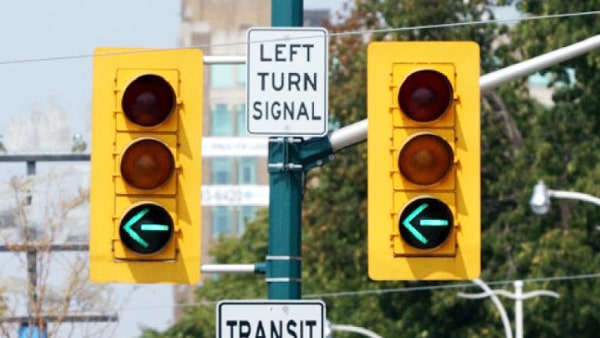
What may you do when a steady green arrow points left?

On the intersection, if you see a green arrow pointing to the left, you can:
  1. A. Proceed in any direction if the intersection appears clear
  2. B. Turn left after yielding to anyone lawfully remaining in the intersection
  3. C. Turn left or continue straight ahead
  4. D. Wait for a circular green light before turning

Correct answer: B. – Turn left after yielding to anyone lawfully remaining in the intersection

A steady green arrow permits traffic to cautiously proceed in the direction shown. A left-pointing arrow permits a left turn, not straight travel. Iowa law still requires the turning driver to yield to vehicles and pedestrians lawfully within the intersection.

Source: Iowa Code § 321.257(2)(d) – Official traffic-control signal, Iowa Driver’s License Manual — § 2.9, “Traffic Signals”

Question 3

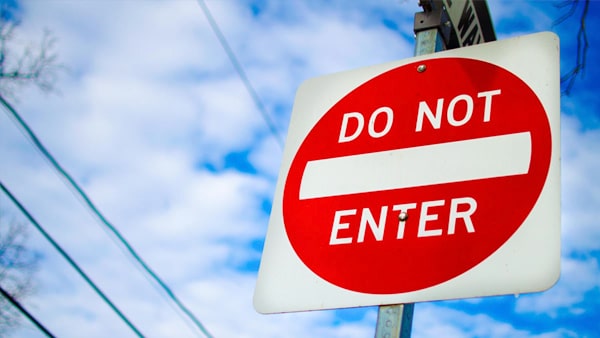
A red circular sign with a horizontal white bar across its center means:

This sign means:
  1. A. Stop before proceeding
  2. B. U-turns are prohibited
  3. C. Yield to approaching traffic
  4. D. Do not enter this roadway

Correct answer: D. – Do not enter this roadway

The DO NOT ENTER sign prohibits entry at that roadway opening. It is commonly placed at exit ramps, divided-roadway crossovers, and entrances to one-way roads. A driver who has mistakenly entered an opposing lane should get out of the traveled portion and turn around as quickly and safely as possible.

Source: Iowa Driver’s License Manual — § 2.2, “Regulatory Signs”

Question 4

Two vehicles reach an uncontrolled intersection from different roads at approximately the same time. Who must yield?

  1. A. Either driver may proceed first
  2. B. The driver on the left
  3. C. The driver on the right
  4. D. Neither driver

Correct answer: B. – The driver on the left

Under Iowa law, when vehicles enter an intersection from different roads at approximately the same time, the driver on the left must yield to the driver on the right. Both drivers should slow down and approach an uncontrolled intersection carefully. The rule may be modified at through highways or where other traffic controls apply.

Source: Iowa Code § 321.319 – Entering intersections from different highways, Iowa Driver’s License Manual — § 2.22, “Right-of-Way”

Question 5

When turning left from a two-way road onto a multilane one-way road, which lane should you enter unless signs or markings direct otherwise?

  1. A. The far-right lane
  2. B. Any open lane
  3. C. The left lane nearest your original lane
  4. D. The lane carrying the least traffic

Correct answer: C. – The left lane nearest your original lane

The Iowa driver’s manual directs drivers to turn from the lane closest to the intended direction and enter the lane closest to the lane they came from. For this left turn, that is the nearest left lane of the one-way road. After completing the turn, make any needed lane change separately and only when it is safe.

Source: Iowa Code § 321.311(1)(c), (2) – Turning at intersections, Iowa Driver’s License Manual — § 2.18, “General Lane Use”

Question 6

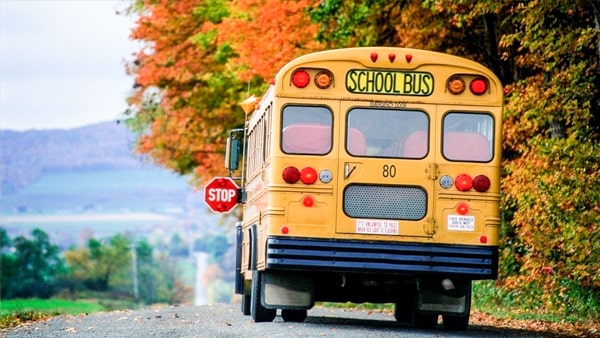
You are approaching a stopped school bus from behind while its stop arm is extended. Where must you stop?

When a school bus has its lights flashing and its Stop arm extended, you must:
  1. A. No closer than 15 feet behind the bus
  2. B. Beside the rear bumper after all children have exited
  3. C. Five feet behind the bus
  4. D. Only long enough to check for children

Correct answer: A. – No closer than 15 feet behind the bus

In Iowa, a driver approaching a school bus from behind must not pass while its red or amber warning lights are flashing. When the bus stops and extends its stop arm, the vehicle must stop no closer than 15 feet behind it. Remain stopped until the arm is retracted and the bus resumes motion.

Source: Iowa Code § 321.372(3)(b) – Discharging pupils — stopping requirements — penalties, Iowa Driver’s License Manual — § 2.24, “School Buses”