Iowa Driving Practice Test 9

5 out of 5 (51 votes)
80% Passing score
20 Questions
4 Mistakes allowed
Iowa’s knowledge exam is not a mystery, but it is a real test: 35 questions, 28 correct answers needed, 80% or better to pass. That is the number to keep in your head while you work through this Iowa permit practice test, because practice only helps when it is tied to what the state actually expects you to know. This practice test is built around school bus safety, which may sound narrow at first, and then—well, it is not quite so narrow once you think about how often Iowa drivers meet buses on two-lane roads, neighborhood streets, rural highways, and those stretches where everyone seems to be doing 55 until a stop arm swings out. The rules are strict because children are unpredictable, traffic is impatient, and the driver behind you may or may not be paying the kind of attention they should be paying. You need to know when to stop, when traffic in both directions must stop, and when you can legally continue. Not vaguely know. Know. The format keeps things manageable: 20 questions, untimed, with room to slow down and actually read the wording. That matters. A good Iowa DMV practice test should not turn into a race against a clock; it should make you notice the little details that separate a correct answer from the one that merely sounds reasonable. Use it on your phone, use it at home, use it between other things if that is the only time you have. Just use it with enough attention that the answers start making practical sense. For teen drivers, this is also part of a longer licensing path, not a one-and-done errand. Iowa allows an instruction permit at 14, but getting to an intermediate license means holding that permit for 12 months, completing 20 supervised driving hours, including 2 at night, and staying clean of the kind of violations that can delay everything. A full license can come at 17, after another 12-month intermediate period and additional supervised driving. You will also need the usual documents: proof of identity and date of birth, Social Security number, two Iowa residency documents, and parent or guardian consent if you are a minor. So yes, study the school bus rules. But also understand the process around the test, because Iowa licensing rewards drivers who are prepared in the boring ways too.
FREE DMV Practice Test App
Study for your Iowa permit test or driver’s license with the NextDoorDriving app. 700+ DMV questions and answers, 100% free!
Download on the App Store

Sample Iowa Permit Test Questions

Question 1

On a roadway wide enough for two lines of traffic in your direction, you may pass on the right when the vehicle ahead is:

  1. A Preparing to turn right
  2. B Making or preparing to make a left turn
  3. C Stopping beside the right curb
  4. D Turning into a driveway on the right

Correct answer: B – Making or preparing to make a left turn

A driver may pass on the right of a vehicle that is making or about to make a left turn when the roadway has enough unobstructed pavement and the movement can be made safely. The passing driver may not leave the pavement, use the shoulder, or cross an intersection apron to complete the maneuver.

Source: Iowa Code § 321.302(1), (3) – Overtaking and passing.

Question 2

Which types of drugs may make a person unsafe to drive?

What kinds of drugs, other than alcohol, can affect your driving ability?
  1. A Some allergy medicines
  2. B Illegal or controlled drugs
  3. C Some cold remedies
  4. D All of these choices

Correct answer: D – All of these choices

Illegal drugs and some prescription or over-the-counter medicines can impair safe driving. Cold and allergy products may cause drowsiness or otherwise affect driving ability, so drivers should follow warning labels and medical instructions. Iowa prohibits operating a vehicle while under the influence of an alcoholic beverage, another drug, or a combination of substances.

Source: Iowa Code § 321J.2(1) – Operating while under the influence of alcohol or a drug or while having an alcohol concentration of .08 or more (OWI)., Iowa Commercial Driver’s License Manual — § 2.22.2, “Other Drugs”

Question 3

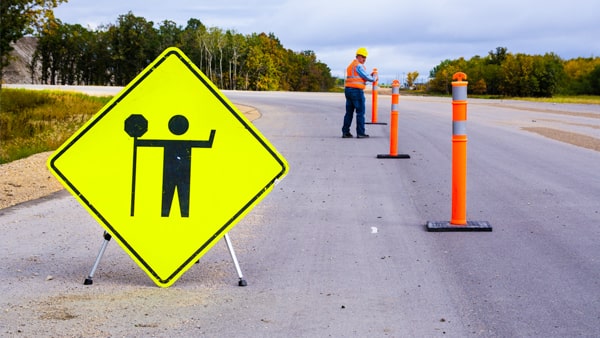
An orange diamond sign showing a person holding a flag warns of:

This sign means:
  1. A A pedestrian crossing
  2. B The end of a work zone
  3. C A school crossing
  4. D A flagger controlling traffic ahead

Correct answer: D – A flagger controlling traffic ahead

The flagger symbol sign warns that a flagger is directing traffic ahead in a temporary traffic-control zone. Slow down, remain alert, and be prepared to stop. The Iowa manual requires drivers to stop when instructed by a construction work-zone flagger.

Source: 761 IAC 130.1 – Manual., Iowa Driver’s License Manual — § 2.1, “Traffic Signs”, Iowa Driver’s License Manual — § 4.4, “Braking and Stopping”

Question 4

If the accelerator remains stuck after you release your foot, what should you do?

  1. A Keep your eyes on the road
  2. B Quickly shift the transmission into Neutral
  3. C Pull off safely and turn off the engine after stopping
  4. D Take all of these actions

Correct answer: D – Take all of these actions

Keep watching the road so you can steer and identify a safe escape path. Quickly shift into Neutral to disconnect engine power from the wheels, then pull off the road when it is safe. Once the vehicle has stopped, turn off the engine. Do not switch off the engine while the vehicle is still moving.

Source: Iowa Driver’s License Manual — § 5.14, “Equipment Failure Emergencies,” “Stuck Gas Pedal”

Question 5

In the Iowa driver’s manual, a yellow-painted curb generally marks:

  1. A A no-parking zone
  2. B Parking reserved for buses
  3. C Parking for emergency vehicles only
  4. D A space reserved for drivers with disabilities

Correct answer: A – A no-parking zone

Yellow-painted curbs or pavement markings are commonly used to identify no-parking zones. A nearby sign may provide the exact restriction or indicate when it applies. Do not treat a yellow curb as general permission to stop for loading or unloading unless an official sign specifically allows it.

Source: Iowa Driver’s License Manual — § 2.26, “Parking Not Allowed”

Question 6

When should you allow a following distance of six seconds or more?

  1. A When a station wagon is ahead in clear weather
  2. B When a large tour bus ahead blocks your view
  3. C Whenever any passenger car is ahead
  4. D In all of these situations

Correct answer: B – When a large tour bus ahead blocks your view

The normal following interval applies only under favorable traffic and weather conditions. The Iowa manual recommends six seconds or more when the roadway is slippery or the vehicle ahead blocks your view. Extra space behind a large bus gives you more time to react to hazards that the bus may conceal.

Source: Iowa Driver’s License Manual — § 4.4, “Braking and Stopping,” “Safe Following Distance”