


Iowa DMV Test Evaluation

4.5 out of 5 (266 votes)
80% Passing score
10 Questions
2 Mistakes allowed
The Iowa permit test rewards people who study the rules, not people who skim road signs five minutes before walking in. That sounds blunt, but it is the useful version of the truth. The official Iowa operator knowledge test pulls from the Iowa Driver’s License Manual, which means you are dealing with traffic laws, right-of-way rules, signs, signals, pavement markings, lane controls, safe driving, alcohol and drug laws, emergency situations, and sharing the road. It is not wildly complicated, no, but it does expect you to know the details instead of just recognizing a few familiar sign shapes. This Iowa permit practice test gives you a tighter, more manageable way to check that knowledge before the real exam. You will answer 10 questions, and you need 8 correct to pass, matching the 80% standard Iowa uses for passing. The full Iowa knowledge test is commonly reported as 35 questions, with 28 correct answers needed, so this shorter DMV practice test works best as a diagnostic tool — a quick, honest read on whether your study time is actually sticking. And yes, taking it more than once matters. Each attempt gives you a different mix of questions, which is where the value starts to show up. You may get Iowa road signs test material on one round, then safe-driving scenarios, lane markings, or right-of-way questions on the next. That variety keeps you from falling into the lazy comfort of memorizing a pattern. It also reflects the way Iowa driving works in real life, where rural intersections, winter roads, work zones, farm equipment, and plain old confusing traffic situations do not arrive in neat little categories. For younger drivers, this practice test fits into the larger Iowa instruction permit process. Teens can apply at age 14, but they still need parent or guardian consent, required identity and residency documents, a vision screening, and a passing knowledge test. Adult first-time applicants have their own licensing steps too, including document checks, vision testing, written tests, and sometimes a road test. So the point here is not just to pass a quiz and move on. It is to get familiar with the rules Iowa expects you to understand before you are trusted with the keys.
FREE DMV Practice Test App
Study for your Iowa permit test or driver’s license with the NextDoorDriving app. 700+ DMV questions and answers, 100% free!
Download on the App Store

Sample Iowa Permit Test Questions

Question 1

When parking downhill on a two-way road without a curb, how should you position the front wheels?

  1. A Toward the center of the road
  2. B Toward the right side of the road
  3. C Straight ahead
  4. D Toward the nearest travel lane

Correct answer: B – Toward the right side of the road

Turn the front wheels toward the right side of the road when parking downhill without a curb. If the vehicle begins to roll, this wheel position directs it away from the center of the roadway. Set the parking brake and properly secure the vehicle before leaving it unattended.

Source: Iowa Driver’s License Manual — § 2.25, “Parking”, Iowa Code § 321.362 – Unattended motor vehicle
Question 2

Before turning right on a steady green light, to whom must you yield?

  1. A No one, because green gives an absolute right-of-way
  2. B Only vehicles approaching from behind
  3. C Pedestrians and vehicles lawfully within the intersection
  4. D Only pedestrians displaying a red signal

Correct answer: C – Pedestrians and vehicles lawfully within the intersection

A steady circular green light permits a right turn unless a sign prohibits it. Iowa law requires the turning driver to yield to pedestrian and vehicle traffic lawfully within the intersection. Check the crosswalk and intended path before beginning the turn.

Source: Iowa Code § 321.257(2)(c) – Official traffic-control signal, Iowa Driver’s License Manual — § 2.9, “Traffic Signals”

Question 3

Your vehicle is parked facing downhill where there is no curb. Which way should the front wheels point?

  1. A Toward the center line
  2. B Parallel with the roadway
  3. C Toward the roadside
  4. D Either direction

Correct answer: C – Toward the roadside

Point the front wheels toward the roadside when parking downhill without a curb. This positioning helps direct the vehicle away from traffic if it begins to roll. The vehicle should also be placed in park or the proper gear, and the parking brake should be set before it is left unattended.

Source: Iowa Driver’s License Manual — § 2.25, “Parking”, Iowa Code § 321.362 – Unattended motor vehicle

Question 4

A vehicle approaching from behind disappears from your mirrors as you prepare to change lanes. What must you do before moving over?

  1. A Signal and begin moving into the lane slowly
  2. B Look over your shoulder to check the blind spot
  3. C Sound the horn and rely on the other driver to respond
  4. D Accelerate rapidly into the other lane

Correct answer: B – Look over your shoulder to check the blind spot

Blind spots are areas outside the vehicle that cannot be seen in the mirrors. Before changing lanes, check the rearview and side mirrors and then look over your shoulder in the direction you plan to move. Confirm that the lane is clear and yield to vehicles already occupying it before changing lanes.

Source: Iowa Driver’s License Manual — § 3.4, “Being Aware of Blind Spots”, Iowa Driver’s License Manual — § 4.9, “Changing Lanes”

Question 5

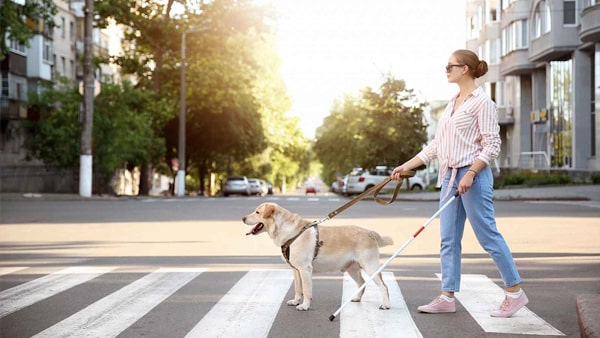
A pedestrian using a guide dog is about to cross in front of your vehicle as you prepare to turn right. What must you do?

You want to make a right turn at the corner. A pedestrian with a guide dog is at the corner ready to cross the street in front of you. Before making your right turn, you should:
  1. A Turn off the engine until the pedestrian signals you
  2. B Tell the pedestrian when it is safe to cross
  3. C Stop and wait until the pedestrian is safely clear
  4. D Sound the horn before completing the turn

Correct answer: C – Stop and wait until the pedestrian is safely clear

Iowa law requires a driver approaching a wholly or partially blind person led by a harnessed guide dog to come to a complete stop. The driver must take the precautions necessary to avoid an accident or injury. Wait until the pedestrian is safely clear of your turning path before proceeding.

Source: Iowa Code § 321.333 – Duty of drivers, Iowa Driver’s License Manual — § 4.4, “Braking and Stopping”

Question 6

Which driving technique helps prevent a skid on a slippery surface?

  1. A Apply the brakes sharply whenever you need to slow
  2. B Brake and steer smoothly, avoiding sudden stops or turns
  3. C Drive in another vehicle’s tire tracks at a short following distance
  4. D Aim for low areas where water or ice may collect

Correct answer: B – Brake and steer smoothly, avoiding sudden stops or turns

Hard braking can cause a vehicle to skid on snow, ice, gravel, or other low-traction surfaces. Slow down and make steering, braking, and acceleration changes gradually. Increase your following distance to provide more time for a smooth stop; emergency braking in an ABS-equipped vehicle should follow the vehicle manufacturer’s instructions.

Source: Iowa Driver’s License Manual — § 4.4, “Braking and Stopping”, Iowa Driver’s License Manual — § 5.6, “Rural/Gravel Road Driving”