


Kansas General Knowledge CDL Prep Test (KS) 4

4.9 out of 5 (52 votes)
80% Passing score
20 Questions
4 Mistakes allowed
If you're gearing up for your CDL in 2026, our fourth Kansas general knowledge CLD practice test is a valuable resource to help you get ready. Designed to mirror the real DMV exam, this 20-question test is a critical step in your preparation. To pass, you'll need to correctly answer at least 16 questions. The beauty of our Kansas CDL practice test lies in its format and flexibility. It adopts the same multiple-choice and true/false format as the actual DMV written permit test in 2026, offering an authentic experience. This approach helps you practice the skill of eliminating incorrect answers to pinpoint the right one, a crucial tactic for the real CDL general knowledge test. One of the standout features of our test is the ability to customize your practice sessions. We understand that everyone has different strengths and weaknesses when it comes to test topics. Therefore, you can focus your efforts on areas that need more attention, repeat the permit practice test to improve your score, and engage with the material at your own pace and at times that suit you best. What makes our Kansas general knowledge CDL test practice even more appealing is that it's completely free! While other platforms may charge for similar services, we believe in providing equal opportunities for everyone preparing for their CDL. Our DMV practice test is as comprehensive and feature-rich as any paid version out there, ensuring you get quality preparation without any cost. So, whether you're just starting out or looking to refine your skills, our fourth Kansas CDL practice test is an invaluable tool in your preparation arsenal in 2026. With a realistic format, customizable practice sessions, and no cost, you're set up for success. Start practicing today and get one step closer to acing your Kansas CDL test!
FREE CDL Practice Test App
Pass your Kansas CDL General Knowledge test with the NextDoorDriving app. Real questions and answers—100% free and ad-free.
Download on the App Store

Sample Kansas CDL Test Questions - General Knowledge

Question 1

What is off-tracking in a combination vehicle?

  1. A Operating the combination on an unpaved road
  2. B Passing another vehicle on the right
  3. C Moving the trailer onto the shoulder
  4. D The rear wheels following a different path from the front wheels

Correct answer: D – The rear wheels following a different path from the front wheels

During a turn, a vehicle’s rear wheels follow a different path from its front wheels; this is called off-tracking. The powered unit’s rear wheels off-track, and the trailer’s rear wheels off-track even more. With multiple trailers, the last trailer generally off-tracks the most, requiring the driver to allow adequate turning clearance.

Source: Kansas Commercial Driver’s License Manual (March 2025) — § 6.1.6, “Turn Wide”
Question 2

Besides keeping cargo low, what helps prevent a combination vehicle from rolling over?

  1. A Adjusting the brakes immediately before each turn
  2. B Holding the steering wheel as tightly as possible
  3. C Driving slowly through turns and ramps
  4. D Removing all fifth-wheel free play

Correct answer: C – Driving slowly through turns and ramps

Combination vehicles are more likely to roll when turns are taken too fast. Keep cargo close to the ground and reduce speed before corners, entrance ramps, and exit ramps. The load should also be centered, and sudden lane changes should be avoided, particularly when the vehicle is fully loaded.

Source: Kansas Commercial Driver’s License Manual (March 2025) — § 6.1.1, “Rollover Risks”

Question 3

A commercial vehicle is disabled on a two-way, undivided Kansas highway with a clear view in both directions. How should the three warning triangles be placed?

  1. A One within 10 feet of the vehicle and one about 100 feet in each direction
  2. B About 10, 100, and 200 feet behind the vehicle
  3. C About 100 feet ahead and 100 and 200 feet behind the vehicle
  4. D About 100, 200, and 500 feet behind the vehicle

Correct answer: A – One within 10 feet of the vehicle and one about 100 feet in each direction

On a two-way road or undivided highway, place one warning device within 10 feet of the vehicle to mark its location. Place the other two about 100 feet ahead of and behind the vehicle, on the shoulder or in the lane where it stopped. Federal motor-carrier rules establish this general placement pattern for a stopped commercial vehicle.

Source: Kansas Commercial Driver’s License Manual — § 2.5.2, “Communicating Your Presence”, 49 CFR § 392.22(b)(1) – Emergency Signals; Stopped Commercial Motor Vehicles

Question 4

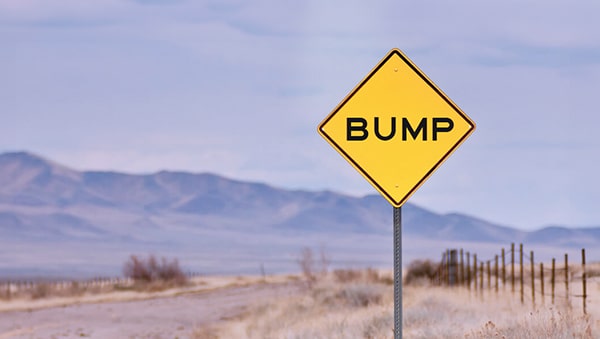
What does a BUMP warning sign indicate?

This sign warns drivers to _____________.
  1. A A low area in the roadway
  2. B A sharp rise in the roadway surface
  3. C A minimum-speed zone ahead
  4. D A dip that may collect water

Correct answer: B – A sharp rise in the roadway surface

A BUMP sign warns of a sharp rise in the roadway profile. It alerts drivers to a surface change that may require a lower speed to cross smoothly and maintain vehicle control. A DIP sign, rather than a BUMP sign, identifies a low place in the road.

Source: Manual on Uniform Traffic Control Devices, 11th Edition with Revision 1 — § 2C.26, “BUMP and DIP Signs (W8-1 and W8-2)”

Question 5

Which description best identifies black ice?

  1. A A thin, clear ice layer through which the pavement remains visible
  2. B Ice that has almost completely melted
  3. C A thick ice buildup found only along the shoulder
  4. D Ice that does not affect vehicle traction

Correct answer: A – A thin, clear ice layer through which the pavement remains visible

Black ice is a thin, clear layer through which the roadway can still be seen, making the surface appear wet. In Kansas winter conditions, a wet-looking road when the temperature is below freezing should be treated as a warning of possible black ice. This ice can sharply reduce traction.

Source: Kansas Commercial Driver’s License Manual — § 2.6.2, “Matching Speed to the Road Surface”

Question 6

After selecting the proper low gear for a long, steep downgrade, how should you use the service brakes?

  1. A Apply steady brake pressure for the entire descent
  2. B Use only engine braking, regardless of conditions
  3. C Brake to about 5 mph below the safe speed, release, and repeat as speed returns
  4. D Use the parking brake together with engine braking

Correct answer: C – Brake to about 5 mph below the safe speed, release, and repeat as speed returns

Apply the brakes firmly enough to produce a definite slowdown. When the vehicle reaches about 5 mph below the selected safe speed, release the brakes; the application should last about three seconds. When the vehicle returns to the safe speed, repeat the process. Continuous braking can create excessive heat and brake fade.

Source: Kansas Commercial Driver’s License Manual — § 2.16.4, “Proper Braking Technique”