Kansas DMV Practice Test 3

4.8 out of 5 (277 votes)
80% Passing score
20 Questions
4 Mistakes allowed
Kansas gives Class C knowledge test applicants more than one way to get the written portion done, and that is worth knowing before you start studying with one vague idea of “going to the DMV” floating around in your head. You can take the Kansas knowledge exam in person at a driver license office, or, if you’re eligible, online through KnowTo Drive, the official Kansas online driver knowledge exam platform. Appointments are recommended for office visits, which is one of those small details people tend to remember only after they are already irritated. This Kansas DMV practice test is built around the part you can actually control ahead of time: knowing the rules well enough that the format does not rattle you. It includes 20 carefully selected questions covering Kansas driving laws, road signs, speed limits, mobile-device rules, safe following distance, weather judgment, and the ordinary-but-important habits that show up again and again on permit exams. You need 16 correct answers to pass, so the scoring gives you a realistic measure of whether you are ready, nearly ready, or still leaning on guesses in places you probably should not. The real Kansas DMV permit test is not released question-for-question, so memorizing exact answers is not much of a strategy. A better use of your time is learning how the questions tend to work: read carefully, notice the legal wording, and pay attention to the small conditions that change the answer. This Kansas permit practice test is written to mirror the general DMV test format while keeping the focus on rules and judgment you will actually need once you are driving in Kansas. If you take the test online, KnowTo Drive has its own setup rules. You need a desktop or laptop computer, internet connection, keyboard and mouse, webcam, and an updated browser such as Chrome, Firefox, or Edge. Touch devices are not supported. The online Class C knowledge test has a 60-minute limit, registrations are valid for 14 days, and eligible Kansas residents can use it starting at age 14. Applicants under 18 need a Kansas-resident parent or guardian, age 18 or older, to register with them. Before test day, it is also worth sorting out the practical pieces that have nothing to do with knowing who has the right-of-way. The online KnowTo Drive test costs $6.50 per attempt, and Kansas learner permit or license fees are handled separately through the Kansas Department of Revenue. A regular Kansas learner permit is valid for 1 year and can be renewed by retaking and passing the written exam. You should also have your original identity, residency, Social Security number, and any name-change documents ready; copies are not accepted. For the actual studying, use every legitimate advantage available. Kansas provides the official driver handbook in English and Spanish, and the online test is offered in English and Spanish with audio support. Then use this free Kansas DMV practice test to turn that handbook knowledge into test-taking confidence. The questions help you practice the same kind of thinking you will need on Kansas roads, whether that means handling Wichita traffic, open rural highways, high winds, sudden snow, or just the long, quiet stretches where a driver’s attention can wander.

FREE DMV Practice Test App
Study for your Kansas permit test or driver’s license with the NextDoorDriving app. 700+ DMV questions and answers, 100% free!
Download on the App Store

Sample Kansas Permit Test Questions

Question 1

On a two-way road, yellow centerlines separate:

  1. A A center lane from traffic moving in the same direction
  2. B A bicycle lane from motor vehicles
  3. C Lanes traveling in the same direction
  4. D Traffic moving in opposite directions

Correct answer: D – Traffic moving in opposite directions

Yellow pavement lines are used between lanes carrying traffic in opposite directions. A dashed yellow line may permit passing when the opposing lane is clear. Solid yellow markings restrict passing, although a driver may cross a solid yellow line to turn when a safe gap exists.

Source: Kansas Driving Handbook — § 6, “Pavement Markings—Yellow Lane Markings”

Question 2

According to the Kansas handbook, what following interval should you allow behind a motorcycle in normal conditions?

When traveling behind a motorcycle:
  1. A At least two car lengths
  2. B Exactly two seconds
  3. C About three to four seconds
  4. D At least four motorcycle lengths

Correct answer: C – About three to four seconds

The handbook recommends a three- to four-second following interval behind a motorcycle, scooter, or moped. More space should be allowed in wet conditions. State law also requires every driver to maintain a following distance that is reasonable and prudent for the speed, traffic, and highway conditions.

Source: K.S.A. 8-1523(a) – Following another vehicle too closely, Kansas Driving Handbook — § 9, “Motorcycles, Scooters and Mopeds”

Question 3

At a Kansas railroad crossing without gates or flashing lights, what should you do?

  1. A Stop every time, even when no train is approaching
  2. B Slow down, look and listen, and be prepared to stop
  3. C Continue normally because every crossing has active signals
  4. D Accelerate to clear the tracks quickly

Correct answer: B – Slow down, look and listen, and be prepared to stop

Many passive railroad crossings have only warning signs and a crossbuck. Slow down, look in both directions, listen, and be prepared to stop before crossing. A stop is required 15 to 50 feet from the nearest rail when a train is plainly visible and hazardously close or gives an audible warning and presents an immediate hazard.

Source: K.S.A. 8-1551(a)(3)-(4) – Obedience to signal indicating approach of train or other on-track equipment, Kansas Driving Handbook — § 10, “Rural Road Driving—Highway-Railroad Grade Crossings”

Question 4

Which area is not a lawful parking space?

  1. A An access aisle beside or between accessible parking spaces
  2. B An unrestricted curbside parking space
  3. C An ordinary marked parking stall with no posted restriction
  4. D A public parking space that is open for general use

Correct answer: A – An access aisle beside or between accessible parking spaces

An access aisle beside or between designated accessible parking spaces is not a parking space. Kansas law prohibits stopping, standing, parking in, or blocking such an aisle, subject to limited statutory exceptions. A violation is an unclassified misdemeanor punishable by a fine of $50 to $100.

Source: K.S.A. 8-1,129(a)(4)-(5), (b) – Unlawful parking in accessible parking; blocking access ramp or aisle; penalties

Question 5

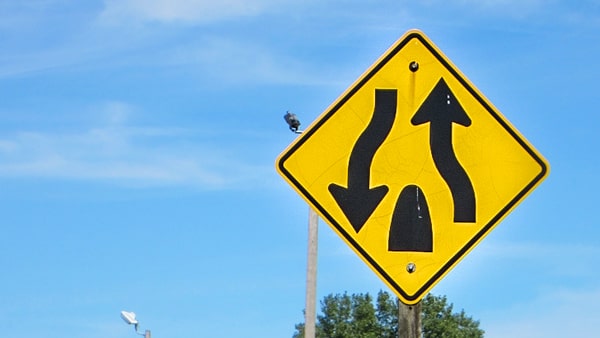
A yellow diamond sign showing the median between opposing traffic lanes ending means:

This sign means:
  1. A Turn at the next intersection
  2. B Divided highway ends ahead
  3. C One-way street ahead
  4. D Road closed ahead

Correct answer: B – Divided highway ends ahead

This sign warns that the divided highway ends ahead. The median or other physical divider separating opposing traffic will no longer continue. Drivers should be prepared for an undivided roadway carrying traffic in both directions.

Source: Kansas Driving Handbook — § 6, “Warning Signs”

Question 6

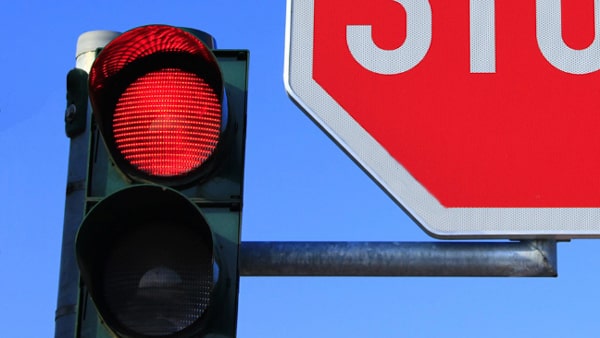
How must you respond to a flashing red traffic signal?

If you are approaching an intersection with a red flashing light, what should you do?
  1. A Enter the intersection without slowing
  2. B Slow down and yield without stopping
  3. C Wait until the signal displays green
  4. D Stop, then proceed when right-of-way rules permit

Correct answer: D – Stop, then proceed when right-of-way rules permit

A flashing red signal requires a complete stop at the stop line, before the near crosswalk, or at the nearest point with a view of intersecting traffic. After stopping, the same right-of-way rules used at a stop sign apply. Proceed only when the movement can be made safely.

Source: K.S.A. 8-1510(a)(1) – Flashing traffic signals