


Kansas Driving Test Practice 4

4.8 out of 5 (221 votes)
80% Passing score
20 Questions
4 Mistakes allowed
This Kansas DMV practice test is built around child safety seats, which is one of those topics every driver is expected to know, not just parents or people hauling around a backseat full of booster seats and dropped snacks. The test gives you 20 multiple-choice questions on Kansas child passenger safety rules, proper seat use, and the judgment calls that come with driving young passengers around. You need 16 correct answers to pass, so yes, it is manageable, but it is still a real check on whether you understand the material. The format is deliberately low-pressure. There is no time limit, which means you can read the question, sit with the wording for a second, and avoid that familiar mistake of answering what you thought it asked instead of what it actually asked. That makes this Kansas driving test practice useful for first-time drivers, license renewal applicants, senior drivers brushing up, and anyone using a Kansas driver permit practice test to tighten up the details before the real exam. Kansas licensing has a few age rules worth keeping straight while you study. The state allows a Class C instruction permit at age 14. Applicants younger than 16 need written approval from a parent or guardian, and they must pass the vision and written exams unless they bring a DE-99 form from an approved driver education course they are currently attending. Driver education is not required for the instruction permit itself, which people do confuse. It is required, however, for a 15-year-old restricted driver license. Also, Kansas does not accept online driver education courses for that requirement; approved courses come through local accredited school districts and are approved by the Kansas Department of Education. For a restricted license at 15, the applicant must have held a state-issued learner permit for at least one year, completed 25 hours of supervised driving, and finished an approved driver education course. At 16, the requirement shifts to 50 hours of supervised driving, including 10 hours at night, plus the vision, written, and driving exams unless a DE-99 completion slip covers the testing requirement. Updated for 2026, this Kansas drivers permit practice test keeps the focus where it belongs: learning the rule, understanding the reason behind it, and being ready to apply it when a child is actually riding in your vehicle.
FREE DMV Practice Test App
Study for your Kansas permit test or driver’s license with the NextDoorDriving app. 700+ DMV questions and answers, 100% free!
Download on the App Store

Sample Kansas Permit Test Questions

Question 1

What do two solid yellow lines between opposing lanes indicate?

  1. A Passing is allowed in both directions
  2. B Passing is prohibited in both directions
  3. C The area is a center left-turn lane
  4. D Both lanes carry traffic in the same direction

Correct answer: B – Passing is prohibited in both directions

The Kansas handbook states that two solid yellow lines between opposing lanes prohibit passing in both directions. Unlike a physical median, these markings do not create an absolute barrier. A driver may cross a solid yellow line to turn when a safe gap in traffic exists.

Source: Kansas Driving Handbook — § 6, “Yellow Lane Markings”
Question 2

Which driving behavior leaves too little space to avoid a rear-end crash if traffic ahead stops suddenly?

  1. A Checking mirrors regularly
  2. B Following another vehicle too closely
  3. C Scanning well ahead
  4. D Maintaining a steady lane position

Correct answer: B – Following another vehicle too closely

Kansas law requires a following distance that is reasonable and prudent for the vehicles’ speed, traffic, and highway conditions. Following too closely reduces the time and space available to react when traffic ahead slows or stops. The handbook recommends at least two seconds under prime conditions and four seconds under adverse conditions.

Source: K.S.A. § 8-1523(a) – Following Another Vehicle Too Closely, Kansas Driving Handbook — § 2, “Following Other Vehicles”

Question 3

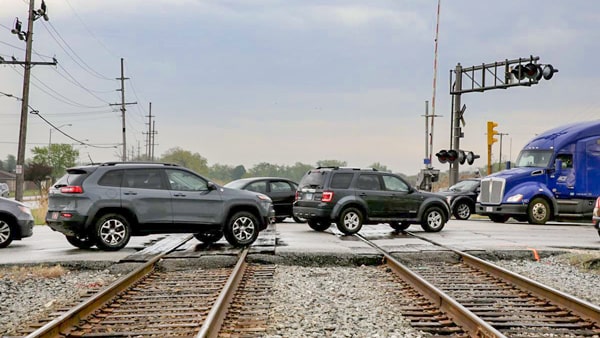
In slow traffic near railroad tracks, when may you begin crossing?

Before you reach the intersection, when crossing railroad tracks in slow traffic, you should:
  1. A When the vehicle ahead reaches the tracks
  2. B When you can stop briefly on the tracks
  3. C When there is room between the crossing gates
  4. D When enough space exists to clear the tracks completely

Correct answer: D – When enough space exists to clear the tracks completely

Do not drive onto a railroad grade crossing unless there is enough room on the far side for your entire vehicle. The law applies even when a traffic signal indicates that you may proceed. If traffic is stopped beyond the tracks, wait before the crossing until you can travel across without stopping.

Source: K.S.A. § 8-1584 – Restrictions on Driving into Intersection or Crosswalk or onto Railroad Grade Crossing, Kansas Driving Handbook — § 6, “Railroad Crossing Warning Signs”

Question 4

An oncoming vehicle begins turning left across your path. What is the safest response?

  1. A Maintain speed because you have priority
  2. B Slow down or stop to avoid a collision
  3. C Sound the horn while maintaining speed
  4. D Accelerate through the conflict area

Correct answer: B – Slow down or stop to avoid a collision

Kansas law requires a left-turning driver to yield to an oncoming vehicle that is an immediate hazard. If that driver turns across your path, maintaining or increasing speed could lead to a collision. The handbook directs drivers to do everything possible to prevent striking another vehicle, making slowing or stopping the appropriate response.

Source: K.S.A. § 8-1527 – Same; Turning Left, Kansas Driving Handbook — § 6, “Right-of-Way”

Question 5

In Kansas, you have a green light and want to turn left, but oncoming traffic prevents an immediate turn. What should you do?

  1. A Continue straight and turn at another intersection
  2. B Stop on the crosswalk and wait
  3. C Enter the intersection if the exit is clear, then wait for a safe gap
  4. D Turn immediately because the signal is green

Correct answer: C – Enter the intersection if the exit is clear, then wait for a safe gap

The handbook instructs a left-turning driver to pull into the intersection when the light turns green and be ready to turn. The driver must yield to oncoming vehicles that are close enough to be an immediate hazard. Enter only if sufficient space exists beyond the intersection, and complete the turn when a safe gap appears.

Source: K.S.A. § 8-1508(a)(1) – Traffic-Control Signal Legend, K.S.A. § 8-1527 – Same; Turning Left, Kansas Driving Handbook — § 6, “Turning—Left Turns”

Question 6

Which action is part of maintaining awareness while driving?

  1. A Checking the rearview and side mirrors regularly
  2. B Fixing your eyes only on the pavement ahead
  3. C Using high beams in fog
  4. D Following the vehicle ahead closely

Correct answer: A – Checking the rearview and side mirrors regularly

Effective visual searching includes looking ahead, to both sides, and behind your vehicle. Mirrors help you monitor traffic approaching from the rear and prepare for changes in speed or lane position. Fixating on only one area prevents you from maintaining full awareness of surrounding traffic.

Source: Kansas Driving Handbook — § 7, “Visual Search”