Kansas Road Signs Test

4.7 out of 5 (195 votes)
80% Passing score
10 Questions
2 Mistakes allowed
A Kansas DMV road sign practice test is worth taking seriously because sign questions are not decorative filler on the exam. They are part of the Kansas Class C knowledge test, which is the written test used for a standard noncommercial driver license or instruction permit. The full test has 25 questions drawn from the Kansas Driving Handbook, including traffic laws, safe driving habits, driver responsibility, impaired and distracted driving, sharing the road, rural driving, and, yes, road signs—the part many people think they already know because they have seen a stop sign before. This Kansas DMV road sign test gives you a focused way to work through that material without getting buried in the entire handbook at once. The practice test includes 20 multiple-choice questions on the signs Kansas drivers are expected to recognize by shape, color, symbol, and meaning. Warning signs, regulatory signs, guide signs, and the familiar-looking ones that still manage to cause second-guessing all belong here. And that matters, because on the real Kansas knowledge test, road sign questions are folded into the same exam as the traffic-law questions. There is not a separate road-sign-only test for a standard Class C permit or license, so these answers count toward your overall score. For this Kansas permit practice test, you will need 16 correct answers out of 20 to pass. On the official Kansas knowledge test, the practical passing target is 20 correct out of 25, or 80%, meaning you can miss up to 5 questions. Applicants may take the written test at a Kansas driver license office or online through KnowTo Drive. One more detail that is worth knowing before you get too casual about retesting: Kansas allows 4 chances to pass the written test. After that fourth failed attempt, the wait becomes much longer. Use this Kansas driving test practice as a concentrated sign review before you move into the broader exam material. Read the Kansas Driving Handbook, absolutely, but do not just skim the sign pages and call it handled. Shapes and colors do a lot of work on the test, and the faster you can connect them to meaning, the less room there is for hesitation. That is the quiet advantage of practicing signs separately: by the time they show up inside the full Kansas DMV test, they feel familiar instead of weirdly negotiable.
FREE DMV Practice Test App
Study for your Kansas permit test or driver’s license with the NextDoorDriving app. 700+ DMV questions and answers, 100% free!
Download on the App Store

Sample Kansas Permit Test Questions

Question 1

A five-sided sign showing two people above crosswalk lines means:

This road sign means:
  1. A School crossing
  2. B Business district
  3. C Sidewalk required
  4. D Pedestrian crossing prohibited

Correct answer: A – School crossing

The Kansas handbook identifies this symbol as a school crossing sign. It warns that students may cross the roadway at this location. Reduce speed as conditions require, watch carefully for children, and obey directions given by a school crossing guard.

Source: Kansas Driving Handbook — Section 6, “Warning Signs—School Crossing”
Question 2

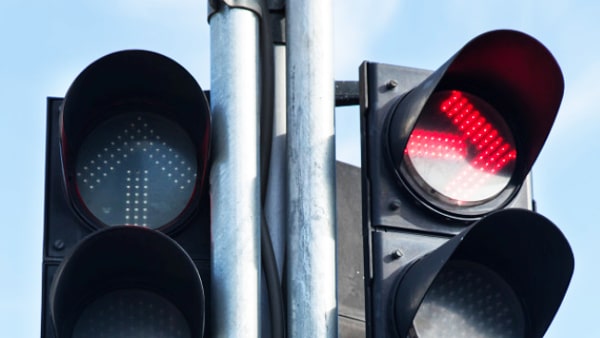
What does a steady red right arrow require?

A red arrow pointing to the right on a traffic light means you may:
  1. A Stop, then turn right when clear
  2. B Remain stopped until a signal permits the turn
  3. C Slow down before turning right
  4. D Turn if traffic behind you is waiting

Correct answer: B – Remain stopped until a signal permits the turn

In Kansas, a red arrow requires you to stop and remain stopped from moving in the arrow's direction until a green arrow or light appears. The handbook expressly states that you may not proceed in the arrow's direction while it remains red. This differs from an otherwise permitted right turn on a steady circular red signal.

Source: K.S.A. 8-1508(c)(1) – Traffic-control signal legend, Kansas Driving Handbook — Section 6, “Traffic Signals—Red Arrow”

Question 3

A five-sided sign showing an adult and child, without crosswalk lines, warns of:

This road sign means:
  1. A A stop sign ahead
  2. B A school area ahead
  3. C A shopping area ahead
  4. D A pedestrian-only sidewalk

Correct answer: B – A school area ahead

This is the school warning sign. It alerts drivers that they are approaching a school area where children may be present near or entering the roadway. Watch carefully and be prepared to adjust your speed or stop when necessary.

Source: Kansas Driving Handbook — Section 6, “Warning Signs—School”

Question 4

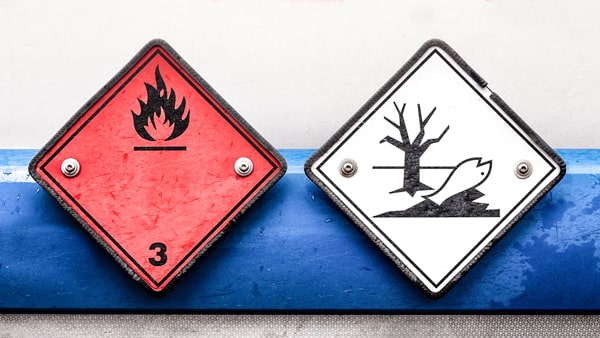
In general, what must the driver of a vehicle displaying a hazardous-material placard do at a railroad crossing?

Which of the following is true about vehicles displaying a diamond-shaped sign (indicating a hazardous load)?
  1. A Avoid all freeway routes
  2. B Travel no faster than 35 mph
  3. C Stop before crossing the tracks
  4. D Proceed before other vehicles

Correct answer: C – Stop before crossing the tracks

Kansas law requires covered hazardous-material vehicles to stop between 15 and 50 feet from the nearest rail, look and listen in both directions, and proceed only when safe. The requirement is subject to listed exceptions, including certain crossings controlled by a police officer, flagger, or qualifying green traffic signal. The vehicle must not manually shift gears while crossing.

Source: K.S.A. 8-1553(a)–(c) – Certain vehicles required to stop at railroad grade crossings; exceptions, K.A.R. 36-26-1 – Railroad grade crossings; stopping required

Question 5

What is the main hazard indicated by a SHOULDER DROP-OFF warning sign?

What should you be most concerned about when you see this sign?
  1. A Headlights may become misaligned
  2. B Tires will immediately become damaged
  3. C Water will always cover the shoulder
  4. D Leaving the pavement and steering back sharply may cause loss of control

Correct answer: D – Leaving the pavement and steering back sharply may cause loss of control

An uneven surface drop-off can lead to a serious crash if the driver panic-steers back toward the pavement. If your wheels leave the roadway, ease off the accelerator, avoid hard braking, and keep the vehicle under control. Return to the pavement gradually when traffic conditions permit.

Source: Kansas Driving Handbook — Section 7, “Uneven Surface Drop-Offs”

Question 6

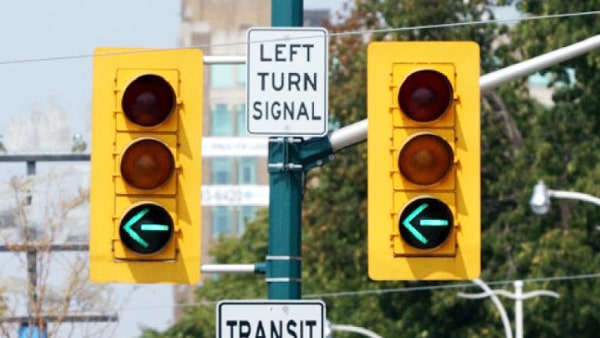
When facing a green left arrow, you may:

On the intersection, if you see a green arrow pointing to the left, you can:
  1. A Travel in any direction
  2. B Turn left after yielding to lawful roadway users still in your path
  3. C Turn left or proceed straight regardless of other indications
  4. D Turn only after all opposing vehicles receive a red light

Correct answer: B – Turn left after yielding to lawful roadway users still in your path

Kansas law permits traffic facing a green arrow to enter the intersection cautiously for the movement shown. The driver must still yield to pedestrians in an adjacent crosswalk and other traffic lawfully using the intersection. A green arrow does not excuse the driver from checking that the turn can be completed safely.

Source: K.S.A. 8-1508(a)(2) – Traffic-control signal legend, Kansas Driving Handbook — Section 6, “Traffic Signals—Green Arrow”