Kansas Road Signs Test 2

4.9 out of 5 (106 votes)
80% Passing score
20 Questions
4 Mistakes allowed
Kansas road signs are not just decoration in the handbook, and they are not treated that way on the Kansas Class C knowledge test either. They are folded into the same written exam that covers traffic laws, safe driving habits, driver responsibility, impaired and distracted driving, sharing the road, and the ordinary rules that become much less ordinary when you are trying to answer them under pressure. This Kansas DMV practice test gives you a focused way to work on the sign portion without pretending road signs live in a separate universe from the rest of the permit test. The real Kansas knowledge test has 25 questions. A practical passing score is 20 correct answers, or 80%, so you can miss up to 5. Road sign questions count inside that overall score; Kansas does not use a separate road-sign-only test for a standard Class C instruction permit or driver license. That matters, because a missed sign question is still a missed question. Shape, color, and symbol recognition are fair game, and the test can expect you to know the difference between a warning sign, a regulatory sign, a guide sign, and those school-zone or school-bus situations where the rule sounds simple until you realize the details are doing most of the work. This Kansas road signs permit test gives you 20 multiple-choice questions built for practice, repetition, and a little useful humility. You will see the kinds of signs drivers actually need on Kansas roads, from rural highways to town streets to busier intersections where everything happens a bit faster than you would prefer. Red signs, yellow signs, green signs, odd shapes, familiar symbols — all of it starts to feel more manageable once you have seen it more than once, and preferably more than once before exam day. You can take the official Kansas knowledge exam at a driver license office or online through KnowTo Drive. The online version has its own requirements, including a desktop or laptop, webcam, keyboard, mouse, updated browser, and no touch devices, plus a 60-minute time limit. Kansas also limits repeat attempts, so “I’ll just wing it” is not much of a strategy. Use this Kansas driving test practice until the answers stop feeling like guesses. That is the point: not drama, not panic, just enough familiarity that the real Kansas DMV sign test questions feel like something you have already dealt with.
FREE DMV Practice Test App
Study for your Kansas permit test or driver’s license with the NextDoorDriving app. 700+ DMV questions and answers, 100% free!
Download on the App Store

Sample Kansas Permit Test Questions

Question 1

In Kansas, a police officer lawfully directs you through a red light. Which instruction must you follow?
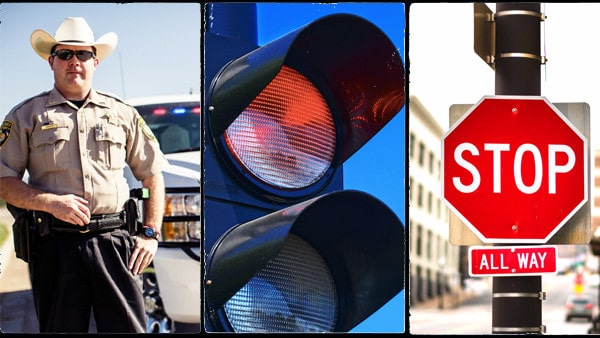
Which of the following must you obey over the other three?
  1. A The red traffic light
  2. B The police officer's direction
  3. C A nearby stop sign
  4. D A flashing red signal

Correct answer: B – The police officer's direction

Drivers must comply with lawful traffic directions given by police officers or authorized fire personnel. Traffic-control devices must ordinarily be obeyed, but the statute expressly recognizes directions from a police officer as controlling. Follow the officer's direction even when it differs from the displayed signal.

Source: K.S.A. 8-1503 – Required obedience to lawful order of police officer or fireman; misdemeanor, K.S.A. 8-1507(a) – Official traffic-control devices; required obedience; placement; presumptions

Question 2

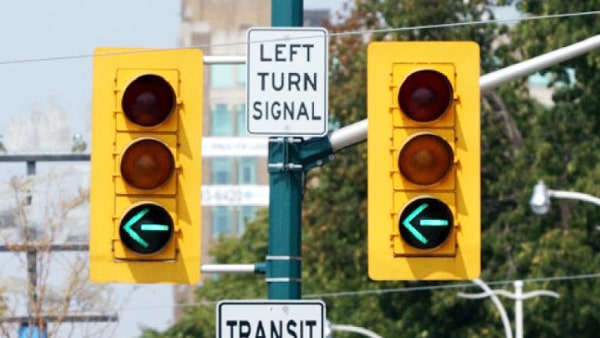
What does a green arrow pointing left authorize by itself?

A green arrow pointing to the left on a traffic light means you may:
  1. A Turning left or continuing straight without checking traffic
  2. B Turning left only after making another stop
  3. C Entering cautiously to turn left after yielding to lawful intersection users
  4. D Turning left even when the path is blocked

Correct answer: C – Entering cautiously to turn left after yielding to lawful intersection users

A green arrow permits a driver to enter cautiously and make the movement shown by the arrow. It does not remove the duty to yield to pedestrians lawfully in an adjacent crosswalk. Other traffic already lawfully using the intersection must also be allowed to clear.

Source: K.S.A. 8-1508(a)(2) – Traffic-control signal legend

Question 3

What is required when you face a flashing yellow traffic signal?

  1. A Merge into another lane
  2. B Proceed with caution
  3. C Stop for every pedestrian crossing
  4. D Come to a complete stop

Correct answer: B – Proceed with caution

A flashing yellow light permits traffic to proceed, but only with caution. The driving handbook advises slowing and being prepared to stop for traffic entering the intersection. Unlike a flashing red signal, a flashing yellow signal does not automatically require a complete stop.

Source: K.S.A. 8-1510(a)(2) – Flashing traffic signals, Kansas Driving Handbook — § 6, “Traffic Signals”

Question 4

What is the correct top-to-bottom order of lights on a vertical traffic signal?

From top to bottom, the following is the proper order for traffic lights:
  1. A Red, yellow, green
  2. B Red, green, yellow
  3. C Green, red, yellow
  4. D Green, yellow, red

Correct answer: A – Red, yellow, green

The Kansas handbook identifies the vertical order as red, yellow, and green from top to bottom. Yellow occupies the middle position. On a horizontal signal, red is on the left, yellow is in the middle, and green is on the right.

Source: Kansas Driving Handbook — § 6, “Traffic Signals”

Question 5

What must you do at a red, eight-sided STOP sign?

This sign means:
  1. A Slow down and stop only if another vehicle approaches
  2. B Stop completely, yield as required, and proceed when safe
  3. C Continue cautiously without stopping if the road looks clear
  4. D Stop only for traffic on the intersecting road

Correct answer: B – Stop completely, yield as required, and proceed when safe

A driver must stop at the marked stop line, before the near crosswalk if there is no line, or at the nearest point with a view of intersecting traffic. After stopping, the driver must yield to pedestrians in the adjacent crosswalk and vehicles presenting an immediate hazard. The driver may proceed when it is safe.

Source: K.S.A. 8-1528(b) – Stop signs and yield signs; duties of drivers, Kansas Driving Handbook — § 6, “Stop Sign”

Question 6

A yellow diamond sign showing a line from the right curving into your lane warns of:

This sign means:
  1. A Two-way traffic beginning ahead
  2. B A roadway narrowing from the left
  3. C Traffic merging into your roadway ahead
  4. D A divided highway beginning

Correct answer: C – Traffic merging into your roadway ahead

This warning sign identifies merging traffic ahead. It indicates that vehicles from another roadway may enter the traffic stream you are using. Watch the joining area and be prepared for traffic entering your roadway.

Source: Kansas Driving Handbook — § 6, “Warning Signs”