


Kansas DMV Sign Test 4

4.8 out of 5 (94 votes)
80% Passing score
20 Questions
4 Mistakes allowed
Kansas puts road signs inside the regular Class C knowledge test, not on some separate road-sign-only exam, which is worth knowing before you start studying the wrong thing with too much confidence. The real knowledge test has 25 questions, and you need 20 correct to pass. That gives you room to miss 5, and honestly, that room can disappear faster than people expect when the questions start leaning into sign shapes, colors, and symbols instead of plain common sense. This Kansas road signs practice test gives you a focused way to work on that part of the exam without dragging every licensing rule into the same study session. It uses 20 multiple-choice questions, with 16 correct matching the 80% passing standard, so the scoring feels familiar without pretending to be the full official test. The point is not to memorize every sign like you are collecting stamps. It is to recognize what a sign is telling you quickly: stop, yield, merge, slow down, watch for a school zone, prepare for a curve, pay attention to lane use, or understand that a symbol-only sign is not asking for your creative interpretation. And yes, the details matter. Kansas sign questions may ask about shape, color, and symbol identification, which sounds simple in a nice calm sentence like this one. Then you get several answer choices that all seem almost reasonable, and suddenly that calm sentence is less helpful. A red octagon, a yellow warning diamond, an orange work-zone sign, a railroad crossing marker, a school crossing sign—these are the things you want settled in your head before the DMV screen is involved. There are a few licensing facts that sit nearby, so keep them nearby. If you fail the written test, you can retake it the next working day, but Kansas limits you to 4 written-test attempts before a 6-month wait may apply. The online KnowTo Drive test has a 60-minute limit, and online registration is valid for 14 days. Teen drivers can start with an instruction permit at 14, with parent approval required for 14- and 15-year-olds, and supervised practice comes before restricted license privileges. Use this free Kansas DMV practice test as a sharp, practical warm-up for the road sign questions on the knowledge test. Read the handbook too, of course—nobody is pretending otherwise—but this is where you find out which signs you actually know and which ones were just sort of floating around in your memory looking familiar.
FREE DMV Practice Test App
Study for your Kansas permit test or driver’s license with the NextDoorDriving app. 700+ DMV questions and answers, 100% free!
Download on the App Store

Sample Kansas Permit Test Questions

Question 1

At an intersection, what does a flashing red traffic signal require?

  1. A Remain stopped until the signal is repaired
  2. B Wait for a police officer
  3. C Make a complete stop and follow stop-sign right-of-way rules
  4. D Continue through without changing speed

Correct answer: C – Make a complete stop and follow stop-sign right-of-way rules

A flashing red signal requires every approaching driver facing it to stop at the proper location. After stopping, the driver may proceed subject to the same yielding rules that apply at a stop sign. Do not enter until vehicles presenting an immediate hazard and pedestrians in the adjacent crosswalk have been given the right-of-way.

Source: K.S.A. 8-1510(a)(1) – Flashing traffic signals, K.S.A. 8-1528(b) – Stop signs and yield signs; duties of drivers
Question 2

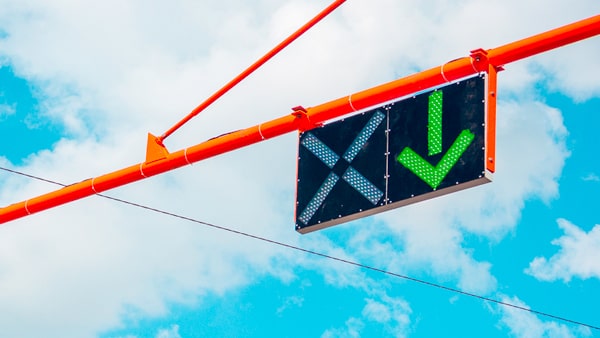
A steady downward green arrow over a traffic lane means:

This green arrow on a lane use control signal means that:
  1. A Traffic may use the lane
  2. B The lane is closed
  3. C Traffic in the lane has unconditional right-of-way
  4. D Drivers must merge into the lane

Correct answer: A – Traffic may use the lane

Kansas law provides that traffic may travel in a lane displaying a green lane-control signal. A steady red indication over a lane, by contrast, prohibits entering or traveling in that lane. The green arrow shows that the lane is open; it does not grant an unconditional right-of-way over other traffic.

Source: K.S.A. 8-1511(a), (c) – Lane-direction-control signals

Question 3

Orange-and-black traffic signs generally warn drivers about:

  1. A Permanent route closures
  2. B Work activity, workers, or temporary roadway changes
  3. C School speed zones
  4. D High-occupancy vehicle lanes

Correct answer: B – Work activity, workers, or temporary roadway changes

The Kansas handbook identifies orange-and-black signs as work-zone warnings. They may alert drivers to workers, detours, reduced speeds, construction equipment, or changing road surfaces. Reduce speed as directed and be prepared for temporary traffic controls.

Source: Kansas Driving Handbook — § 6, “Work Zone Signs”

Question 4

Under Kansas law, when may a driver turn left at a steady red signal?

  1. A From a two-way street onto a one-way street whenever traffic is clear
  2. B From a one-way street onto a two-way street
  3. C From a one-way street onto another one-way street proceeding left, after stopping and yielding, unless prohibited
  4. D Whenever the vehicle ahead makes the same turn

Correct answer: C – From a one-way street onto another one-way street proceeding left, after stopping and yielding, unless prohibited

A left turn on red is permitted only from a one-way roadway onto another one-way roadway proceeding to the left. The driver must first stop and may not turn if a sign prohibits it. Before turning, the driver must yield to pedestrians and traffic lawfully using the intersection.

Source: K.S.A. 8-1508(c)(1), (3) – Traffic-control signal legend

Question 5

Before proceeding in the direction of a green arrow, what must you still do?

  1. A Check only the vehicle behind you
  2. B Wait five seconds
  3. C Yield to pedestrians and other traffic lawfully using the intersection
  4. D Yield to vehicles but not pedestrians

Correct answer: C – Yield to pedestrians and other traffic lawfully using the intersection

A green arrow permits movement in the direction shown, but the driver must enter the intersection cautiously. Pedestrians lawfully within an adjacent crosswalk must be given the right-of-way. The driver must also yield to other traffic lawfully using the intersection.

Source: K.S.A. 8-1508(a)(2) – Traffic-control signal legend

Question 6

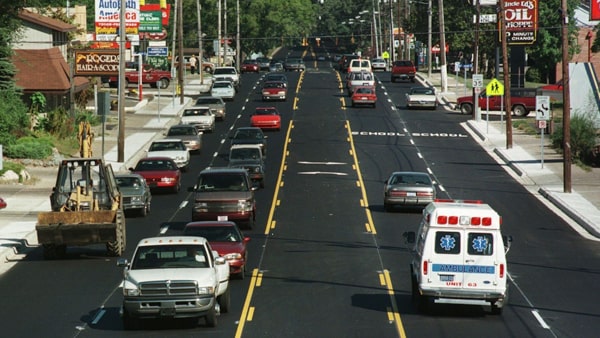
A shared center lane marked for use by traffic traveling in either direction is primarily for:

The center lane in the illustration is used for:
  1. A Regular through travel
  2. B Preparing for or making left turns
  3. C Passing slower vehicles
  4. D Emergency vehicles only

Correct answer: B – Preparing for or making left turns

Kansas law limits a marked two-way left-turn lane to preparing for or making a left turn into or from the roadway, or a U-turn when otherwise permitted. It cannot be used as a regular through lane. The solid yellow boundary also indicates that the lane is not for passing.

Source: K.S.A. 8-1545(b) – Required position and method of turning vehicles, Kansas Driving Handbook — § 6, “Shared Center Left Turn Lane”