Kentucky DMV Test Evaluation

4.6 out of 5 (2479 votes)
80% Passing score
10 Questions
2 Mistakes allowed
A Kentucky DMV practice test is useful for one very simple reason: it tells you, before the appointment and before the nerves kick in, whether the material is actually sticking. This KY DMV practice test keeps things short on purpose, with 10 randomly selected questions pulled from the kind of topics Kentucky expects new drivers to know: road signs, right-of-way, traffic laws, safe driving procedures, signals, pavement markings, sharing the road, and the usual impaired-driving material that people tend to skim and then regret skimming. You need 8 correct answers to pass this practice DMV test. That is not an accidental number. Kentucky’s written permit test is commonly treated as a 40-question multiple-choice exam, and the passing score is 80%, which means 32 correct answers and no more than 8 misses. So this shorter KY permit practice test gives you a quick read on where you stand without pretending it replaces the full thing. It is a checkpoint, basically. And it can help you pass the permit test on the first try.   The real Kentucky knowledge test is based on the Kentucky Driver Manual, and yes, road signs are a big part of it. Sign colors, shapes, regulatory signs, warning signs, lane markings, pavement markings, and traffic signals can all show up in the written test mix. That matters because plenty of drivers recognize a Stop sign, but Kentucky can ask about the less obvious stuff too, and that is where weak studying starts to show. There is also the licensing side, which is where things get a little more procedural, a little more “bring the right paper or enjoy coming back later.” Applicants under 18 are in Kentucky’s Graduated Driver Licensing Program and must be at least 15 to test for a permit. Teens have the 180-day permit period, 60 supervised driving hours, 10 of them at night, and restrictions like no driving from midnight to 6 a.m. without good cause. Adults are not all handled the same way either: ages 18 to 20 must hold a permit for 180 days, while first-time applicants 21 and older must hold one for at least 30 days. Take the practice test, review what you missed, and start to get your license ducks in a row.
FREE DMV Practice Test App
Study for your Kentucky permit test or driver’s license with the NextDoorDriving app. 700+ DMV questions and answers, 100% free!
Download on the App Store

Sample Kentucky Permit Test Questions

Question 1

A vehicle passes you on the right while both vehicles travel on a multilane roadway. When is this permitted?

  1. A Whenever the passing driver sounds the horn
  2. B Only when the vehicle being passed is a truck
  3. C Only when the passing vehicle uses the shoulder
  4. D When the pavement provides at least two unobstructed lines of traffic in the same direction and the pass can be made safely

Correct answer: D – When the pavement provides at least two unobstructed lines of traffic in the same direction and the pass can be made safely

Kentucky permits passing on the right when the roadway has unobstructed pavement wide enough for two or more lines of vehicles moving lawfully in the same direction. The maneuver must be possible in safety. Driving off the roadway to pass is generally prohibited unless the vehicle being passed is completely stopped and the movement can be made safely.

Source: KRS § 189.340(3)(b), (4) – Overtaking vehicles, bicycles, or electric low-speed scooters -- Traffic lanes -- Following vehicles -- Exemption for commercial motor vehicle platoon trailing vehicle, Kentucky Driver Manual — Section Seven, “Passing”
Question 2

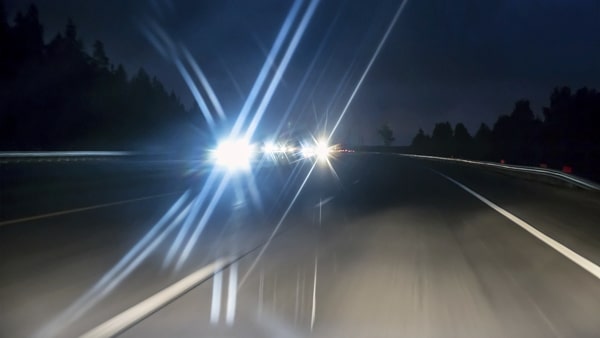
At night, an approaching driver does not dim the vehicle's high beams. Where should you direct your vision?

At night, if an oncoming vehicle fails to dim its high-beams, look:
  1. A Toward the centerline
  2. B Toward the right side of the road
  3. C Directly at the approaching headlights
  4. D Into the inside rearview mirror

Correct answer: B – Toward the right side of the road

Look toward the right side of the road to avoid becoming distracted or momentarily blinded by oncoming high beams. Do not stare directly into the headlights, but continue searching the roadway ahead. Keep your own lights properly dimmed rather than responding with high beams.

Source: Kentucky Driver Manual — Section Eleven, “Night Driving”

Question 3

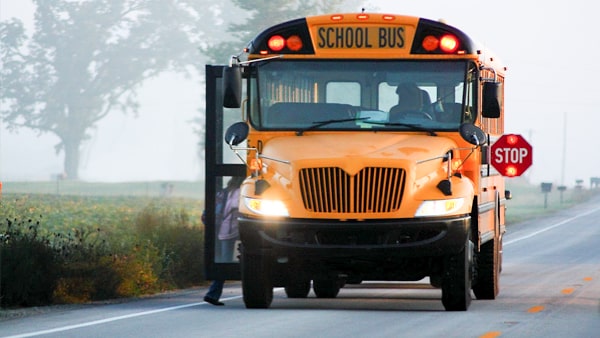
On a two-lane Kentucky highway, a school bus stops to unload children with its stop arm and signal lights activated. What must an approaching driver in the opposite lane do?

If a school bus stops to unload children on a two-lane highway, vehicles traveling in the opposite direction are:
  1. A Continue without stopping
  2. B Signal and pass at a reduced speed
  3. C Stop, then proceed as soon as the children reach the shoulder
  4. D Stop until unloading is complete and the bus begins moving

Correct answer: D – Stop until unloading is complete and the bus begins moving

With the stop arm and signal lights activated, drivers approaching a stopped school bus from either direction must stop. They may not proceed until the bus has completed receiving or discharging passengers and has been put into motion. The opposite-direction exception is limited to certain highways with four or more lanes.

Source: KRS 189.370(1) – Passing stopped school or church bus prohibited -- Application to properly marked vehicles -- Rebuttable presumption as to identity of violator, Kentucky Driver Manual — Section Seven, “Rules for School Buses”

Question 4

When parking downhill beside a curb, how should you position the front wheels?

Turn your front wheels toward the curb when you are parked:
  1. A Away from the curb
  2. B Straight ahead
  3. C Toward the curb
  4. D In either direction

Correct answer: C – Toward the curb

When facing downhill beside a curb, turn the front wheels toward the curb. The hill-parking guidance in the Kentucky manual shows this wheel position. If the vehicle begins moving, the front tire should contact the curb rather than allowing the vehicle to roll into the roadway.

Source: Kentucky Driver Manual — Section Seven, “Parking on a Hill”

Question 5

Your vehicle is parked facing uphill next to a curb. Which way should the front wheels point?

When parking your vehicle facing uphill with a curb, you should point your front wheels:
  1. A Toward the curb
  2. B Away from the curb
  3. C Either direction
  4. D Straight ahead

Correct answer: B – Away from the curb

When parking uphill with a curb, turn the front wheels away from the curb. The Kentucky manual’s hill-parking diagram specifies this position. If the vehicle begins rolling backward, the wheel is positioned to contact the curb and help prevent movement into traffic.

Source: Kentucky Driver Manual — Section Seven, “Parking on a Hill”

Question 6

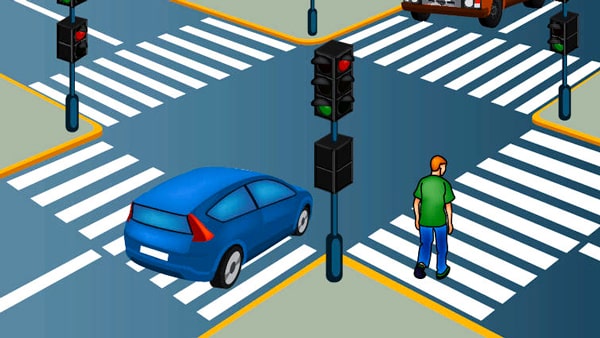
You are turning right on a green light while a pedestrian is already crossing in the adjacent crosswalk. Who has the right-of-way?

You are waiting at a red light to turn right, and a pedestrian on your right is waiting to cross the street you want to enter. Who has the right-of-way when your light turns green?
  1. A The pedestrian
  2. B You, if the crosswalk is unmarked
  3. C You, because the light is green
  4. D Whoever enters the travel lane first

Correct answer: A – The pedestrian

A green light permits a driver to proceed or turn, but the driver must yield to pedestrians lawfully within the intersection or an adjacent crosswalk. This duty applies to right and left turns. Wait until the pedestrian is safely clear of your path before completing the turn.

Source: KRS 189.338(1)(a) – Limitation of colored lights used in traffic-control signals -- Rules for vehicular and pedestrian traffic controlled by traffic-control signals -- Affirmative defense for motorcyclists, Kentucky Driver Manual — Section Ten, “Pedestrians”