


Kentucky Permit Practice Test 7

4.8 out of 5 (384 votes)
80% Passing score
20 Questions
4 Mistakes allowed
A good Kentucky permit practice test should do more than toss road signs at you and call it studying. This KY DMV practice test gives you 20 questions that stay close to what new drivers in the Commonwealth actually need to understand: traffic laws, sign meanings, right-of-way rules, safe driving habits, and Kentucky’s financial responsibility requirements, including proof of insurance. It is the kind of material that looks plain on the page, then gets a little less plain when you have to choose between two answers that sound almost the same. That is where practice helps. This seventh Kentucky practice permit test is built for steady, realistic prep before the real permit test. You can take it online from a phone, tablet, or computer, which means you are not locked into studying at a desk like it is 1998. There is no timer, either, so you can actually read the wording, think through the rule, and figure out why the correct answer is correct. A passing score is 16 out of 20, but the smarter move is to treat every missed question as a warning flare — small, maybe, but worth noticing before exam day. Kentucky also expects young drivers to understand that licensing is not just the written test. Applicants under 18 must bring a School Compliance Verification Form, usually from their school, while homeschool, alternative-school, and similar students get it through the local school district office. The No Pass / No Drive law is part of that same world of under-18 rules, and a suspension for school compliance issues can keep a driver from earning credit toward the required waiting period. It is paperwork, yes, but paperwork with consequences. Before the road skills test, drivers under 18 must present a Practice Driving Log to the Kentucky State Police license examiner. That log has to show 60 hours of supervised driving, including 10 nighttime hours, and it needs signatures from both the applicant and a parent or guardian. The test vehicle must also be properly registered and insured, with acceptable proof such as an insurance card, current policy, or binder from an agent. And, because Kentucky takes medical fitness seriously, the Medical Review Board may become involved after seizures, blackouts, loss of consciousness, altered awareness, or similar conditions; drivers generally must be free of those episodes for 90 days to obtain or keep driving privileges. Use this Kentucky permit test practice as a written-exam warm-up, but also as a quiet reminder that getting licensed in KY includes rules, records, insurance, and a few details people tend to learn late.
FREE DMV Practice Test App
Study for your Kentucky permit test or driver’s license with the NextDoorDriving app. 700+ DMV questions and answers, 100% free!
Download on the App Store

Sample Kentucky Permit Test Questions

Question 1

What is required when you approach a stop sign?
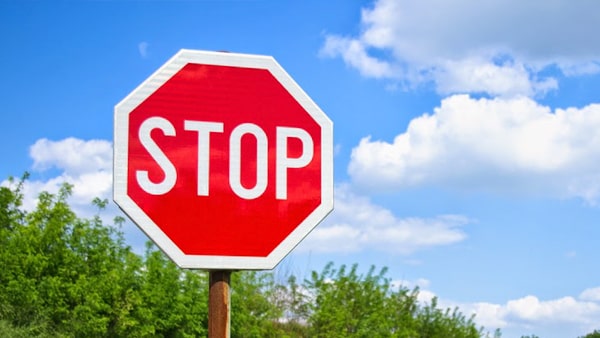
When you see this sign, you must:
  1. A Stop at the stop line or other legally designated point, then yield before entering
  2. B Slow down and proceed without stopping if the road appears clear
  3. C Stop and wait for a traffic signal to turn green
  4. D Stop only when another vehicle is approaching

Correct answer: A – Stop at the stop line or other legally designated point, then yield before entering

A driver must stop at the marked stop line. If there is no line, stop before the near crosswalk or at the nearest point with a view of approaching traffic. After stopping, yield to vehicles in or approaching the intersection closely enough to present an immediate hazard.

Source: KRS 189.330(3)–(4) – Turning and right-of-way at intersections, Kentucky Driver Manual — Section Six, “Traffic Signs”
Question 2

If your engine shuts off while the vehicle is moving, which actions should you take?

  1. A Grip the steering wheel firmly because steering may become difficult
  2. B Brake steadily and guide the vehicle off the roadway
  3. C After stopping, try to restart; if unsuccessful, use emergency flashers and call for help
  4. D All of these actions

Correct answer: D – All of these actions

Keep a firm grip because loss of power assistance may make steering harder. Look for a safe escape path, apply steady rather than hard braking, and pull off the roadway. Once stopped, try restarting the engine; if that fails, activate the emergency flashers, raise the hood, and request assistance.

Source: Kentucky Driver Manual — Section Nine, “Power Failure”

Question 3

Before making a left turn, how long must you yield to approaching traffic?

  1. A Until at least two vehicles have passed
  2. B Until vehicles close enough to create an immediate hazard have passed
  3. C Until every visible vehicle has passed
  4. D Only until the traffic light begins changing to red

Correct answer: B – Until vehicles close enough to create an immediate hazard have passed

Kentucky law requires a driver turning left to yield to an oncoming vehicle that is already within the intersection or is close enough to constitute an immediate hazard. The driver may turn after that hazard has cleared and the movement can be completed safely. This duty also applies when turning left into an alley, private road, or driveway.

Source: KRS 189.330(9) – Turning and right-of-way at intersections

Question 4

In Kentucky, when may a driver turn left while facing a steady red light?

  1. A Whenever no opposing traffic is visible
  2. B From a two-way street onto a one-way street
  3. C From the left lane of a one-way street into the left lane of another one-way street, after stopping
  4. D Whenever the vehicle ahead completes the same turn

Correct answer: C – From the left lane of a one-way street into the left lane of another one-way street, after stopping

After stopping, a driver in the left lane of a one-way roadway may turn left into the left lane of another one-way roadway carrying traffic in the direction of the turn. The movement is prohibited if an official sign forbids it. The driver must yield to pedestrians and other traffic lawfully using the intersection.

Source: KRS 189.338(3)(a)2., (3)(b) – Limitation of colored lights used in traffic-control signals -- Rules for vehicular and pedestrian traffic controlled by traffic-control signals -- Affirmative defense for motorcyclists

Question 5

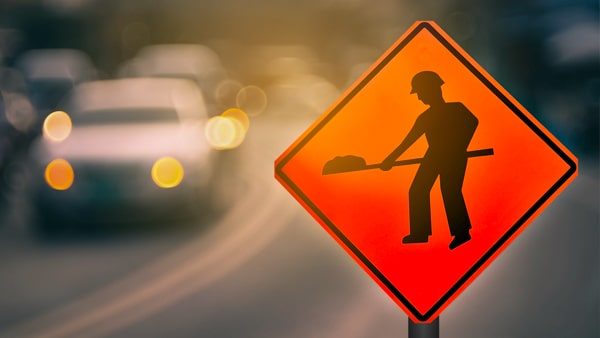
An orange diamond sign showing a worker with a shovel warns of:

This sign means that:
  1. A A roadside litter collection group
  2. B Workers on or near the roadway ahead
  3. C A playground area
  4. D A pedestrian crosswalk

Correct answer: B – Workers on or near the roadway ahead

The sign warns that workers may be on or close to the roadway in a work zone. Watch for cones, barriers, equipment, flaggers, and changes in the road surface or traffic pattern. Reduce speed, allow additional space, and obey directions from authorized traffic controllers.

Source: Kentucky Driver Manual — Section Six, “Work Zone Signs”, Kentucky Driver Manual — Section Eleven, “Work Zones”

Question 6

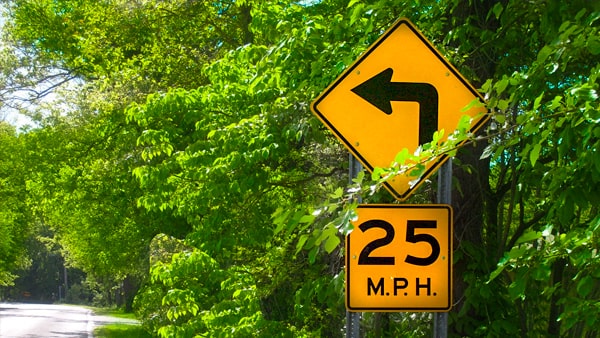
A yellow sign shows a left curve with a smaller “25 MPH” plaque below it. What does the combination mean?

This sign means:
  1. A Left curve ahead; drivers must travel at least 25 mph
  2. B Right curve ahead; the advisory speed is 25 mph
  3. C Left curve ahead; the regulatory speed limit is always 25 mph
  4. D Left curve ahead; the advisory speed for the curve is 25 mph

Correct answer: D – Left curve ahead; the advisory speed for the curve is 25 mph

The warning sign shows that the roadway curves left, and the plaque provides an advisory speed of 25 mph for the curve. Reduce speed before entering the curve and maintain a speed that allows smooth vehicle control. Poor visibility or reduced traction may require traveling below the advisory speed.

Source: Kentucky Driver Manual — Section Six, “Traffic Signs—Warning Signs”, Kentucky Driver Manual — Section Eight, “Adjusting To Roadway Conditions”