


Kentucky DMV Sign Test 3

4.9 out of 5 (257 votes)
80% Passing score
20 Questions
4 Mistakes allowed
Kentucky road signs deserve more attention than most people give them, mostly because they show up inside the official written knowledge test along with traffic laws, pavement markings, safe driving procedures, signals, impaired-driving rules, and all the other material pulled from the Kentucky Driver Manual. So, yes, this KY DMV road signs test is focused, but it is not some extra little practice activity floating outside the real exam. It targets the sign knowledge Kentucky expects you to have before you walk into a KSP testing location for the permit test. This practice test keeps the attention where it belongs: sign shapes, colors, and meanings. The octagon, the triangle, the warning sign that looks familiar until you realize you never actually learned what it was warning you about—those details matter. Kentucky can include questions on regulatory signs, warning signs, guide signs, lane markings, traffic signals, and pavement markings, and the official sources reviewed do not show a separate road-sign-only score. The signs are folded into the written knowledge test, which is exactly why it makes sense to study them on their own for a while, even if that sounds a little too serious for reflective metal on a post. The official Kentucky permit knowledge test is commonly reported as 40 multiple-choice questions, with an 80% passing score. That means 32 correct answers and no more than 8 missed. Not impossible. Also not something to stroll into after glancing at a few red and yellow signs like they are all self-explanatory, because some are, and then some are absolutely not. This Kentucky road signs practice test gives you a cleaner way to rehearse the visual side of the exam before the official version starts counting. Each question is paired with a road sign image, which is useful in the plainest possible sense: you see the sign, you choose the meaning, and your brain starts connecting the shape and color with the action expected on the road. That matters whether you are driving through Louisville traffic, easing along a rural highway, or meeting one of Kentucky’s many slow, wide, inconveniently timed vehicles on a road that suddenly feels narrower than it looked a minute ago. Take this KY DMV road sign test as many times as needed. Miss the weird ones here. Fix the guesses here. Build the recognition here, where the stakes are mercifully low and nobody at the testing counter needs to know how many tries it took.
FREE DMV Practice Test App
Study for your Kentucky permit test or driver’s license with the NextDoorDriving app. 700+ DMV questions and answers, 100% free!
Download on the App Store

Sample Kentucky Permit Test Questions

Question 1

A diamond-shaped warning sign displaying a walking person indicates:

This sign means:
  1. A. A children's play area
  2. B. A pedestrian crossing ahead
  3. C. A sidewalk closed to pedestrians
  4. D. A mandatory stop ahead

Correct answer: B. – A pedestrian crossing ahead

The walking-person symbol warns of a pedestrian crossing. Reduce speed, search the roadway and its edges, and be prepared to stop if necessary. Where traffic signals are not operating, a driver must yield to a pedestrian crossing the roadway, slowing or stopping when needed.

Source: KRS § 189.570(4) – Pedestrians, Kentucky Driver Manual — § 6, “Traffic Signs—Warning Signs”

Question 2

A steady yellow left-turn arrow appears while you are in a dedicated turn lane. What does it indicate?

  1. A. The protected turn will continue indefinitely
  2. B. You should accelerate into the intersection
  3. C. The green movement is ending, and a red indication may follow
  4. D. All opposing vehicles and pedestrians must remain stopped

Correct answer: C. – The green movement is ending, and a red indication may follow

Under Kentucky signal rules, a steady yellow indication warns that the related green movement is ending or that red will appear immediately afterward. If you have not entered the intersection, be prepared to stop safely. Do not accelerate merely to beat the changing signal.

Source: KRS § 189.338(2)(a) – Limitation of colored lights used in traffic-control signals -- Rules for vehicular and pedestrian traffic controlled by traffic-control signals -- Affirmative defense for motorcyclists, Kentucky Driver Manual — § 6, “Traffic Signals”

Question 3

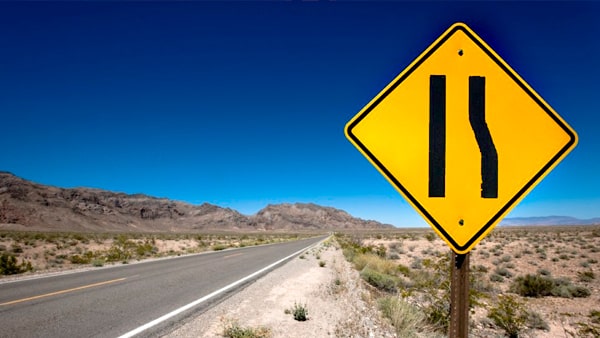
A warning sign showing the right lane tapering into the left lane means:

This sign means:
  1. A. The right lane ends ahead
  2. B. A divided highway begins
  3. C. A steep hill is ahead
  4. D. Trucks will cross the roadway

Correct answer: A. – The right lane ends ahead

This sign warns that the right lane will end ahead. Drivers in that lane should check mirrors and the blind spot, signal, and identify a safe gap before moving left. Drivers must remain within their lane until they have determined that a lane change can be completed safely.

Source: Kentucky Driver Manual — § 6, “Traffic Signs—Warning Signs”, Kentucky Driver Manual — § 7, “Changing Lanes”, KRS § 189.340(7)(a) – Overtaking vehicles, bicycles, or electric low-speed scooters -- Traffic lanes -- Following vehicles -- Exemption for commercial motor vehicle platoon trailing vehicle

Question 4

When a traffic signal changes from red to green, what must you do before entering the intersection?

  1. A. Proceed immediately because all other traffic must stop
  2. B. Check that the path is clear and yield to lawful traffic and pedestrians still in the intersection
  3. C. Sound the horn to warn crossing traffic
  4. D. Wait for the vehicle behind you to begin moving

Correct answer: B. – Check that the path is clear and yield to lawful traffic and pedestrians still in the intersection

Kentucky law permits movement on green but requires drivers to yield to vehicles and pedestrians lawfully within the intersection or an adjacent crosswalk. Before moving, look for crossing traffic and bicyclists and verify that your path is clear. Do not enter immediately merely because the light changed.

Source: KRS § 189.338(1)(a) – Limitation of colored lights used in traffic-control signals -- Rules for vehicular and pedestrian traffic controlled by traffic-control signals -- Affirmative defense for motorcyclists, Kentucky Driver Manual — § 7, “Intersections”

Question 5

Which of these signs normally has a vertical rectangular shape?

  1. A. School crossing sign
  2. B. Railroad advance-warning sign
  3. C. Stop sign
  4. D. Speed limit sign

Correct answer: D. – Speed limit sign

A vertical rectangle generally identifies a regulatory sign. Speed limit signs regulate the lawful speed of traffic and use this shape. School signs are normally pentagonal, railroad advance-warning signs are round, and stop signs are octagonal.

Source: Kentucky Driver Manual — § 6, “Standard Shapes”, Kentucky Driver Manual — § 6, “Traffic Signs—Regulatory Signs”

Question 6

What is the usual top-to-bottom order of lights on a vertical traffic signal?

From top to bottom, the following is the proper order for traffic lights:
  1. A. Red, yellow, green
  2. B. Red, green, yellow
  3. C. Green, red, yellow
  4. D. Green, yellow, red

Correct answer: A. – Red, yellow, green

On a standard vertical traffic signal, red is at the top, yellow is in the middle, and green is at the bottom. Horizontal signals place red on the left, yellow in the center, and green on the right. The consistent arrangement helps drivers recognize each indication.

Source: Kentucky Driver Manual — § 6, “Traffic Signals”