Kentucky DMV Sign Test 4

4.9 out of 5 (266 votes)
80% Passing score
20 Questions
4 Mistakes allowed
Getting ready for the Kentucky permit test means more than glancing at a few stop signs and hoping the rest feels familiar. The written knowledge test is built around the Kentucky Driver Manual, and yes, road signs matter, but they sit alongside traffic laws, safe driving habits, pavement markings, signals, sharing the road, and the kind of rules that sound simple until the test asks them in a very Kentucky-specific way. This KY DMV practice test keeps that bigger picture in view. You’ll see multiple-choice questions that help reinforce the same core topics found on the real Kentucky written permit test, including highway signs, regulatory signs, warning signs, guide signs, lane markings, and basic right-of-way thinking. The road sign practice is especially useful because Kentucky does not treat signs like a cute little extra. Shapes, colors, symbols, and markings are part of the knowledge test, and quick recognition is what you need both for passing and for not hesitating when a yellow warning sign or red regulatory sign shows up in real traffic. The Kentucky written permit test is commonly reported as 40 questions, with an 80% passing score, which means 32 correct answers and no more than 8 missed. So, no, this is not a test you want to treat like a casual warm-up. If you miss a question here, the practice test gives you a chance to slow down, look at the explanation, and actually fix the gap instead of just clicking around and pretending the mistake never happened. We have all done that. It is not a strategy. For younger drivers, the stakes are tied into Kentucky’s Graduated Driver Licensing process. Applicants can start at age 15, and drivers under 18 have extra requirements, including supervised driving hours, nighttime practice, passenger limits, and a driver education requirement before a full unrestricted license. Adults have their own permit holding periods too, including 180 days for ages 18 to 20 and at least 30 days for applicants 21 and older. Use this Kentucky permit practice test as a focused study tool, not just a score-chasing exercise. The goal is to recognize the rules, signs, and driving decisions quickly enough that the real test feels familiar, maybe not fun, but absolutely manageable.
FREE DMV Practice Test App
Study for your Kentucky permit test or driver’s license with the NextDoorDriving app. 700+ DMV questions and answers, 100% free!
Download on the App Store

Sample Kentucky Permit Test Questions

Question 1

Which centerline marking prohibits passing by traffic in both directions?

  1. A One solid yellow line beside one broken yellow line
  2. B A single broken yellow line
  3. C Two solid yellow lines
  4. D A single broken white line

Correct answer: C – Two solid yellow lines

Two solid yellow centerlines separate opposing traffic and mark a two-direction no-passing zone. Drivers traveling in either direction may not cross these lines to overtake another vehicle. Kentucky has adopted the MUTCD standards that establish this meaning for centerline markings.

Source: 603 KAR 5:050 §§ 2–3 – Uniform traffic control devices, Manual on Uniform Traffic Control Devices for Streets and Highways, 11th ed. § 3B.01, “Yellow Center Line Pavement Markings”
Question 2

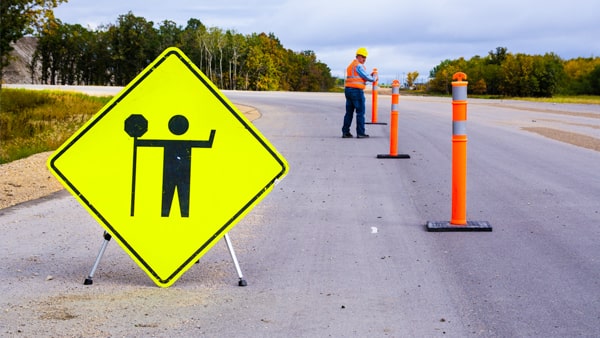
The pictured orange diamond sign showing a flagger means:

This sign means:
  1. A Pedestrian crossing ahead
  2. B End of the work zone
  3. C School crossing ahead
  4. D A flagger is controlling traffic ahead

Correct answer: D – A flagger is controlling traffic ahead

This sign warns that a flagger is stationed ahead to control traffic through a temporary traffic-control zone. Slow down and be prepared to follow the flagger’s directions. Flaggers ordinarily use a STOP/SLOW paddle; flags are reserved for emergency situations under the standards adopted in Kentucky.

Source: 603 KAR 5:050 §§ 2–3 – Uniform traffic control devices, Manual on Uniform Traffic Control Devices for Streets and Highways, 11th ed. Figure 6H-1, “Warning Signs and Plaques in Temporary Traffic Control Zones”, Manual on Uniform Traffic Control Devices for Streets and Highways, 11th ed. §§ 6D.02–6D.05, “STOP/SLOW Paddle for Hand-Signaling” and “Flagger Procedures”

Question 3

Your signal turns green, but vehicles are still blocking your path through the intersection. What should you do?

  1. A Enter and wait inside the intersection
  2. B Drive around the vehicles if space is available
  3. C Remain stopped until your path is clear
  4. D Enter because the green light gives you priority

Correct answer: C – Remain stopped until your path is clear

Kentucky law requires traffic facing a circular green signal to yield to vehicles and pedestrians lawfully within the intersection or an adjacent crosswalk. If vehicles remain in your path, wait until they have cleared and you can proceed safely. A green light permits movement; it does not authorize driving into occupied space.

Source: KRS 189.338(1)(a) – Limitation of colored lights used in traffic-control signals -- Rules for vehicular and pedestrian traffic controlled by traffic-control signals -- Affirmative defense for motorcyclists, Kentucky Driver Manual — Section Six, “Yielding Right of Way”

Question 4

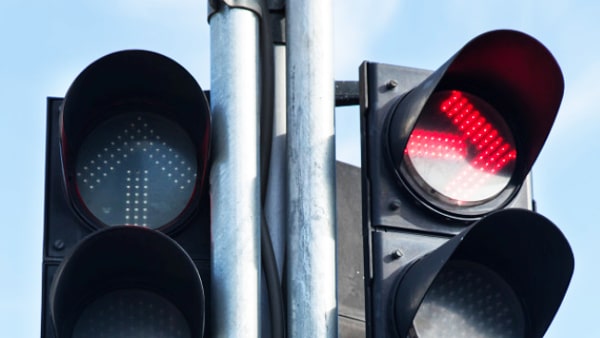
At a steady right-pointing red arrow, with no sign or signal permitting the turn, you must:

A red arrow pointing to the right on a traffic light means you may:
  1. A Turn right after stopping
  2. B Remain stopped until the signal permits the turn
  3. C Slow down and turn if traffic is clear
  4. D Turn to avoid delaying traffic behind you

Correct answer: B – Remain stopped until the signal permits the turn

A steady red arrow prohibits entering the intersection to make the movement shown by the arrow. Stop at the stop line, before the crosswalk if no line exists, or before entering the intersection if neither is present. Remain stopped until a signal or other traffic-control device permits the right turn.

Source: KRS 189.231(2) – State maintained highways -- Restriction and regulation of traffic, 603 KAR 5:050 §§ 2–3 – Uniform traffic control devices, Manual on Uniform Traffic Control Devices for Streets and Highways, 11th ed. § 4A.03, “Meanings of Steady Vehicular Signal Indications”

Question 5

The pictured diamond warning sign with a black cross symbol indicates:

This sign shows one type of:
  1. A A crossroad intersection ahead
  2. B A series of roadway curves
  3. C A mandatory right turn
  4. D A lane shift ahead

Correct answer: A – A crossroad intersection ahead

The Cross Road warning sign indicates that another road intersects your roadway ahead. It warns of the intersection and the possibility of vehicles turning or entering from the crossing road. Watch for cross traffic and obey any regulatory signs or signals at the intersection.

Source: 603 KAR 5:050 §§ 2–3 – Uniform traffic control devices, Manual on Uniform Traffic Control Devices for Streets and Highways, 11th ed. § 2C.41, “Intersection Warning Signs (W2-1 through W2-8)”

Question 6

A solid yellow centerline may be crossed when you are:

  1. A Passing a slower vehicle
  2. B Driving during daylight hours
  3. C Following traffic that crossed the line
  4. D Making a permitted left turn into or from a driveway

Correct answer: D – Making a permitted left turn into or from a driveway

A solid yellow line prohibits crossing to pass when it is on your side of the centerline. A driver may cross the center while making a permitted left turn into or from an alley, private road, or driveway when the movement can be completed safely. The driver turning left must yield to oncoming traffic that presents an immediate hazard.

Source: KRS 189.330(9) – Turning and right-of-way at intersections, KRS 189.345(2) – Prohibitions against driving on left side of roadway, Kentucky Driver Manual — Section Six, “Pavement Markings”