Kentucky Road Signs Test Simulator

4.9 out of 5 (297 votes)
80% Passing score
25 Questions
5 Mistakes allowed
Kentucky road signs deserve more attention than most people give them. They are not separate from the real permit test, not in any official neat little bucket, but they do sit inside the written knowledge exam alongside traffic laws, safe driving procedures, rules of the road, signals, pavement markings, impaired driving, and all the other material pulled from the Kentucky Driver Manual. So yes, knowing signs matters. More than people tend to admit after they have driven past the same yellow diamond for ten years without thinking about what the shape alone is supposed to tell them. This Kentucky DMV practice test keeps the focus tightly on road signs, traffic signals, lane markings, and pavement markings, which is exactly why it is useful. The full Kentucky written permit test is commonly reported as 40 multiple-choice questions, and the passing score is 80%, so that means 32 correct answers, with no more than 8 missed. This practice test uses the same 80% idea in a smaller, more targeted format: 20 questions, with 16 correct needed to pass. It is not trying to replace the full KY DMV permit test. It is built to sharpen the part of the test where visual recognition and rule knowledge overlap. Each round pulls from a larger question bank, so retaking it does not feel like tapping through the same stale quiz until muscle memory takes over. You will see regulatory signs, warning signs, guide signs, sign colors and shapes, lane-use clues, traffic signals, and pavement markings mixed in the way they should be studied — close enough together that your brain starts sorting them properly. There is a small satisfaction in that, weirdly. Maybe not thrilling, but it works. The test is especially useful because Kentucky applicants do not all arrive at the permit stage the same way. Teens under 18 enter the Graduated Driver Licensing Program, adults ages 18 to 20 must hold a permit for 180 days before the road test, and first-time applicants 21 or older must hold one for at least 30 days. But every route starts with getting through the knowledge test and vision screening. After each practice session, the summary shows what you missed and gives the correct answers. Read that part. Slowing down there is where the learning usually happens, especially with signs that look familiar but carry a stricter meaning than “probably slow down.”
FREE DMV Practice Test App
Study for your Kentucky permit test or driver’s license with the NextDoorDriving app. 700+ DMV questions and answers, 100% free!
Download on the App Store

Sample Kentucky Permit Test Questions

Question 1

The pictured warning sign showing one traffic stream joining another means:
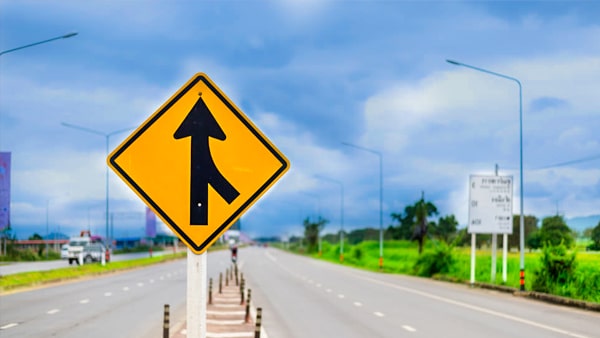
This sign means:
  1. A Two-way traffic begins ahead
  2. B The roadway becomes narrower
  3. C Traffic will merge into your roadway
  4. D A divided highway begins

Correct answer: C – Traffic will merge into your roadway

A Merge sign warns drivers on the main roadway that traffic from another roadway may join their traffic stream ahead. It is used where lanes from separate roadways converge and a merging movement is required. Watch the entering roadway and adjust your driving as necessary for surrounding traffic.

Source: 603 KAR 5:050 §§ 2–3 – Uniform traffic control devices, Manual on Uniform Traffic Control Devices for Streets and Highways, 11th ed. § 2C.45, “Merge Signs and Plaque (W4-1, W4-5, and W4-5aP)”
Question 2

Before proceeding into an intersection after stopping, which directions should you check?

  1. A Ahead and left only
  2. B Left and right only
  3. C Left, right, and ahead
  4. D Ahead and right only

Correct answer: C – Left, right, and ahead

After stopping, a driver must yield to vehicles already in the intersection and to approaching vehicles that present an immediate hazard. Looking left, right, and ahead provides the complete check among these choices and covers cross traffic as well as traffic in the intended path. Proceed only when the required right-of-way has been yielded.

Source: KRS 189.330(4) – Turning and right-of-way at intersections, Kentucky Driver Manual — Section Six, “Yielding Right of Way”

Question 3

You must not cross a broken white or yellow line when:

  1. A The movement would interfere with other traffic
  2. B Turning left into a driveway
  3. C Passing a disabled vehicle safely
  4. D Passing on the right on a one-way street

Correct answer: A – The movement would interfere with other traffic

Broken lines permit certain lane changes or passing maneuvers, but they do not give a driver an unconditional right to cross. A lane change must be made safely, and a pass using the left side must not interfere with approaching or overtaken traffic. White broken lines separate same-direction lanes, while broken yellow lines separate opposing traffic where passing may be permitted.

Source: KRS 189.300(1) – Vehicles to keep to right -- Exceptions, KRS 189.340(5), (7)(a) – Overtaking vehicles, bicycles, or electric low-speed scooters -- Traffic lanes -- Following vehicles -- Exemption for commercial motor vehicle platoon trailing vehicle, Kentucky Driver Manual — Section Six, “Pavement Markings”

Question 4

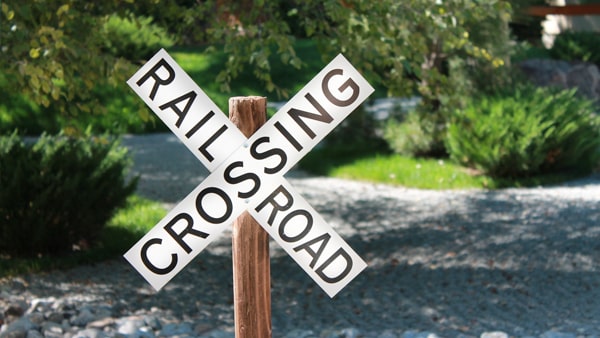
The X-shaped crossbuck sign identifies:

This road sign means:
  1. A A place to stop only when road traffic approaches
  2. B A three-way highway intersection
  3. C A crossroad warning
  4. D A railroad grade crossing

Correct answer: D – A railroad grade crossing

The crossbuck identifies a location where railroad tracks cross the roadway. At the crossing, obey any accompanying STOP or YIELD sign, flashing lights, bell, or gate. Kentucky law requires drivers to stop when a train is plainly visible and dangerously close or when an approaching train, warning signal, or lowered gate indicates that crossing would be unsafe.

Source: KRS 189.560(1) – Railroad crossings -- Duties of motor vehicle operators and commercial drivers -- Railroad's liability for death or injury, 603 KAR 5:050 §§ 2–3 – Uniform traffic control devices, Manual on Uniform Traffic Control Devices for Streets and Highways, 11th ed. § 8B.03, “Grade Crossing (Crossbuck) Sign (R15-1) and Number of Tracks Plaque (R15-2P) at Active and Passive Grade Crossings”

Question 5

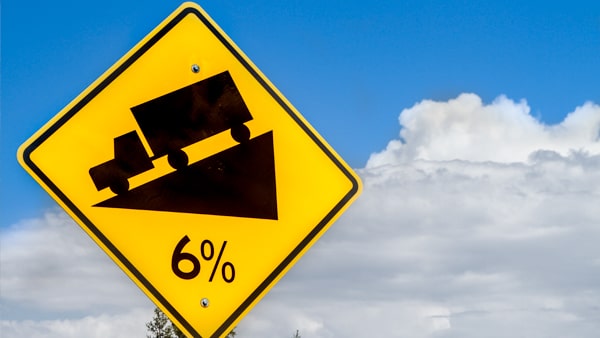
The warning sign showing a truck descending a slope means:

This sign means:
  1. A Light trucks only
  2. B Hill or steep downgrade ahead
  3. C Truck services ahead
  4. D Trucks are prohibited

Correct answer: B – Hill or steep downgrade ahead

The Hill sign warns drivers of a significant grade or downgrade ahead. It is a roadway-condition warning, not a truck restriction or service sign. Approach at a careful speed and maintain control of the vehicle based on the grade and other roadway conditions.

Source: KRS 189.290 – Operator of vehicle to drive carefully, 603 KAR 5:050 §§ 2–3 – Uniform traffic control devices, Manual on Uniform Traffic Control Devices for Streets and Highways, 11th ed. § 2C.14, “Hill Signs (W7-1 and W7-1a)”

Question 6

A fluorescent yellow-green pentagon sign showing schoolchildren indicates:

This road sign means:
  1. A A stop sign ahead
  2. B A school area or school crossing activity ahead
  3. C A shopping district ahead
  4. D Pedestrians are prohibited from leaving the sidewalk

Correct answer: B – A school area or school crossing activity ahead

The School sign warns of a school area, designated school zone, or location associated with schoolchildren crossing the roadway. An AHEAD or distance plaque can identify an approaching school crossing, while a downward arrow identifies the crossing itself. Watch carefully for children and any additional speed or crossing controls.

Source: 603 KAR 5:050 §§ 2–3 – Uniform traffic control devices, Manual on Uniform Traffic Control Devices for Streets and Highways, 11th ed. § 7B.02, “School Area Signs and Plaques”