


Louisiana DMV Practice Test 3

4.9 out of 5 (106 votes)
80% Passing score
20 Questions
4 Mistakes allowed
Louisiana’s permit process is not just a quick stop at the OMV and a lucky guess at a few road sign questions. There is a real structure behind it, especially for younger drivers, and this Louisiana DMV practice test is built around that structure. It gives you a practical way to review the road rules, traffic signs, safety habits, and licensing details that show up in the real Class E knowledge test—the stuff you actually need before anyone hands you a learner’s permit. The practice test includes 20 multiple-choice questions, and you need 16 correct answers to pass. That lines up with the 80% standard used for Louisiana’s official knowledge exam, so the scoring is not decorative. It is there to show whether you are close, sort of close, or still mixing up basic rules in a way that could make the real test unpleasant. The questions cover the familiar material like signs, signals, right-of-way, safe following distance, impaired driving, seat belts, and cellphone rules, but they are meant to make you apply the rules, not just recognize a phrase you skimmed once in the driver guide. For teen drivers, the licensing path has several pieces, and it helps to keep them straight. A Class E learner’s permit starts at age 15. The Temporary Instructional Permit, or TIP, may be issued at 14, but only for driver education, behind-the-wheel instruction with an instructor, and road skills testing. Applicants under 18 must complete the 38-hour driver education course: 30 hours in the classroom and 8 hours behind the wheel. After the classroom portion, the knowledge test enters the picture — which is where a serious Louisiana DMV permit practice test starts earning its keep. Louisiana’s Graduated Licensing Program, also called the R.Y.A.N. Act, moves teen drivers from learner’s permit to intermediate license and then to a full Class E license. The learner’s permit must be held for at least 180 days, and the driver must complete 50 supervised driving hours, including 15 at night. Intermediate license holders have extra limits too, including late-night driving restrictions, passenger rules, and cellphone restrictions. Adults have a cleaner route, thankfully. First-time applicants age 18 or older may take either the 38-hour driver education course or the 14-hour pre-licensing course. Either way, the knowledge test still matters. This free DMV practice test is meant to make that part less of a guessing exercise and more of a measured, useful review.
FREE DMV Practice Test App
Study for your Louisiana permit test or driver’s license with the NextDoorDriving app. 700+ DMV questions and answers, 100% free!
Download on the App Store

Sample Louisiana Permit Test Questions

Question 1

If another vehicle is following you too closely, what space must you continue to maintain?

  1. A A very small gap ahead to prevent other vehicles from merging
  2. B A safe following distance behind the vehicle ahead
  3. C No gap if traffic is moving below the speed limit
  4. D Only enough room to brake suddenly

Correct answer: B – A safe following distance behind the vehicle ahead

Continue to maintain a safe following distance behind the vehicle ahead when another driver is tailgating you. A cushion of space can help prevent your vehicle from being pushed into the vehicle ahead if a rear-end collision occurs. Do not respond by closing the gap or braking suddenly.

Source: La. R.S. 32:81(A) – Following vehicles; exceptions, Class D & E Driver’s Guide — Ch. 7, “Rural Roads”

Question 2

An emergency vehicle is approaching with its siren or warning lights activated. What must you do?

When you hear the sirens or see the red emergency lights of a closely approaching emergency vehicle, you must:
  1. A Accelerate until you are ahead of it
  2. B Continue slowly in your lane
  3. C Move near the right edge, clear of the intersection, and stop
  4. D Stop immediately in the intersection

Correct answer: C – Move near the right edge, clear of the intersection, and stop

Louisiana requires drivers to yield when an authorized emergency vehicle approaches using audible or visual signals. Move parallel to and as close as possible to the right-hand edge or curb, remain clear of any intersection, and stop. Stay there until the emergency vehicle passes unless a police officer directs otherwise.

Source: La. R.S. § 32:125(A) – Procedure on approach of an authorized emergency vehicle; passing a parked emergency vehicle

Question 3

If you must leave your vehicle parked on a highway between sunset and sunrise, you should:

  1. A Display appropriate warning or parking lights
  2. B Park at an angle to traffic
  3. C Leave one turn signal operating
  4. D Use high-beam headlights

Correct answer: A – Display appropriate warning or parking lights

A vehicle left on a highway between sunset and sunrise must display appropriate signal lights to warn approaching traffic. When there is insufficient light to reveal an object within 1,000 feet, the vehicle must display the required parked-vehicle lamps. Outside a business or residence district, park off the traveled roadway whenever practicable.

Source: La. R.S. § 32:141(A), (C) – Stopping, standing, or parking outside business or residence districts, La. R.S. § 32:314 – Lamps on parked vehicles

Question 4

Orange signs and channelizing cones along a highway indicate that you should:

  1. A Change lanes without reducing speed
  2. B Watch for workers, work vehicles, and changing traffic conditions
  3. C Assume your lane ends immediately
  4. D Accelerate through the area

Correct answer: B – Watch for workers, work vehicles, and changing traffic conditions

Orange signs, cones, barrels, and barricades identify construction or maintenance areas. Conditions may include workers, work vehicles, narrowed lanes, or flaggers controlling traffic. Reduce your speed, obey every temporary traffic-control device, and be prepared to stop.

Source: Louisiana Class D & E Driver’s Guide — “Construction and Maintenance Signs” and “Highway Work Zones”

Question 5

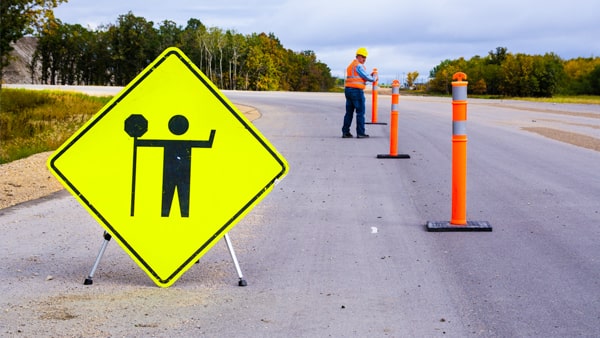
An orange diamond-shaped sign showing a person holding a flag warns of:

This sign means:
  1. A A pedestrian crossing
  2. B The end of road work
  3. C A school crossing
  4. D A flagger controlling traffic ahead

Correct answer: D – A flagger controlling traffic ahead

The sign warns that a flagger is stationed ahead to control traffic through a work zone. A flagger may use a STOP/SLOW paddle or another authorized signal. Slow down, watch the flagger carefully, and be prepared to stop.

Source: Louisiana Class D & E Driver’s Guide — “Construction and Maintenance Signs,” “Flagger Ahead”

Question 6

What is the proper action when entering a Louisiana work zone?

  1. A Reduce speed and be prepared to stop
  2. B Slow only when a worker is standing in your lane
  3. C Ignore temporary signs while the lane remains open
  4. D Follow closely to prevent other vehicles from merging

Correct answer: A – Reduce speed and be prepared to stop

Drivers should reduce speed and be prepared to stop in a work zone. Temporary signs, cones, barrels, and barricades guide traffic around potentially dangerous conditions and help protect workers and motorists. Drivers must also obey construction warnings and the instructions of flaggers.

Source: La. R.S. § 32:237(A)(1) – Traffic control devices in construction areas, Louisiana Class D & E Driver’s Guide — “Highway Work Zones”