


Louisiana Permit Practice Test 9

5 out of 5 (53 votes)
80% Passing score
20 Questions
4 Mistakes allowed
The Louisiana Class E learner’s permit knowledge test is built from the Louisiana Class D & E Driver’s Guide, so the official exam is going to care about more than whether you remember the obvious signs. It covers traffic laws, road signs and signals, pavement markings, safe driving practices, driver responsibility, alcohol laws, emergencies, vehicle requirements, and the Louisiana-specific rules that new drivers are expected to know before they get behind the wheel with any real freedom. This Louisiana permit practice test narrows in on school bus safety, which deserves its own attention because the rules are strict, and for good reason. You need to know when to stop for a bus loading or unloading children, how flashing lights change what drivers must do, and how those rules apply when the road layout is not perfectly simple. And, well, roads are rarely perfectly simple. A divided highway, an unexpected lane setup, or a bus stopped in a place that makes you second-guess yourself can turn a “sure, I know this” rule into something you actually have to think through. This DMV practice test includes 20 multiple-choice questions on school bus interactions and related safety rules. You need 16 correct answers to pass, matching Louisiana’s 80% passing standard. The official Class E knowledge test is longer (40 questions total) and applicants must answer at least 32 correctly, which means only 8 misses are allowed. So this shorter Louisiana driving practice test is not pretending to be the whole exam. It is more focused than that, in a useful way. There is no time limit, which is how practice should work when you are trying to learn the rule instead of just panic-clicking through it. After each answer, you get immediate feedback with an explanation, not just a blunt right-or-wrong result. That matters more than it sounds like it should, because the real permit test may phrase things differently from the way you studied them. For teen applicants, Louisiana usually starts the process with a Temporary Instructional Permit, or TIP, before driver education, testing, and the road skills exam. A learner’s permit may be issued at age 15 after the required steps, including the vision screening and knowledge test. Adults age 18 or older may follow a different path, but first-time drivers still have to satisfy the training and testing requirements before receiving a full Class E license. Use this updated 2026 Louisiana practice permit test to review school bus laws, strengthen your knowledge of state driving rules, and prepare for the official Louisiana OMV knowledge exam with a little more confidence and a lot less guessing.
FREE DMV Practice Test App
Study for your Louisiana permit test or driver’s license with the NextDoorDriving app. 700+ DMV questions and answers, 100% free!
Download on the App Store

Sample Louisiana Permit Test Questions

Question 1

In Louisiana, when may a vehicle displaying an accessible plate or hang tag use an accessible parking space?

  1. A. Whenever the plate or tag is displayed
  2. B. Only when the person with the impairment is driving
  3. C. When the person entitled to the privilege is driving or being transported
  4. D. Whenever an immediate family member has a disability

Correct answer: C. – When the person entitled to the privilege is driving or being transported

An accessible plate or hang tag does not authorize unrestricted use of an accessible space. The person with the mobility impairment must be operating the vehicle or being transported in it. Using the plate or tag when the vehicle has not transported that person is an illegal use of the parking privilege.

Source: La. R.S. § 40:1742(B) – Parking spaces for certain persons with disabilities, La. R.S. § 47:463.4(G)(2), (I) – Special license plates or hang tags for persons with mobility impairments

Question 2

Unless passing on the right is specifically permitted, you should overtake a vehicle traveling in your direction:

  1. A. On the right
  2. B. On the left
  3. C. Only after the other driver signals
  4. D. On whichever side first becomes available

Correct answer: B. – On the left

Louisiana law generally requires an overtaking driver to pass on the left at a safe distance and remain left until safely clear. Passing on the right is allowed only in specified situations, such as on a multilane highway or when the other vehicle is preparing to turn left. A right-side pass must be safe and may not use the shoulder or leave the pavement.

Source: La. R.S. § 32:73 – Passing a vehicle on the left, La. R.S. § 32:74 – When passing on the right is permitted

Question 3

When traveling behind or beside a motorcycle, you must:

If you are driving behind a motorcycle, you must:
  1. A. Allow the motorcycle full use of its lane
  2. B. Use the shoulder to travel beside it
  3. C. Require the motorcycle to remain in half the lane
  4. D. Pass the motorcycle within the same lane

Correct answer: A. – Allow the motorcycle full use of its lane

Louisiana law entitles a motorcycle to the full use of a traffic lane, and another motor vehicle may not deprive it of that space. Do not crowd the motorcycle or attempt to pass beside it within the same lane. The law separately permits two motorcycles to ride abreast in one lane.

Source: La. R.S. § 32:191.1(A) – Operating motorcycles on roadways laned for traffic

Question 4

While a covered passenger vehicle is moving forward, when must its occupants generally wear safety belts?

  1. A. Only when the vehicle has no airbags
  2. B. Only when seated in the front
  3. C. Whenever the vehicle is in forward motion
  4. D. Only while traveling on a highway

Correct answer: C. – Whenever the vehicle is in forward motion

Louisiana generally requires every occupant of a passenger car, van, SUV, or covered truck to have a safety belt properly fastened whenever the vehicle is in forward motion, subject to statutory exceptions. The rule is not limited to front seats or highways. Airbags supplement safety belts rather than replace them.

Source: La. R.S. § 32:295.1(A), (B) – Safety belt use; tags indicating exemption, Louisiana Class D & E Driver’s Guide — “Air Bags”

Question 5

Which step should you take whenever parking on a hill?

  1. A. Place a rear tire against the curb
  2. B. Set the parking brake and secure the transmission in Park or the proper gear
  3. C. Keep the front wheels straight when no curb is present
  4. D. Turn the wheels toward the curb in every situation

Correct answer: B. – Set the parking brake and secure the transmission in Park or the proper gear

Always set the parking brake and place an automatic transmission in Park or a manual transmission in the proper gear. Wheel direction depends on whether the vehicle faces uphill or downhill and whether a curb is present. Without a curb, turn the wheels toward the road’s edge.

Source: Louisiana Class D & E Driver’s Guide — “Parking Brake” and “Parking on Hills”

Question 6

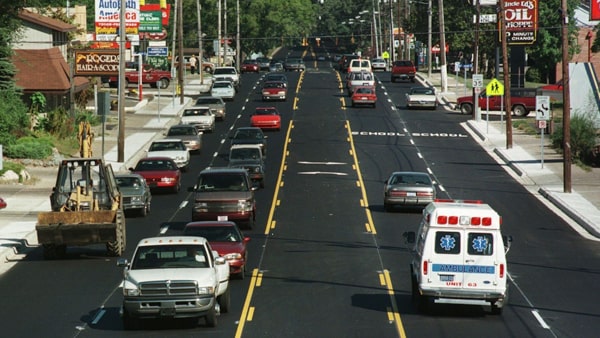
A roadway’s marked center lane, shared by traffic traveling in both directions, is intended for:

The center lane in the illustration is used for:
  1. A. Continuous travel
  2. B. Left turns and permitted U-turns
  3. C. Passing slower vehicles
  4. D. Emergency vehicles only

Correct answer: B. – Left turns and permitted U-turns

A two-way left-turn lane is used by vehicles making left turns from either direction and may also be used for a permitted U-turn. It is not a regular travel lane or a passing lane. Louisiana limits travel in this lane to 200 feet for the turning and merging situations specified by law.

Source: La. R.S. § 32:83(A), (B) – Driving on highways with two-way left-turn lanes and dedicated left-turn lanes, Louisiana Class D & E Driver’s Guide — “Shared Center Left Turn Lane”