


Maine Permit Practice Test 6

4.9 out of 5 (63 votes)
80% Passing score
20 Questions
4 Mistakes allowed
A Maine permit practice test should do more than toss a few road signs at you and call it preparation. The real Maine knowledge test has 30 questions, and you need 24 correct answers to pass, so there is not a huge cushion for guesses, half-remembered rules, or that one answer choice that sounds official but is quietly wrong. This practice test gives you 20 focused questions based on the same Maine driver’s manual material used for the real BMV test, with extra attention on turn signals and the rules that make everyday driving less chaotic. Turn signals are a bigger deal than they seem, mostly because they are one of the few ways drivers get to communicate without waving, glaring, or inventing their own little road language. You need to know when to signal, how early to signal, and why it matters when you are changing lanes, turning, pulling from a curb, or moving through a busy stretch of Portland traffic. Same idea on quieter roads, honestly. A bad signal in Camden or on a coastal route can still create a mess; it just comes with a nicer view. The licensing details matter too, because the permit test is only one piece of the Maine process. You can apply for a learner permit at 15, and that permit is valid for 2 years. It is not renewable. If it expires, you have to submit a new application and retake the written and vision tests, which is the sort of fine print worth knowing before it becomes your problem. Logged driving hours can carry over, though, and a later permit does not restart the 6-month waiting period for road-test eligibility. For permit holders under 21, Maine requires at least 6 months with the permit and 70 hours of practice driving, including 10 hours after dark. The supervising driver must be at least 20 years old and licensed for at least 2 years. Under 18? Then approved driver education is part of the deal, including 30 classroom hours and 10 behind-the-wheel hours. You can take this Maine DMV practice test—BMV, technically, but people often think DMV—on your phone, tablet, or computer. Afterward, review the explanations instead of just checking the score and moving on. The missed questions are usually where the useful stuff is hiding.
FREE DMV Practice Test App
Study for your Maine permit test or driver’s license with the NextDoorDriving app. 700+ DMV questions and answers, 100% free!
Download on the App Store

Sample Maine Permit Test Questions

Question 1

In Maine, when may you turn right at a steady circular red signal?

  1. A After stopping, if no sign prohibits it and you yield as required
  2. B Whenever a steady red arrow points right
  3. C Only when approaching from the left lane
  4. D After slowing without making a complete stop

Correct answer: A – After stopping, if no sign prohibits it and you yield as required

A driver facing a steady circular red light must stop. A cautious right turn is then permitted unless a sign prohibits it. The turning driver must yield to pedestrians in the crosswalk and vehicles proceeding on a green signal; a steady red arrow does not permit the indicated movement.

Source: M.R.S. Title 29-A, § 2057(1)(C), (C-1) – Traffic-control devices
Question 2

An approaching train is visible and dangerously close to a railroad crossing. What must you do?

  1. A Cross quickly before the train arrives
  2. B Sound your horn and continue across
  3. C Stop before the tracks and wait until crossing is safe
  4. D Drive around the gate if no flagger is present

Correct answer: C – Stop before the tracks and wait until crossing is safe

Maine requires a driver to stop 15 to 50 feet from the nearest rail when a train is visible and in hazardous proximity to the crossing. The driver must also stop for an active warning signal, lowered gate, or flagger’s warning. Proceed only after the applicable warning has cleared and no train is approaching.

Source: M.R.S. Title 29-A, § 2076(2) – Railroad or grade crossings

Question 3

In Maine, a turn signal must be used continuously for at least the last:

  1. A 50 feet before the turn
  2. B 100 feet before the turn
  3. C 300 feet before the turn
  4. D 400 feet before the turn

Correct answer: B – 100 feet before the turn

State law requires a turn signal to be given continuously during at least the last 100 feet traveled before turning. An appropriate signal is required when other traffic may be affected. Continue checking traffic because signaling does not by itself make the turn safe.

Source: M.R.S. Title 29-A, § 2071(1), (2) – Turning and signals

Question 4

Which check should you make before moving into another lane?

  1. A Check only for vehicles directly behind you
  2. B Check your mirrors and look over your shoulder toward the new lane
  3. C Look over your left shoulder regardless of your direction
  4. D Rely only on the side mirror nearest the new lane

Correct answer: B – Check your mirrors and look over your shoulder toward the new lane

Before leaving a lane, you must determine that the movement can be made safely. Check the rearview and side mirrors, then look over the shoulder toward the lane you plan to enter. This head check covers blind spots that may contain another vehicle, motorcycle, or bicycle.

Source: M.R.S. Title 29-A, § 2051(1-A) – Traffic lanes, Maine Driver’s License Manual — § 7, “Changing Lanes”

Question 5

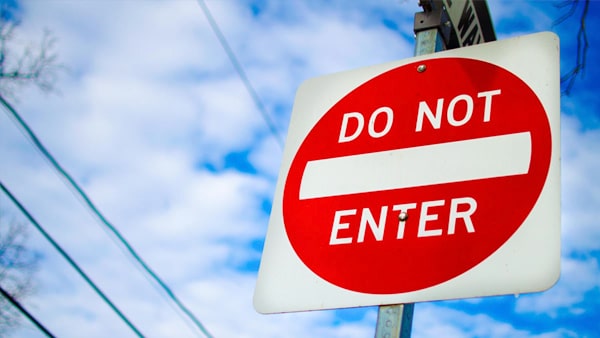
What does a red-and-white DO NOT ENTER sign mean?

This sign means:
  1. A Come to a complete stop before continuing
  2. B U-turns are prohibited
  3. C Yield to traffic entering the roadway
  4. D Do not enter the roadway from this direction

Correct answer: D – Do not enter the roadway from this direction

A DO NOT ENTER sign is a regulatory sign that prohibits traffic from entering from the direction where the sign is displayed. It is different from a stop, yield, or no-U-turn sign. Drivers must obey official traffic-control devices unless directed otherwise by a law enforcement officer.

Source: M.R.S. Title 29-A, § 2057 – Traffic-control devices, Maine Driver’s License Manual — § 6, “Regulatory Signs”

Question 6

Why should you check blind spots carefully for bicycles before turning or changing lanes?

  1. A Bicyclists always have the right-of-way
  2. B A bicycle may be outside the area covered by your mirrors
  3. C Bicyclists are required to ride against traffic
  4. D Bicyclists are exempt from traffic-control devices

Correct answer: B – A bicycle may be outside the area covered by your mirrors

Blind spots include areas beside and behind your vehicle that are not covered by its mirrors. Before changing lanes, look over your shoulder toward the lane you intend to enter and watch specifically for bicycles and motorcycles. Bicycles have smaller profiles and may be less noticeable in traffic.

Source: Maine Driver’s License Manual — § 7, “Changing Lanes”; § 10, “Bicycles”