


Maine Permit Test Practice 9

4.9 out of 5 (60 votes)
80% Passing score
20 Questions
4 Mistakes allowed
Maine’s official written knowledge test is handled by the Maine Bureau of Motor Vehicles, part of the Secretary of State’s office, and it is based on the Maine Driver’s License Manual and Motorist Handbook and Study Guide. The real exam covers rules of the road, Maine traffic laws, road signs, pedestrian and bicycle safety, operating under the influence laws, distracted driving, and the ordinary safe-driving judgment that, frankly, is not always ordinary when you are new to all of this. This Maine permit practice test focuses on school buses, which is a narrower topic, yes, but not a small one. School bus rules are the kind of thing that seem simple from a distance and then get very particular once you are thinking about lanes, divided roads, flashing lights, and whether traffic in both directions has to stop. In Maine, that can matter on a quiet road in Aroostook County just as much as it does in Portland traffic or near the Fryeburg Fair, when the road is busy, drivers are impatient, and everyone is pretending they know exactly what they are doing. The official Maine Class C knowledge test has 30 questions. You need 24 correct answers to pass, an 80% score, which means you can miss up to 6. This Maine permit practice test uses 20 questions and keeps that same passing-score idea: 16 correct answers to pass. It is not a copy of the real BMV test, and it should not be. Actual test questions are restricted. But the topics, phrasing, and driving situations are built to feel familiar enough that the real Maine permit test will not feel like it came out of nowhere. The useful part, the part people sometimes underrate, is the feedback after each question. A missed answer is not just marked wrong and left there sulking on the screen. You get an explanation, and that explanation is where the rule usually becomes clearer. Use this practice test before your first BMV knowledge test, or use it when you have already read the manual and want to see what actually stuck. Either way, it gives you a steadier, more realistic way to prepare for Maine roads.
FREE DMV Practice Test App
Study for your Maine permit test or driver’s license with the NextDoorDriving app. 700+ DMV questions and answers, 100% free!
Download on the App Store

Sample Maine Permit Test Questions

Question 1

When headlights are required, may you drive using only parking lights?

  1. A Yes, between sunset and sunrise
  2. B No; use the vehicle’s headlights
  3. C Yes, whenever fog reduces visibility
  4. D Yes, whenever windshield wipers are operating

Correct answer: B – No; use the vehicle’s headlights

Maine requires illuminated headlights from sunset to sunrise, when people or vehicles are not visible at 1,000 feet because of light or weather, and whenever windshield wipers are in constant use. The manual states that operating with only parking lights is not good driving practice. Use headlights whenever lighting is required.

Source: M.R.S. Title 29-A, § 2067(1) – Lights, Maine Driver’s License Manual — § 8, “Communicating”

Question 2

A KEEP RIGHT sign is posted at an obstruction in the roadway. What does it direct you to do?

This white sign means:
  1. A Pass to the right of the obstruction
  2. B Yield before making a right turn
  3. C Move right only if traveling below the speed limit
  4. D Turn right at the next intersection

Correct answer: A – Pass to the right of the obstruction

A KEEP RIGHT sign directs traffic to travel to the right of an island, divider, or other obstruction. It does not require a turn at the next intersection or establish a yield condition. It is a regulatory sign, and drivers must follow its indicated direction.

Source: Maine Driver’s License Manual — § 6, “Regulatory Signs”

Question 3

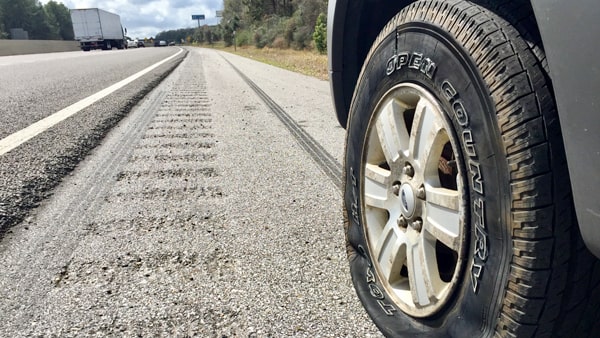
After safely controlling a vehicle with a suddenly deflated tire, where should you stop?

Where should you park when you need help after your tire suddenly deflates while driving on a highway?
  1. A In the right-hand travel lane
  2. B Off the road in a safe place away from traffic
  3. C Where the vehicle is visible only from the front
  4. D Immediately, even if you are on a curve

Correct answer: B – Off the road in a safe place away from traffic

If a tire goes flat, hold the steering wheel firmly, steer straight, and allow the vehicle to slow gradually. Avoid slamming on the brakes. Once you have control, pull off the road in a safe location away from traffic and turn on the emergency flashers.

Source: Maine Driver’s License Manual — § 9, “Tire Blowout”

Question 4

If a U-turn is permitted on a street with two lanes traveling in your direction, which lane should you use to begin the maneuver?

  1. A A shared center lane regardless of its markings
  2. B The far-left travel lane
  3. C The far-right travel lane
  4. D Whichever lane has the least traffic

Correct answer: B – The far-left travel lane

Begin a permitted U-turn from the far-left lane or the portion of the roadway nearest the center line. Signal and verify that the movement can be completed with reasonable safety before turning. Do not make the maneuver where a sign prohibits U-turns or where traffic and visibility make it unsafe.

Source: M.R.S. Title 29-A, § 2060(2), (3) – Turning at intersections, M.R.S. Title 29-A, § 2071(1) – Turning and signals, Maine Driver’s License Manual — § 7, “Turning Around”

Question 5

How should you control your speed when driving at night on a poorly lit road?

  1. A Keep the instrument-panel lights at maximum brightness
  2. B Look directly at approaching headlights
  3. C Drive slowly enough to stop within the distance illuminated ahead
  4. D Use high beams even when following another vehicle

Correct answer: C – Drive slowly enough to stop within the distance illuminated ahead

At night, your headlights limit how far ahead you can identify a hazard. Choose a speed that allows you to stop within the distance you can clearly see. High beams improve visibility on dark roads but must be dimmed when approaching or following other vehicles as required.

Source: M.R.S. Title 29-A, § 2067(2) – Lights, Maine Driver’s License Manual — § 11, “Night Driving”

Question 6

In Maine, when is it permissible to drive if a prescription, over-the-counter, or illegal drug has left you impaired?

  1. A When the drug was legally purchased
  2. B When a doctor prescribed the drug
  3. C Under no circumstances
  4. D When you remain below the posted speed limit

Correct answer: C – Under no circumstances

Operating a motor vehicle while under the influence of intoxicants is OUI. Prescription and over-the-counter drugs can impair driving, and the manual states that their lawful use is not a defense. Check medication warnings and consult a physician or pharmacist when uncertain, but do not drive if the drug has impaired your ability to operate safely.

Source: M.R.S. Title 29-A, § 2411(1-A)(A)(1) – Criminal OUI, Maine Driver’s License Manual — § 3, “Other Impairing Drugs and Driving”