Maine Road Signs Test

4.7 out of 5 (85 votes)
80% Passing score
10 Questions
2 Mistakes allowed
Before you take the Maine learner’s permit test, it helps to know what the road sign questions are actually doing there. They are not a separate test tucked off to the side. They are part of the Maine Class C written knowledge test, the same 30-question exam that also covers rules of the road, Maine traffic laws, pedestrian and bicycle safety, distracted-driving dangers, operating-under-the-influence laws, and the kind of safe-driving judgment the Maine Bureau of Motor Vehicles expects new drivers to have. So, yes, signs matter. But they matter as part of the whole licensing picture, which is where some people get a little too casual with studying. This free Maine BMV signs practice test focuses on that road-sign portion in a direct, useful way. You’ll work through 20 multiple-choice questions covering the signs Maine drivers need to recognize without a long internal debate: stop signs, yield signs, speed limits, construction warnings, regulatory signs, and those color-shape-symbol combinations that tell you what a sign means before you have time to read every word on it. The practice is built around the same general sign standards used in the Manual on Uniform Traffic Control Devices, so it is not just a random collection of sign trivia dressed up as test prep. On the real Maine Class C knowledge test, you need at least 24 correct answers out of 30 to pass. That is an 80% passing score, with up to 6 questions missed overall. Maine does not publish a separate road-sign-only missed-question limit for standard Class C applicants, which means sign questions simply count toward your total score. And that is the part worth paying attention to, because losing points on signs is one of those small, preventable things that feels small only after it is too late to fix it. As you move through this Maine permit test road signs practice, you get instant feedback after each answer, along with explanations that make the answer stick a little better than plain memorization usually does. Use it on your phone, laptop, tablet, whatever is nearby. It is free, repeatable, and practical in the least dramatic sense of the word — the kind of practice that helps you walk into the Maine BMV written knowledge test knowing the signs instead of hoping they look familiar enough.
FREE DMV Practice Test App
Study for your Maine permit test or driver’s license with the NextDoorDriving app. 700+ DMV questions and answers, 100% free!
Download on the App Store

Sample Maine Permit Test Questions

Question 1

A black chevron on a yellow rectangular sign indicates that:
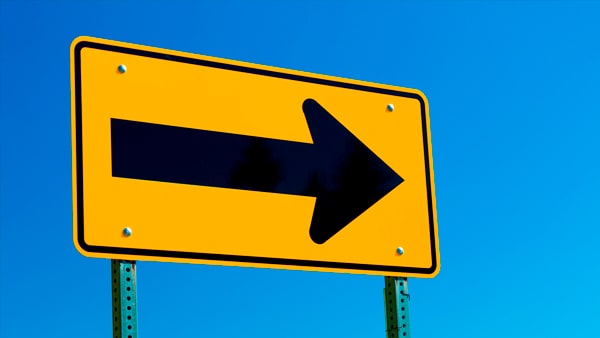
When you see this black and yellow sign, it means:
  1. A The road to the right carries one-way traffic
  2. B A construction detour begins to the right
  3. C The roadway changes direction sharply
  4. D A side road enters from the right

Correct answer: C – The roadway changes direction sharply

A black-and-yellow chevron is a warning of a sharp change in roadway direction. Follow the direction shown by the chevron and reduce speed before entering the curve. Slowing before the curve helps avoid hard braking while turning.

Source: Maine Driver’s License Manual — § 6, “Warning Signs”, Maine Driver’s License Manual — § 8, “Curves”
Question 2

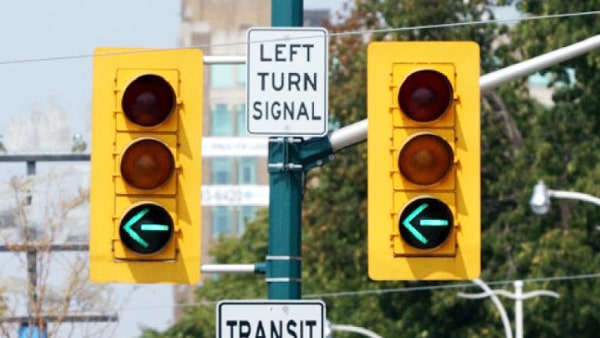
Under Maine law, what does a green arrow pointing left permit you to do?

On the intersection, if you see a green arrow pointing to the left, you can:
  1. A Proceed in any direction
  2. B Enter cautiously to turn left, yielding to anyone lawfully in the intersection
  3. C Turn left or continue straight regardless of other indications
  4. D Turn left only after all opposing signals become green

Correct answer: B – Enter cautiously to turn left, yielding to anyone lawfully in the intersection

A green arrow allows a driver to cautiously enter the intersection for the movement shown. It does not remove the duty to yield to a vehicle or pedestrian lawfully within the intersection or crosswalk. Other signal indications displayed at the same time may authorize additional movements.

Source: Me. Rev. Stat. tit. 29-A, § 2057(1)(A) — Traffic-control devices, Maine Driver’s License Manual — § 6, “Traffic Signals”

Question 3

A steady yellow arrow appears for your dedicated left-turn lane. What does it tell you?

  1. A You may not turn under any circumstances
  2. B You should accelerate to clear the intersection
  3. C The green interval is ending; be ready to obey the next indication
  4. D You have right-of-way over every vehicle and pedestrian

Correct answer: C – The green interval is ending; be ready to obey the next indication

A steady yellow arrow warns that the green indication is ending or that a red indication will appear immediately. Do not accelerate merely to enter before the signal changes. Watch the signal and obey the indication that follows.

Source: Me. Rev. Stat. tit. 29-A, § 2057(1)(B)(1) — Traffic-control devices, Maine Driver’s License Manual — § 6, “Traffic Signals”

Question 4

While preparing to turn from a left-turn-only lane, its green arrow changes to yellow. You should:

  1. A Speed up to enter before it changes
  2. B Remain stopped regardless of your position
  3. C Recognize that the green phase is ending and obey the next signal
  4. D Proceed because turning traffic always has right-of-way

Correct answer: C – Recognize that the green phase is ending and obey the next signal

Maine law treats a steady yellow arrow as a warning that the green indication is being terminated or a red indication will be shown immediately. Continue watching the signal rather than assuming the turn remains protected. Follow the next signal displayed for your lane.

Source: Me. Rev. Stat. tit. 29-A, § 2057(1)(B)(1) — Traffic-control devices, Maine Driver’s License Manual — § 6, “Traffic Signals”

Question 5

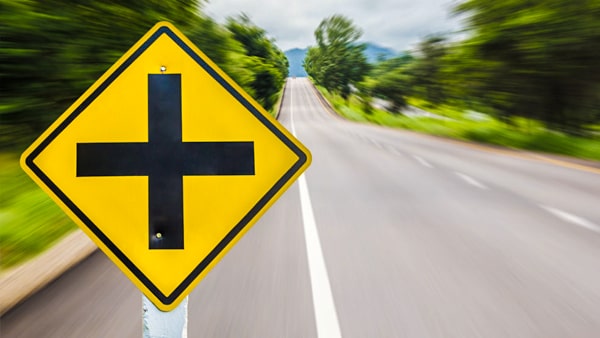
A yellow diamond sign with a black cross symbol means:

This sign means:
  1. A A church is nearby
  2. B A first-aid station is ahead
  3. C A crossroad is ahead
  4. D A railroad crossing is ahead

Correct answer: C – A crossroad is ahead

This warning sign announces an intersection where another road crosses your route. It is commonly identified as an intersection-ahead or crossroad sign. Look for approaching cross traffic and any controls governing the intersection.

Source: Maine Driver’s License Manual — § 6, “Warning Signs”

Question 6

What is the usual purpose of a yellow-and-black diamond-shaped sign?

A yellow and black diamond-shaped sign:
  1. A To warn of a hazard or roadway condition ahead
  2. B To provide directions to cities and towns
  3. C To state a traffic law or regulation
  4. D To identify a construction zone specifically

Correct answer: A – To warn of a hazard or roadway condition ahead

Yellow diamond signs generally warn drivers about hazards or changing roadway conditions ahead. Regulatory signs usually use white backgrounds, while guide signs provide route or destination information. Work-zone warning signs are normally orange rather than yellow.

Source: Maine Driver’s License Manual — § 6, “Warning Signs”, Maine Driver’s License Manual — § 6, “Work Zone Signs”