Maine Road Signs Test Simulator

5 out of 5 (52 votes)
80% Passing score
25 Questions
5 Mistakes allowed
Maine road sign questions sit inside the official Class C knowledge test, not beside it, which is worth knowing before you spend all your study time on general rules and then try to “wing” the signs. The real Maine BMV permit test has 30 questions, and you need 24 correct to pass. Road signs are mixed in with Maine traffic laws, rules of the road, pedestrian and bicycle safety, OUI laws, distracted-driving rules, and the basic safe-driving knowledge pulled from the Maine Driver’s License Manual and Motorist Handbook. So yes, signs are only one slice of the test. They are also one of the easiest slices to lose points on for no especially noble reason. This Maine permit practice test narrows the work down to road signs and keeps it practical. Each session gives you 20 road sign questions from a larger pool, so you are not just memorizing one tidy little answer pattern and congratulating yourself too early. You need 16 correct answers to pass this simulator, which follows the same 80% passing standard used on the official written exam. That detail matters more than it sounds like it should. It trains you to work at the level Maine actually expects, not at the level where a few lucky guesses make the score look better than your understanding really is. The practice test also fits into the real licensing process, which has more moving parts than people tend to remember. First-time applicants still need the learner permit application, proof documents, the $35 permit examination fee, a vision screening, and the written knowledge test. Drivers under 18 must complete approved driver education before getting a learner permit, and permit holders under 21 have to hold the permit for 6 months and complete 70 hours of supervised driving, including 10 hours after dark, before the road test. The road sign work is not the whole road to a license of course, but it is part of the foundation underneath it. At the end of each practice session, you get a results summary with feedback on missed questions, which is where the useful part happens. You can spot the signs you truly know, the ones you almost know, and the ones you have been recognizing by vibe, which is not a study strategy so much as a gamble with a steering wheel attached.
FREE DMV Practice Test App
Study for your Maine permit test or driver’s license with the NextDoorDriving app. 700+ DMV questions and answers, 100% free!
Download on the App Store

Sample Maine Permit Test Questions

Question 1

Your signal changes to green. Before entering the intersection, you must:

  1. A Proceed immediately because you have absolute right-of-way
  2. B Yield to anyone lawfully within the intersection or crosswalk
  3. C Require pedestrians and vehicles to move out of your way
  4. D Yield only when you plan to turn

Correct answer: B – Yield to anyone lawfully within the intersection or crosswalk

A circular green signal permits you to proceed, but it does not provide an unconditional right-of-way. Maine law requires you to yield to any vehicle or pedestrian lawfully within the intersection or crosswalk. Enter only after those road users have cleared your path.

Source: Me. Rev. Stat. tit. 29-A, § 2057(1)(A) — Traffic-Control Devices

Question 2

What must you do at a red, eight-sided STOP sign?

This sign means:
  1. A Slow down and stop only when traffic is approaching
  2. B Stop completely, yield as required, and proceed when safe
  3. C Continue cautiously without stopping when the road looks clear
  4. D Stop only for vehicles on the intersecting road

Correct answer: B – Stop completely, yield as required, and proceed when safe

In Maine, a driver approaching a STOP sign must come to a complete stop at the required location. The driver must yield to vehicles that are already in the intersection or are close enough to present an immediate hazard. After yielding, the driver may proceed when it is safe.

Source: Me. Rev. Stat. tit. 29-A, § 2057(7), (8) — Traffic-Control Devices, Maine Driver’s License Manual — § 6, “Stop Sign”

Question 3

Which center marking prohibits crossing left of center to pass a car?

  1. A A broken white line
  2. B A double solid yellow line
  3. C A broken yellow line
  4. D A solid white lane line

Correct answer: B – A double solid yellow line

Double solid yellow center lines place an unbroken line beside traffic in both directions. Maine’s passing law generally prohibits driving left of center when an unbroken line is marked in the driver’s lane, except in an emergency. These markings therefore prohibit crossing the center to overtake another car.

Source: Me. Rev. Stat. tit. 29-A, § 2070(5)(E) — Passing Another Vehicle, Maine Driver’s License Manual — § 6, “Pavement Markings”

Question 4

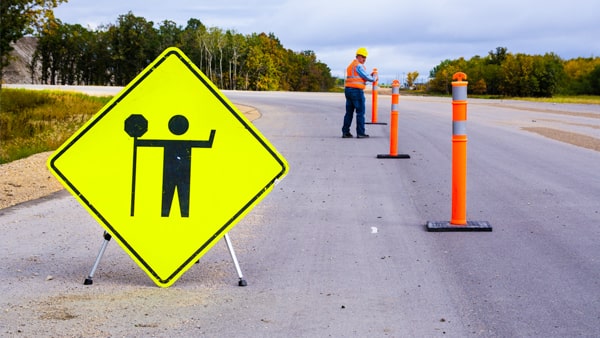
An orange diamond sign showing a person holding a flag warns of:

This sign means:
  1. A Pedestrians ahead
  2. B The end of road construction
  3. C A school crossing
  4. D A flagger ahead

Correct answer: D – A flagger ahead

This is the Flagger Ahead warning sign. It tells drivers that a flagger may be directing traffic in an upcoming work zone. Slow down, remain ready to stop, and follow the flagger’s directions.

Source: Maine Driver’s License Manual — § 6, “Work Zone Signs”

Question 5

A steady yellow traffic signal warns that:

  1. A A flashing yellow signal will appear
  2. B The signal is changing to green
  3. C A red signal will appear immediately
  4. D The signal will begin flashing red

Correct answer: C – A red signal will appear immediately

A steady yellow light warns that the green indication is ending or a red light will be displayed immediately. Begin slowing as you approach the intersection. The signal is a warning of the upcoming change, not an instruction to accelerate through the intersection.

Source: Me. Rev. Stat. tit. 29-A, § 2057(1)(B)(1) — Traffic-Control Devices, Maine Driver’s License Manual — § 6, “Traffic Signals”

Question 6

The right-hand edge of a roadway, when marked, is normally shown by a:

  1. A Broken white line
  2. B Solid yellow line
  3. C Solid white line
  4. D Broken yellow line

Correct answer: C – Solid white line

A right edge line consists of a normal-width solid white line. It delineates the right-hand edge of the roadway and provides drivers with a visual reference. Yellow edge lines are used on the left side of divided highways, one-way roads, and ramps.

Source: Manual on Uniform Traffic Control Devices, 11th ed., rev. 1 — § 3B.09, “Edge Line Pavement Markings”