Maryland Practice Permit Test 3

4.7 out of 5 (299 votes)
80% Passing score
20 Questions
4 Mistakes allowed
This Maryland DMV practice test is meant for the point where studying starts to become more than just reading signs and hoping the obvious answers stay obvious. It gives you 20 questions on Maryland traffic laws, safe driving habits, licensing rules, and the details that can show up on the official MVA knowledge test. You need 16 correct answers to pass this MD permit practice test, which makes it a useful check before you sit for the real thing. A few questions focus on Maryland’s handheld-device and cell phone rules, and that is not filler. Permit holders may not use a cell phone while driving, including Bluetooth or hands-free devices, except to call 911 in an emergency. It sounds like a small rule until you realize Maryland treats it as part of basic driver responsibility, especially for new drivers. So, yes, this MVA permit practice test covers road signs and right-of-way and safe driving judgment, but it also pulls in the rules people tend to half-remember, which is usually where trouble starts. The official knowledge test is part of getting a Maryland learner’s instructional permit, the first stage in the state’s Rookie Driver program. To apply, you generally need to be at least 15 years and 9 months old, pass a vision screening, and pass the knowledge test. Once you have the permit, driving is supervised. Your supervising driver must be at least 21, must have held a license for at least 3 years, and must sit in the front passenger seat. No creative interpretations there, unfortunately. After the learner’s permit comes the longer stretch: driver education, supervised practice, and eventually the provisional license. Maryland requires new drivers to complete an MVA-approved driver education course with 30 classroom hours and 6 behind-the-wheel hours before getting a provisional license. Drivers under 25 must also complete at least 60 hours of supervised practice, including 10 hours at night. Drivers 25 and older have a shorter supervised-practice requirement, but the process still has its own waiting periods and paperwork, because of course it does. Because this Maryland practice permit test is online, you can take it from Baltimore, Annapolis, Silver Spring, Ocean City, or wherever you are trying to study without making a whole production out of it. Miss a question here, read the explanation, and tighten up that weak spot before the official MVA written test is the one keeping you from moving ahead.
FREE DMV Practice Test App
Study for your Maryland permit test or driver’s license with the NextDoorDriving app. 700+ DMV questions and answers, 100% free!
Download on the App Store

Sample Maryland Permit Test Questions

Question 1

Traffic is moving slowly across railroad tracks. What should you do before entering the crossing?
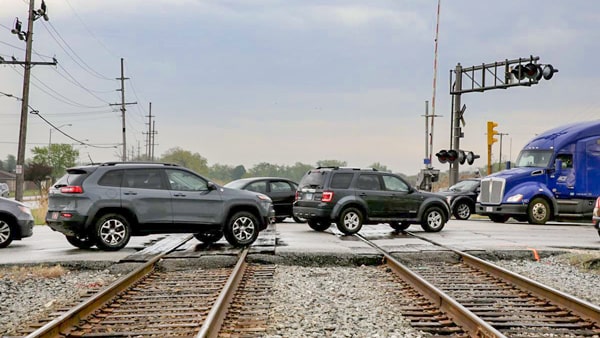
Before you reach the intersection, when crossing railroad tracks in slow traffic, you should:
  1. A Sound your horn and follow the vehicle ahead
  2. B Move onto the tracks and wait for traffic to advance
  3. C Stop between the gates if traffic stops
  4. D Wait until there is enough room to clear the tracks completely

Correct answer: D – Wait until there is enough room to clear the tracks completely

Slow traffic can leave a vehicle trapped on railroad tracks. The manual says not to start across unless you can get completely over and there is room for your vehicle on the far side. Wait before the crossing until traffic ahead has moved far enough for your entire vehicle to clear the tracks.

Source: Maryland Driver’s Manual — Section 5.G, “Highway-Railroad Crossings”
Question 2

What color combination is used on a highway guide sign showing destinations and distances to exits?

  1. A Yellow with black lettering
  2. B Black with white lettering
  3. C Red with white lettering
  4. D Green with white lettering

Correct answer: D – Green with white lettering

Green is used for destinations, distances, and directions, and highway guide signs display their information in white. Yellow signs generally warn of conditions ahead, blue signs identify services, and brown signs identify recreation or cultural-interest areas. A distance-to-exit guide sign uses green with white lettering.

Source: Maryland Driver’s Manual — Section 4.B, “Traffic Signs — Colors & Shapes”

Question 3

Which situation describes a permitted U-turn?

  1. A Where a No U-Turn sign is posted
  2. B Before checking whether U-turns are allowed
  3. C Where permitted, after signaling and yielding until the way is clear
  4. D While an approaching vehicle is close enough to create an immediate danger

Correct answer: C – Where permitted, after signaling and yielding until the way is clear

Maryland law requires a driver making a U-turn to yield to any approaching vehicle close enough to present an immediate danger. The driver’s manual also says to confirm U-turns are allowed, signal left, stop and yield, and turn only when the way is clear. A posted No U-Turn sign rules out the maneuver.

Source: Md. Code, Transp. § 21-402(b) — Turning Left or Making U-Turn, Maryland Driver’s Manual — Section 3.H, “U-turn”

Question 4

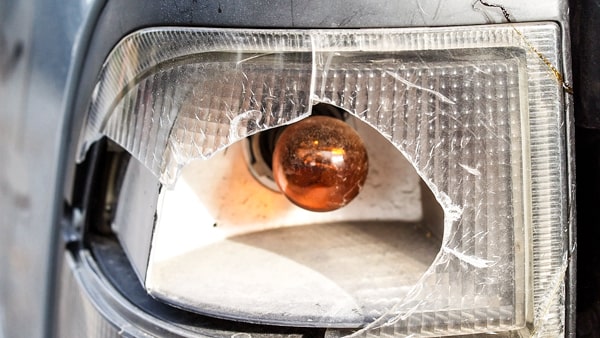
If the electric turn signals on an ordinary passenger car stop working, which method may indicate a turn?

If your turn signals fail, you should use _____ to indicate you are turning.
  1. A Sounding the horn
  2. B Flashing the headlights
  3. C Using the proper hand-and-arm signal
  4. D Turning on the emergency flashers

Correct answer: C – Using the proper hand-and-arm signal

For an ordinary passenger car in Maryland, a required turn signal may be given by the proper hand-and-arm signal or by signal lamps. Larger or longer vehicles described in the statute must use signal lamps. Hand-and-arm signaling is the lawful alternative here; the horn, headlights, and emergency flashers do not communicate the required turn direction.

Source: Md. Code, Transp. § 21-605(a)–(c) — Signals by Hand and Arm or Signal Lamps

Question 5

At a marked midblock crosswalk without an operating signal, a pedestrian is crossing on your half of the roadway. What must you do?

If a pedestrian is in a crosswalk in the middle of a block:
  1. A Come to a stop for the pedestrian
  2. B Continue because the pedestrian must yield
  3. C Honk and proceed slowly through the crosswalk
  4. D Pass any vehicle that has stopped for the pedestrian

Correct answer: A – Come to a stop for the pedestrian

At a crosswalk without an operating traffic signal, Maryland law requires a driver to stop when the pedestrian is on the driver’s half of the roadway or approaching from the adjacent lane on the other half. A pedestrian may not suddenly enter when a vehicle is too close to yield. If a violation contributes to a crash, the penalty can be up to two months’ imprisonment, a $1,000 fine, or both.

Source: Md. Code, Transp. § 21-502(a), (b), (d), (e) — Pedestrians’ Right-of-Way in Crosswalks

Question 6

Before moving left to overtake another vehicle, which action should you take?

  1. A Wait for the other driver to signal that you may pass
  2. B Move left abruptly so the other driver notices you
  3. C Signal, verify the movement is safe, and pass at a safe distance
  4. D Follow closely to shorten the passing distance

Correct answer: C – Signal, verify the movement is safe, and pass at a safe distance

Maryland law requires a lateral movement to be made with reasonable safety and, when another vehicle may be affected, after an appropriate signal. A passing driver must pass on the left at a safe distance and may not move directly in front until safely clear. The overtaken driver also must give way on an audible signal and may not increase speed until completely passed.

Source: Md. Code, Transp. § 21-604(b), (c) — Turning, Slowing, and Stopping Movements; Required Signals, Md. Code, Transp. § 21-303(b)–(e) — Overtaking and Passing Vehicles