


Maryland MVA Permit Practice Test 7

4.8 out of 5 (144 votes)
80% Passing score
20 Questions
4 Mistakes allowed
A Maryland MVA practice test should do more than toss a few road sign questions at you and call it good. This one gives you 20 questions built around the material Maryland drivers are expected to know before walking into the real permit test: road rules, safe driving judgment, permit-test wording, and the everyday responsibilities that come with being allowed behind the wheel. One of those responsibilities is carrying proof of insurance, because Maryland does expect drivers to understand financial responsibility, not just how to merge without causing drama. This free Maryland MVA permit practice test is meant to sit beside your driver’s education course, not replace it. Think of it as the place where the material gets a little more practical and a little less classroom-clean. You can take it more than once, miss questions without the whole day becoming a production, and use the answers to see where your knowledge is solid and where it is still, well, pretending to be solid. A score of at least 16 correct answers out of 20 is the target here, and that is a useful benchmark before you start feeling too comfortable. There is another part of Maryland licensing that deserves attention while you are studying, even though it is not nearly as exciting as passing the test. Paperwork. Maryland learner’s permit applicants need to bring proof of age and identity, a Social Security number or proof of ineligibility, proof of lawful status if born outside the United States, and two documents proving Maryland residency. Identity documents may include a birth certificate, U.S. passport, Permanent Resident Card, Consular Report of Birth Abroad, or Certificate of Naturalization or Citizenship. Applicants under 16 have an extra step: a school attendance or identity verification form. That usually means Form DL-300, completed by the school or county home-school coordinator and kept sealed, or Form DL-300A, co-signed by a parent or guardian. Later, for the provisional license, Maryland also requires an unexpired learner’s instructional permit plus the completed skills practice log and certification page. Drivers under 18 need parent, guardian, or co-signer permission, and that permission is not permanent if the adult decides to withdraw it. So, yes, use this MVA practice test to sharpen your test knowledge. But keep the licensing details close, too. Passing the questions is one part. Showing up ready, documents and all, is the part that keeps the process moving.
FREE DMV Practice Test App
Study for your Maryland permit test or driver’s license with the NextDoorDriving app. 700+ DMV questions and answers, 100% free!
Download on the App Store

Sample Maryland Permit Test Questions

Question 1

Under ideal conditions, what following interval should you leave behind a motorcycle?

When traveling behind a motorcycle:
  1. A At least one second
  2. B At least two seconds
  3. C At least three to four seconds
  4. D At least one motorcycle length

Correct answer: C – At least three to four seconds

The driver’s manual directs motorists to leave at least a three- to four-second following distance behind a motorcycle. Motorcycles may slow for gravel, wet pavement, or railroad crossings, and riders may reduce speed without activating the brake light. The time gap gives you more room to notice the change and respond smoothly.

Source: Maryland Driver’s Manual — Section 7.E, “Motorcycles”
Question 2

A solid white right-edge line gradually angles toward the left. What does this indicate?

  1. A An intersection is immediately ahead
  2. B A work zone begins at the line
  3. C All traffic must turn left
  4. D The roadway edge is moving inward and the road is narrowing

Correct answer: D – The roadway edge is moving inward and the road is narrowing

A single solid white line marks the right edge of the roadway. If that edge line gradually moves left, the marked roadway edge is moving inward, indicating less width ahead. This marking does not by itself announce an intersection, a required left turn, or the beginning of a work zone.

Source: Maryland Driver’s Manual — Section 4.C, “Pavement Markings — Types of Line Markings”

Question 3

When turning left across opposing traffic, you must yield to oncoming vehicles:

  1. A Until more than half of them have passed
  2. B Only when they are within 500 feet
  3. C Except when they are preparing to turn right
  4. D When they are in the intersection or close enough to be an immediate danger

Correct answer: D – When they are in the intersection or close enough to be an immediate danger

Under Maryland law, a driver turning left must yield to an oncoming vehicle that is already in the intersection or is close enough to be an immediate danger. The rule is based on the actual traffic conflict, not a fixed 500-foot distance or the number of vehicles that have passed. Turn only after the conflicting movement has cleared.

Source: Md. Code, Transp. § 21-402(a) — Turning Left or Making U-Turn

Question 4

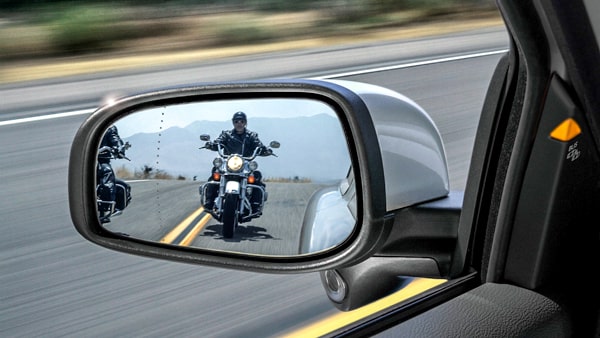
Why should you use your mirrors and look over your shoulder before changing lanes near a motorcycle?

Look carefully for motorcycles before you change lanes because:
  1. A Motorcycles are prohibited from using an entire traffic lane
  2. B Their smaller size allows them to be hidden in a blind spot
  3. C Motorcycles always have priority at intersections
  4. D Motorcycles always have priority on highways

Correct answer: B – Their smaller size allows them to be hidden in a blind spot

Motorcycles are smaller than cars and trucks, making their speed and distance harder to judge. They can also disappear in a vehicle’s blind spot or be missed during a quick glance. The manual directs drivers to use their mirrors and look over the shoulder before changing lanes or merging.

Source: Maryland Driver’s Manual — Section 7.E, “Motorcycles”
Question 5

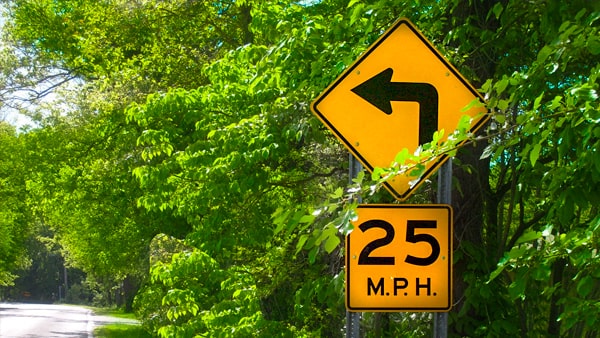
A yellow warning sign shows the road curving left, with a separate 25 MPH advisory panel. What does it mean?

This sign means:
  1. A The road curves left, and you must travel at least 25 mph
  2. B The road curves right, with an advisory speed of 25 mph
  3. C The road curves right, and the speed limit is 25 mph
  4. D The road curves left, with an advisory speed of 25 mph

Correct answer: D – The road curves left, with an advisory speed of 25 mph

The yellow diamond warns that the roadway curves left. The separate 25 MPH panel is an advisory speed for the curve, not a minimum speed or a regular white regulatory speed-limit sign. Drivers should also reduce speed as needed for conditions such as a slippery road or limited visibility.

Source: Maryland Driver’s Manual — Section 4.B, “Traffic Signs — Warning Signs”, Maryland Driver’s Manual — Section 3.C, “Understanding Vehicle Speed — Appropriate Speed for Conditions”

Question 6

Your signal turns green, but vehicles are still lawfully within the intersection. What should you do?

  1. A Enter and wait in the intersection
  2. B Drive around the vehicles if another lane appears open
  3. C Yield and wait until they clear your intended path
  4. D Enter immediately because the green light gives you priority

Correct answer: C – Yield and wait until they clear your intended path

Under Maryland’s steady-green rule, traffic may proceed but must yield to vehicles and pedestrians lawfully within the intersection or adjacent crosswalk. Wait until those vehicles clear your intended path before entering. A green light permits movement only after the required yielding; it does not give an immediate, absolute right-of-way.

Source: Md. Code, Transp. § 21-202(b), (c) — Traffic Lights with Steady Indication